Where to start reading
Start with
The Church History
Books by Eusebius of Caesarea (1)
Biography
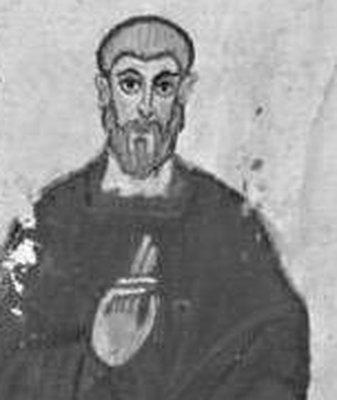
Much of what we know about the first three centuries of the church, we know because one man in a city on the coast of Palestine sat down to write it out. Eusebius of Caesarea was not a martyr, though he mourned his dearest friend as one. He was not a great theologian, and in the heat of controversy he said things the church later refused. He was a reader and a copier of other men’s words, and because he copied them, bishops and martyrs who would otherwise have vanished still speak. He is remembered as the father of church history. He is also one of the most argued-over figures of his age, and an honest account of him has to hold both.
A son of Pamphilus
He was born around 260, most likely in or near Caesarea Maritima, on the Mediterranean coast. Nothing is known of his parents. What Eusebius tells us himself is that he learned the creed of the Caesarean church as a child, was baptized into it, and later served that church as a presbyter, or priest. As a young man he also saw the young Constantine pass through Caesarea in the train of the emperor Diocletian.
The decisive figure of his youth was Pamphilus, a learned presbyter who settled in Caesarea in the later third century. Pamphilus revered Origen, the great Alexandrian scholar who had made Caesarea his home and left his books to its church. He built that bequest into a great library, and gathered a household of students who lived together, studied the Scriptures, and copied and corrected manuscripts of the Bible and of Origen’s works. Eusebius became his closest disciple, so close that he took the name Eusebius Pamphili, Eusebius the son of Pamphilus — a name that may also mean he was Pamphilus’s heir.
Those years among the books seem to have been the happiest of his life. Out of them came the Chronicle, a table of world history set out in parallel columns, and the beginnings of a history of the church itself; how early its first edition appeared is still debated.
The years of the furnace
In 303 the quiet ended. The persecution of Diocletian, remembered as the Great Persecution, broke upon the church, in McGiffert’s phrase, almost like a thunderbolt out of a clear sky. Eusebius watched churches torn down and Scriptures burned in the market-places, and for seven years Caesarea was a city of trials and executions. He was present at martyrdoms in Tyre, and in the Thebais, the upper Nile country of Egypt, he recorded a single day of slaughter: “We, also being on the spot ourselves, have observed large crowds in one day; some suffering decapitation, others torture by fire.”
The persecution reached his own household. Apphianus, a young student who lived under the same roof, kept his plan even from his housemates, then seized the governor’s hand as he was about to sacrifice; he was tortured and killed. In the fifth year Pamphilus himself was arrested. He spent two years in prison, and Eusebius spent much of that time with him; together they wrote a Defence of Origen. Whether Eusebius was ever imprisoned himself is not known. In the seventh year of the persecution, about 309 or 310, Pamphilus was put to death with eleven companions, and Eusebius wrote of him with a grief that has not faded:
Among these was my dearest friend Pamphilus, who was by reason of every virtue the most illustrious of the martyrs in our time.
— Eusebius, Martyrs of Palestine
He wrote a life of Pamphilus, now all but lost, and the Martyrs of Palestine, an account of those who died in his own province. How he himself came through those years unharmed, he never explained. That silence would one day be used against him.
Bishop of a rebuilt church
Not long after peace came, Eusebius became bishop of Caesarea. The year is uncertain — about 313 to 315 is commonly given, though McGiffert allowed anything from 311 to 318 — and he held the see for the rest of his life. One of his first duties was to preach at the dedication of a great new church at Tyre, built by his friend Paulinus, and he copied the sermon into his History without naming himself.
In these years he completed the Church History, carrying it down to Constantine’s victory over his last rival, Licinius, in 324, and dedicating its last book to Paulinus.
Arius, Nicaea, and a letter home
About 318 a dispute broke out in Alexandria that would shadow the rest of his life. A presbyter named Arius taught that the Son of God was a creature, the highest of all, but not eternal: there was a time, his party said, when the Son was not. Excommunicated by his bishop, Alexander, Arius found a friend in Eusebius. The historian Sozomen reports that Eusebius and other Palestinian bishops let Arius gather his people for worship, while urging him to make peace with his bishop. Fragments survive of letters in which Eusebius rebuked Alexander for misrepresenting Arius, in language plainly sympathetic to the Arian side. McGiffert’s judgement was that for a few years Eusebius was an Arian as he understood Arianism, out of conviction and not mere friendship, but that he had not grasped how far Arius went.
In 325 Constantine summoned the bishops to Nicaea. Sozomen says it was Eusebius who gave the opening address in Constantine’s honour, though other ancient writers name other speakers. He put forward the creed of his own church. Constantine declared it orthodox, but asked that one word be added: homoousios, of one substance with the Father. The council then drew up a fuller creed, with condemnations of the Arian slogans attached. Eusebius hesitated, asked what the new phrases meant, was satisfied by the explanations, and signed. Then he wrote home to explain himself. His letter to the church of Caesarea, preserved by the historian Socrates, gives his reasons:
On this account we assented to the sense ourselves, without declining even the term ‘One in substance,’ peace being the object which we set before us, and steadfastness in the orthodox view.
— Eusebius, letter to the church of Caesarea
Readers still argue whether that letter shows an honest mind changing under argument or a man bending to the emperor’s wish. McGiffert found that after Nicaea Eusebius never again defended Arian teaching in his writings, though he never grew fond of the word homoousios. He held what McGiffert called a mild orthodoxy, and feared above all the opposite error, Sabellianism, which blurred the Father and the Son into one.
Tyre, and an old accusation
That fear shaped his later years. He quarrelled with Eustathius of Antioch, a firm defender of Nicaea, each accusing the other of heresy, and a council at Antioch deposed Eustathius. The church there then asked Eusebius to be its bishop, one of the great sees of the East. He refused, and Constantine wrote to praise him for it.
He also stood with the enemies of Athanasius, Alexander’s successor and the champion of the Nicene faith. In 335 Athanasius was tried at a council in Tyre on charges his defenders have always called slander. Eusebius was there, and may have presided; the sources disagree. There Potamo, an Egyptian bishop who had lost an eye for the faith in the persecution, turned on him. According to Epiphanius, he asked: “How wast thou released from prison unless thou didst promise those that put upon us the pressure of persecution to do that which is unlawful, or didst actually do it?” Eusebius rose in anger and dismissed the council.
The charge that he had sacrificed to the gods to save himself has followed him ever since, and it should be said plainly: it was never proven. Potamo claimed no knowledge of any act; he reasoned that a man who left prison unhurt must have given way. Athanasius said only that Eusebius had been “accused of sacrificing,” and never called him a sacrificer, as he did others. Eusebius was made bishop in the very city where his conduct in the persecution must have been known, and he wrote sternly of those who lapsed. Perhaps friends in authority protected him; perhaps he was released when the persecution ended, like many others. The accusation remains an accusation.
The emperor’s friend
Through all of this ran his friendship with Constantine. He corresponded with him, preached before him, and in 336 delivered the oration for the thirtieth year of his reign. When Constantine died in May 337, Eusebius, now an old man, began his Life of Constantine, which tells of the vision of a cross of light that, he said, the emperor himself had described to him. It is a eulogy, not a neutral history, and it was criticised as such in antiquity: Socrates complained that its author cared more for the emperor’s praises than for an accurate account of the facts.
Eusebius died soon after his friend, probably in 339, though some put it early in 340. An ancient Syriac martyrology keeps his memory on 30 May, and his pupil Acacius succeeded him at Caesarea.
The man who kept the record
His reputation has never settled. Some of the Fathers counted him a heretic; others honoured him. He was long commemorated as a saint in parts of the West, until his name was struck from the Roman Martyrology in its revision under Pope Gregory XIII, and the Syrian Orthodox Church venerates him still. Modern critics have been harsh: Edward Gibbon distrusted his account of the martyrs, and Jacob Burckhardt called him “the first thoroughly dishonest historian of antiquity.” Others, Bishop Lightfoot and McGiffert among them, answer that where his quotations can be tested they prove faithful, that he tells the reader openly what he is leaving out, and that his real faults lie elsewhere — careless chronology, too ready a trust in a few doubtful documents, and a fondness for the men he admired that could blind him to their faults. Read him with care, they say, and with gratitude.
The gratitude is owed. The Church History, the book we publish, is the first full history of the church, ten books running from Christ to the peace under Constantine. Much of what survives of early writers such as Papias and Hegesippus survives in its pages, and it preserves two of the noblest records of martyrdom from the ancient church, the death of Polycarp and the sufferings of the churches of Lyons and Vienne. Eusebius knew he was attempting something new:
But at the outset I must crave for my work the indulgence of the wise, for I confess that it is beyond my power to produce a perfect and complete history, and since I am the first to enter upon the subject, I am attempting to traverse as it were a lonely and untrodden path.
— Eusebius, The Church History, Book I
McGiffert’s translation of 1890 includes the Martyrs of Palestine, and it rewards slow reading. It is uneven and digressive. But it was written by a man who had seen his friends die for Christ and then seen the churches rebuilt, and who could not bear that their witness, or the witness of the generations before them, should be lost. That he did not let it be lost is his monument.
Questions and Answers
Who was Eusebius of Caesarea?
Eusebius of Caesarea (c. 260–339) was bishop of Caesarea in Palestine, a biblical scholar, and the author of the first full history of the church. He is remembered as the father of church history.
Where and when was Eusebius born?
He was born around 260, most likely in or near Caesarea Maritima in Palestine; nothing is known of his parents. He learned the creed of the Caesarean church as a child, was baptized there, and later served it as a presbyter.
Who was Pamphilus, and why was Eusebius called Eusebius Pamphili?
Pamphilus was a learned presbyter of Caesarea who built Origen’s bequest of books into a great library and gathered students to study and copy the Scriptures. Eusebius was his closest disciple and took the name Eusebius Pamphili, Eusebius the son of Pamphilus.
What did Eusebius experience during the Great Persecution?
From 303 he saw churches destroyed and Scriptures burned, and he was an eyewitness of martyrdoms in Caesarea, Tyre and Egypt. Pamphilus spent two years in prison, where the two wrote a Defence of Origen together, and was martyred with eleven companions about 309 or 310.
Did Eusebius sacrifice to the gods to escape martyrdom?
There is no proof that he did. At the Council of Tyre in 335 the Egyptian bishop Potamo asked how he could have left prison unharmed without giving way, but this was an inference, not an eyewitness charge, and even Athanasius said only that Eusebius was accused of sacrificing.
When did Eusebius become bishop of Caesarea?
He became bishop not long after the persecution ended; the year is uncertain, though about 313 to 315 is commonly given. He held the see for the rest of his life and refused a later invitation to become bishop of Antioch.
What was Eusebius’s attitude to Arius?
When Arius was excommunicated in Alexandria about 318, Eusebius supported him and wrote to Bishop Alexander complaining that Arius’s views had been misrepresented. Historians disagree about how far he shared Arius’s teaching; his translator McGiffert judged that he was an Arian for a few years as he understood it, but left that position at Nicaea.
What part did Eusebius play at the Council of Nicaea?
At Nicaea in 325 he presented the creed of his church at Caesarea, which Constantine accepted with the addition of the word homoousios, of one substance. After questioning the meaning of the council’s new phrases he signed its creed, and he explained his reasons in a letter to his church, saying that peace was the object he set before him.
What was his relationship with Constantine?
Eusebius first saw Constantine as a young man in Caesarea and became one of the emperor’s most trusted bishops. He preached before him, gave the oration for his thirtieth year as emperor in 336, and after Constantine’s death in 337 wrote the Life of Constantine, a eulogy that even ancient historians criticised for its praise.
What is The Church History by Eusebius?
The Church History is the first full history of the Christian church, in ten books, from Christ to the peace under Constantine around 324. It preserves passages from many early writers otherwise lost; critics fault its chronology and some of its judgements, but it remains the main source for the early church. This is the translation by Arthur Cushman McGiffert (1890), with the Martyrs of Palestine.