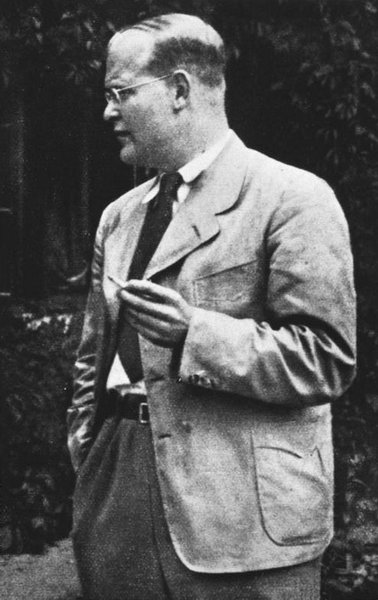
Biography
- 1906 Born
- 1927 Doctorate
- 1930 Harlem
- 1935 Finkenwalde
- 1939 New York
- 1945 Died
Cheap grace is the deadly enemy of our Church.
Many of the church's pastors were shepherds by long habit — parish priests, seminary heads, missionaries who spent forty quiet years in one place. Dietrich Bonhoeffer had barely begun. He was thirty-nine when they hanged him, and the seminary he is best remembered for leading was illegal and lasted two years before the police shut it. He wrote the book on what it costs to follow Christ, and then the bill came, and he paid it in a concentration camp two weeks before the American army arrived. He is the pastor who counted the cost out loud, in print, years before he knew he was pricing his own death.
A theologian in a house that had no use for one
He was born on 4 February 1906 in Breslau, then in Germany, now the Polish city of Wrocław. The Bonhoeffers were privileged, cultured, and not especially religious. His father, Karl, was one of Germany's leading psychiatrists, and when Karl took the psychiatry chair in Berlin the whole large family — eight children — moved to the capital. Dietrich and his twin sister Sabine were the sixth and seventh of them. It was a house of music and science and careful thinking, the kind of house where a boy might be expected to become a doctor or a lawyer, and where nobody prayed much.
So it surprised them all when, as a teenager, he announced he would become a theologian. His clever, secular-leaning brothers thought he was throwing himself away on a church that was fading. He did not argue the point; he simply went and did it. He studied at Tübingen and Berlin, and by 1927, at twenty-one, he had his doctorate from Berlin with a dissertation on the church as a community of persons — Sanctorum Communio, the communion of saints. He was, by any academic measure, a finished prodigy before he was much of a Christian.
Harlem, and the turn from theologian to disciple
In 1930 he crossed the Atlantic to spend a year at Union Theological Seminary in New York. He was unimpressed by much of what he found in the American academy — too pragmatic, too thin on the substance of the faith. What moved him was somewhere else entirely. Through his friendship with a fellow student, Frank Fisher, he began attending the Abyssinian Baptist Church in Harlem, worshipping regularly with a Black congregation and helping teach its Sunday school. There he heard the gospel preached with a passion and a directness the lecture halls lacked — sin and grace and the love of God and a hope that reached past this world. He also saw, close up, what American racism did to the people singing beside him. Scholars are careful not to make that single year a lightning-bolt conversion, but its mark on him lasted the rest of his life.
Something did shift in him in these years — a change he described later, in a 1936 letter, as moving from a man who owned the Bible as a professional to a man the Bible now owned. He had turned the teaching of Christ, he admitted, into something for his own advantage; and then something happened that changed and transformed his life. The Sermon on the Mount stopped being a text to be mastered and became a set of instructions to be obeyed.
Jamming the spokes of the wheel
He came home to Germany, and Germany was about to hand him the crisis that would define him. Hitler became Chancellor on 30 January 1933. Two days later Bonhoeffer gave a radio address on the idea of the Führer, the Leader — warning that a leader who makes himself into an idol, who acknowledges no authority above himself, becomes a Verführer, a misleader, and leads his people to ruin. The broadcast was cut off before he finished. Exactly why it was cut is not certain, and the honest thing is not to gild it; but the young pastor's instinct, in the regime's first days, was already resistance.
That April the state moved to bar those of Jewish descent from the civil service, and the pro-Nazi faction within the church wanted the same rule applied to its own ministers. Bonhoeffer opposed it at once. In an essay on the church and the Jewish question he argued that the church could not surrender its own standards to a racial ideology, that it had a duty to the state's victims, and that a time might come when the church must not merely bind up the wounded under the wheel but jam the spokes of the wheel itself. His essay carried some of the older assumptions of his tradition about Judaism, and it would be dishonest to make him a fully modern man on that score. But his actions were clean: he stood, early and at cost, for the people the state had marked.
When faithful Protestants broke from the Nazified official church to form the Confessing Church in 1934, Bonhoeffer was with its most uncompromising wing. In 1935 that movement gave him the work he loved best: leading an illegal seminary for its preachers at Finkenwalde, in Pomerania. It was an experiment in shared Christian life — worship, confession, study, and a common table — and it was against the law. The Gestapo closed it in 1937. But out of those two years came the two books he is most read for, The Cost of Discipleship and Life Together.
The first of them made a distinction that has outlived every argument of its decade. Grace, Bonhoeffer said, had been sold cheap — forgiveness without repentance, communion without confession, a grace that costs nothing and so changes nothing.
Cheap grace is the deadly enemy of our Church.
— Dietrich Bonhoeffer, The Cost of Discipleship
Against it he set costly grace: grace that costs a man his life because it cost God the life of his Son, grace that cannot be separated from following. It is the treasure a man sells everything to buy. And in the same book stands the sentence that reads, in hindsight, like a prophecy he wrote over himself.
When Christ calls a man, he bids him come and die.
— Dietrich Bonhoeffer, The Cost of Discipleship
The pastor and the plot
In June 1939 friends arranged an escape. He sailed to New York, where he could have sat out the coming war in safety and usefulness. Within about two weeks he knew he had made a mistake, and he took a ship home before the war closed the sea. He explained the decision in a letter to the American theologian Reinhold Niebuhr, and the reason he gave is one of the truest things a pastor ever wrote about his people.
I will have no right to participate in the reconstruction of Christian life in Germany after the war if I do not share the trials of this time with my people.
— Dietrich Bonhoeffer, letter to Reinhold Niebuhr, 1939
Back in Germany, through his brother-in-law Hans von Dohnányi, he was drawn into the Abwehr, German military intelligence, whose leadership had become a nucleus of the resistance against Hitler. On paper he was an agent whose church contacts abroad were useful; in truth the post shielded him from the draft and let him carry the resistance's messages to churchmen overseas, seeking Allied understanding for a Germany after Hitler. He took part in Operation 7, which smuggled a group of Jews to safety in Switzerland.
Here is the hardest turn in his life, and it must be told plainly and without the thrill. This pastor came to support a conspiracy that included plans to kill Hitler. He was not a bomb-maker or an assassin — the popular retellings that cast him as a spy-thriller operative go beyond what the record holds. He was a supporter, a courier, a man who lent the plot his conscience and his cover. He did not pretend the killing was clean. The men of the resistance understood tyrannicide as a grave guilt, and were willing to carry that guilt to stop a greater evil. In the ethics he was writing in these years, unfinished, he wrestled with exactly this: the disciple who, for his neighbour's sake, is willing to step into wrong and answer for it before God rather than keep his own hands clean while others die.
Tegel, Flossenbürg, and a witness that outlived him
In January 1943 he became engaged to Maria von Wedemeyer, from a Pomeranian family he knew; she was far younger than he was, and the engagement was kept quiet at first. On 5 April 1943 he was arrested, along with Dohnányi. The charges were, at first, relatively minor — the Gestapo suspected irregularities in the Abwehr, not yet the plot on Hitler's life. He was held at Tegel military prison in Berlin, and it was there, in his cell, that he wrote the letters and papers his friend Eberhard Bethge would later publish as Letters and Papers from Prison. In them he turned over strange, unfinished ideas about a faith stripped of easy religion in a world come of age, and he wrote poems — among them, in December 1944, one on being sheltered by gracious powers even in the dark, sent as a New Year's greeting to those he loved.
The failed bomb plot of 20 July 1944 changed everything. Seized resistance documents exposed the deeper conspiracy, and Bonhoeffer with it. He was moved to the Gestapo prison, then to Buchenwald, and at last to Flossenbürg. On 8 April 1945 a summary SS court, without real defence or evidence, condemned him. At dawn on 9 April 1945 he was hanged, with fellow conspirators, on what is generally held to have been an order from the very top of the regime after Hitler saw the papers. The camp was liberated by American forces two weeks later.
The account long associated with his death — from a camp doctor who described him kneeling in fervent prayer and going to the gallows composed and unafraid — is one scholars now treat with real caution; the man gave it years later and may have idealized what he saw, or whom. What is better attested comes from a fellow prisoner, Captain Payne Best, who remembered Bonhoeffer's parting words as he was led away, asking that a message be carried to a bishop in England: this is the end — for him, the beginning of life. Even that is a recollection set down five years afterward, not a transcript, and it is honest to hold it as such.
What he leaves
Bonhoeffer left an Ethics he never finished and a stack of prison letters he never meant as a book, and out of those unfinished things came one of the most read Christian voices of the century. He also left a warning against ourselves. So many of his best lines have been sharpened into slogans and, in at least one famous case, put in his mouth though he never wrote them — a reminder that even a martyr can be conscripted for causes he never spoke for, and that honouring him means quoting him truly.
He was a young shepherd, and his crook was broken soon. But he understood something the long-serving shepherds also knew: that a pastor does not lead his people from a safe distance. He shares their trials. He goes back across the ocean when he could have stayed. And when Christ calls, he comes — even when the call, as Bonhoeffer had written with his own hand years before the Gestapo ever knocked, leads him out to die.
Books about Dietrich Bonhoeffer (1)

Also appears in
Questions and Answers
What kind of family did Dietrich Bonhoeffer grow up in, and how did he end up a theologian?
He was born in 1906 into a privileged, cultured Berlin household that had little use for religion. His father, Karl, was one of Germany's leading psychiatrists, and the home was full of music, science, and careful argument, the kind of place where a boy was expected to become a doctor or a lawyer. When the teenage Dietrich announced he would study theology instead, his secular-leaning brothers thought he was throwing himself away on a fading church, yet he went and did it, earning his doctorate from Berlin in 1927 at just twenty-one with a dissertation on the church as a community of persons, Sanctorum Communio.
How did his year in America change him?
In 1930 he spent a year at Union Theological Seminary in New York and found the academy there too pragmatic and thin. What moved him was Harlem: through his friend Frank Fisher he began worshipping at the Abyssinian Baptist Church and helping teach its Sunday school, hearing the gospel preached with a directness the lecture halls lacked and seeing up close what racism did to the people beside him. Scholars resist calling it a single lightning-bolt conversion, but he described the shift later as moving from a man who owned the Bible professionally to a man the Bible now owned.
What was his stand against Nazified Christianity?
When Hitler took power in 1933, pro-Nazi factions wanted the church to bar ministers of Jewish descent and to bend to a racial ideology. Bonhoeffer opposed this at once, arguing the church had a duty to the state's victims and might one day have to do more than bind up those crushed under the wheel, and instead jam the spokes of the wheel itself. When faithful Protestants broke away to form the Confessing Church in 1934, he stood with its most uncompromising wing.
What was the seminary at Finkenwalde, and what came out of it?
In 1935 the Confessing Church gave him the work he loved best: leading an illegal seminary for its preachers at Finkenwalde in Pomerania, an experiment in shared Christian life built around worship, confession, study, and a common table. The Gestapo shut it down in 1937 after only two years. Yet out of it came the two books he is most read for, Life Together and The Cost of Discipleship.
What did he mean by cheap grace and costly grace?
In The Cost of Discipleship he warned that grace had been sold cheap, offered as forgiveness without repentance and communion without confession, a grace that costs nothing and so changes nothing. "Cheap grace is the deadly enemy of our Church," he wrote. Against it he set costly grace, which costs a person their life because it cost God the life of his Son, and in the same book he wrote a line that reads in hindsight like a prophecy over himself: "When Christ calls a man, he bids him come and die."
Why did he leave the safety of America in 1939 to return to Germany?
In June 1939 friends arranged for him to sail to New York, where he could have waited out the war in safety. Within about two weeks he knew he had made a mistake and took a ship home before the sea closed. He explained it in a letter to the American theologian Reinhold Niebuhr: "I will have no right to participate in the reconstruction of Christian life in Germany after the war if I do not share the trials of this time with my people."
Did he really take part in a plot to kill Hitler?
Through his brother-in-law Hans von Dohnányi he was drawn into the Abwehr, the military intelligence service whose leadership had become a nucleus of the resistance, and he came to support a conspiracy that included plans to assassinate Hitler. He was not a bomb-maker or an assassin; the spy-thriller retellings overreach the record. He was a courier and a supporter who lent the plot his conscience and his cover, and he also helped smuggle a group of Jews to safety in Switzerland in what was known as Operation 7, never pretending the guilt of tyrannicide was clean.
What did he write during his imprisonment?
Arrested on 5 April 1943, he was held at Tegel military prison in Berlin, and there he wrote the letters his friend Eberhard Bethge later published as Letters and Papers from Prison. In them he turned over unfinished ideas about a faith stripped of easy religion in a world come of age, and he wrote poems, among them one from December 1944 on being sheltered by gracious powers even in the dark, sent as a New Year's greeting to those he loved. He had become engaged to Maria von Wedemeyer months before his arrest, and she corresponded with him and visited him in prison.
How did Bonhoeffer die?
After the failed bomb plot of 20 July 1944 exposed the deeper conspiracy, he was moved through Gestapo custody to Buchenwald and finally to Flossenbürg concentration camp. On 8 April 1945 a summary SS court condemned him without real defence, and at dawn on 9 April he was hanged with fellow conspirators, two weeks before American forces reached the camp. A fellow prisoner, Captain Payne Best, recalled his parting words asking that a message be carried to a bishop in England, that this was the end and, for him, the beginning of life, though even that is a recollection set down years afterward.
Are the famous quotes attributed to him always genuine?
Not always, and he would have minded. Some of his sharpest lines have been trimmed into slogans, and at least one much-repeated saying, about silence in the face of evil being itself evil, appears nowhere in his writings and was never his. Honouring him means quoting him truly, since even a martyr can be conscripted for causes he never spoke for.
Portrait: Bundesarchiv, Bild 146-1987-074-16 / unknown / CC BY-SA 3.0 DE — adapted (black-and-white)