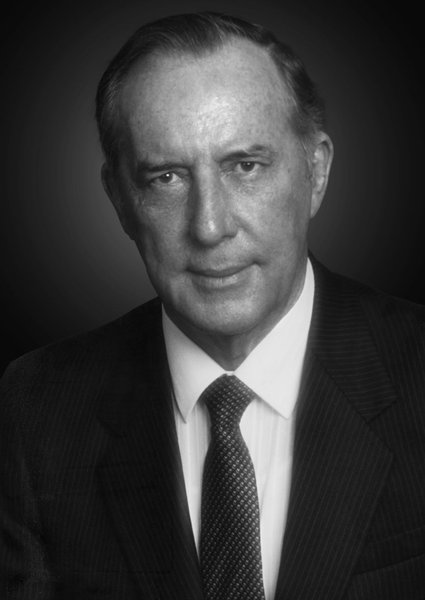
Biography
- 1915 Born
- 1941 Converted
- 1973 Shaping History
- 1981 Jerusalem
- 2003 Died
Jesus Christ is alive, and the Bible is a true, relevant, up-to-date book.
Most great men of prayer learned to pray before they learned much else. Derek Prince came at it the other way round. He was a professional philosopher, a Fellow of King's College, Cambridge, a scholar of Plato who read the Bible the way he read any old text — as a problem in language and logic, evidence to be weighed by a mind trained to doubt. He was, by his own account, a skeptic. And then, in the worst years of a world war, in an army barrack room, the book he had been analysing answered back. The rest of his long life was spent teaching other people to take it as seriously as it had taken him — and, above all, to pray it.
A scholar who did not believe
He was born Peter Derek Vaughan Prince on 14 August 1915 in Bangalore, in British India, into a British military family. His gifts showed early. He won a scholarship, at around fourteen, to Eton College, where he read Greek and Latin, and went on to King's College, Cambridge, where he held a fellowship in Ancient and Modern Philosophy — an academic post, a professional philosopher's chair. He was steeped in Plato. He had also studied Hebrew and Greek, a competence that would later give his Bible teaching its careful, text-first grain.
None of it made him a believer. As a young don he approached Scripture as a set of documents, not as revelation — a work of ancient philosophy to be examined, and found wanting or interesting, but not obeyed.
The barrack room
He enlisted in 1940 and served, as a non-combatant, in the Royal Army Medical Corps — a hospital orderly, a medic. Somewhere in that upheaval he began reading the Bible, he said, as he would read any philosophical work: to understand it, to master it. By his own testimony the reading went on for some nine months. Then, in a barrack room — the ministry he founded places it at Scarborough, in Yorkshire, in the summer of 1941 — the analysis broke open into an encounter. He met, he insisted ever after, not a text but a living Christ.
He came away convinced of two things, and he would repeat them for the next sixty years: that Jesus Christ is alive, and that the Bible is, in his words, a true, relevant, up-to-date book.
Jesus Christ is alive, and the Bible is a true, relevant, up-to-date book.
— Derek Prince, on the two convictions he drew from his conversion
That is the whole of his later ministry in a sentence. Everything he did afterward was a working-out of those two claims by a man who had been paid to be sceptical and had stopped being able to.
He served roughly three years as an army medic in North Africa, through the desert campaign, and was discharged in Jerusalem. There, in the years around the founding of the State of Israel in 1948, a second burden was laid on him that never lifted — a lifelong sense of responsibility toward the Jewish people and their land.
The teacher
What Cambridge had made him did not go to waste; it was converted. After the war he taught and pastored — in London, then in Kenya from the late 1950s, where he worked as an educator and administrator. In the early 1960s he moved to the United States, pastoring in Seattle, Minneapolis, and Chicago before settling in Fort Lauderdale, Florida, where his publishing work — later Derek Prince Ministries — took shape. In 1981 he moved his base to Jerusalem, and taught worldwide almost to the end of his life.
His manner was unmistakable, and it is the through-line from the philosopher to the preacher. Even his obituary called him logical and reserved. He did not shout or dramatise. He defined his terms, built from the text, and distrusted hype — a scholar's plain here is what the Bible actually says. Through a daily radio ministry his teaching was carried, in his lifetime, worldwide in many languages, and he wrote dozens of books. He aimed always at the same thing: to make ordinary believers competent readers and doers of Scripture, dependent on the book and not on him.
Ruling by prayer
If there is a spine to Derek Prince's life, it is intercession. He taught on prayer, fasting, and spiritual warfare across decades, but the burden gathered into one book above the rest: Shaping History Through Prayer and Fasting, first published in 1973. Its claim is bold and simple. Ordinary believers — not only prophets and statesmen — praying and fasting on the authority of Scripture, can change the course of nations.
He did not argue it only from theory. He pointed to things he had lived near: the North African campaign he had served in, the founding of Israel he had witnessed, the end of the Stalin era, the coming of Kenyan independence — reading each, in faith, as something prayer had helped to shape. His model was Daniel, the exile who fasted and humbled himself and prayed his people's Scriptures back to God until history moved. That was the pattern Prince pressed on his readers: not vague, wishful praying, but standing on God's own promises and proclaiming them — believers taking up what he called their office as a kingdom of priests, whose work is to rule by prayer.
The burden that had settled on him at his discharge in Jerusalem never left. To the end of his life he urged Christians to accept a responsibility to intercede for Israel, for Jerusalem, and for the Jewish people — a duty he thought the wider church had forgotten. He was influential in the founding of Intercessors for America, whose work drew on Shaping History. When he moved his own home to Jerusalem in his later years, it was not retirement to a view. It was an intercessor moving to the place he had been praying for since 1948.
Deliverance — central, and contested
Any honest account has to name what Prince became equally known for, because he did not hide it. He was one of the most prominent twentieth-century teachers of deliverance — the practice of casting out demons — and he taught that Christians themselves could be, in his term, demonized, and could need deliverance. His book They Shall Expel Demons is a standard text of that movement, and he practised what he taught.
It is genuinely contested ground. Many Christians reject the idea that a believer can be demonized, or are wary of the practice altogether, and the disagreement is serious and sincere on both sides. It belongs in the record, plainly, as central to his ministry and as something a thoughtful part of the church has never accepted. A devotional reader is owed the fact and left to weigh it.
A movement he helped lead, and repented of
The hardest chapter is one Prince himself came to call an error. In the early 1970s he was one of the so-called Fort Lauderdale Five — with Bob Mumford, Charles Simpson, Don Basham, and Ern Baxter — who founded and led what became the Shepherding, or Discipleship, Movement. It taught that every believer should submit to a personal "shepherd" over his life.
The teaching drew serious and sustained criticism. In practice, followers were said to need a shepherd's approval for the major decisions of their lives — marriage, moves, money, work — and critics charged the movement with authoritarian, controlling excess. It is not a small footnote, and it should not be smoothed away.
What sets Prince apart is what he did with it. He was the first of the five to leave, and to repudiate the teaching publicly, in 1983 — not with excuses but with repentance. His own summary has become the line most quoted about the whole affair.
I believe we were guilty of the Galatian error: having begun in the Spirit, we quickly degenerated into the flesh.
— Derek Prince, on leaving the Shepherding movement (1983)
He was neither a cult leader nor a bystander to a minor disagreement; both descriptions distort it. He was a gifted teacher who helped build something that went wrong, saw it, named it in the plainest scriptural terms, and walked away first. He went on reflecting on the danger of manipulative spiritual authority for years afterward. That a leader of his stature would say we were wrong in public is itself part of his witness.
A houseful of daughters, and the end in Jerusalem
His long ministry was married to another. In the mid-1940s he married Lydia Christensen, a Danish missionary who ran a home for children in Jerusalem, and by joining her household he became father to a houseful of adopted daughters, girls of varied backgrounds she had already taken in. Lydia was considerably older than he was, and their marriage bound his life to the land he prayed for. She died in 1975. In 1978 he married Ruth Baker; Ruth died in Jerusalem in 1998.
Derek Prince died at his home in Jerusalem on 24 September 2003, aged eighty-eight, in his sleep. He had gone on teaching almost to the last. He was buried in the city he had carried in prayer for more than half a century.
He leaves an unusual example. Most of the great praying men came to Scripture in simplicity and never left it. Prince came to it as a critic, was overcome by it, and then spent his life persuading ordinary people that the book he had once weighed and doubted was strong enough to rest a life on — and to move the history of nations through their prayers. He got things wrong, and said so. But the two convictions he carried out of that barrack room he never let go of, and the second of them — that the Bible is a true, relevant, up-to-date book — he turned, for fifty years, into a summons to pray.
Books about Derek Prince (1)

Also appears in
Questions and Answers
Who was Derek Prince?
Derek Prince (1915–2003) was a Cambridge philosophy fellow and Plato scholar, converted in a WWII army barrack room, who became a systematic Bible teacher heard worldwide and a lifelong intercessor — especially in prayer and fasting for Israel and the Jewish people. He helped found the Shepherding movement in the 1970s and was the first of its leaders to publicly repudiate it. He came to prayer the opposite way from most: as a professional sceptic overcome by the book he had been analysing.
What was his background?
Born Peter Derek Vaughan Prince on 14 August 1915 in Bangalore, in British India, into a military family, he won a scholarship to Eton and went on to King's College, Cambridge, where he held a fellowship in Ancient and Modern Philosophy — a professional philosopher's chair, steeped in Plato. He had also studied Hebrew and Greek, a competence that would later give his Bible teaching its careful, text-first grain. None of it made him a believer; he approached Scripture as a set of documents, not as revelation.
How was he converted?
He enlisted in 1940 and served as a non-combatant in the Royal Army Medical Corps. He began reading the Bible as he would any philosophical work, to master it, and the reading went on for some nine months. Then, in a barrack room — placed at Scarborough in the summer of 1941 — the analysis broke open into an encounter: he met, he insisted ever after, not a text but a living Christ, coming away convinced of two things he would repeat for sixty years — "Jesus Christ is alive, and the Bible is a true, relevant, up-to-date book."
Where did his burden for Israel begin?
He served roughly three years as an army medic in North Africa through the desert campaign and was discharged in Jerusalem. There, in the years around the founding of the State of Israel in 1948, a second burden was laid on him that never lifted — a lifelong sense of responsibility toward the Jewish people and their land, which would shape his intercession for the rest of his life and eventually bring him to make his home in Jerusalem.
What kind of teacher was he?
What Cambridge had made him did not go to waste; it was converted. After the war he taught and pastored in London, then Kenya, then the United States, settling in Fort Lauderdale. His manner was the through-line from philosopher to preacher: logical and reserved, he did not shout or dramatise but defined his terms, built from the text, and distrusted hype — a scholar's plain "here is what the Bible actually says." Through a daily radio ministry his teaching was carried worldwide in many languages, and he wrote dozens of books, always aiming to make ordinary believers competent readers and doers of Scripture.
What did he teach about prayer and fasting?
The spine of his life was intercession, gathered above all into "Shaping History Through Prayer and Fasting" (1973). Its claim is bold and simple: ordinary believers, praying and fasting on the authority of Scripture, can change the course of nations. His model was Daniel, who fasted and prayed his people's Scriptures back to God until history moved — not vague, wishful praying, but standing on God's promises and proclaiming them, believers taking up their office as a kingdom of priests whose work is to rule by prayer.
What was his lifelong burden for the Jewish people?
The burden that settled on him at his discharge in Jerusalem never left. To the end of his life he urged Christians to accept a responsibility to intercede for Israel, for Jerusalem, and for the Jewish people — a duty he thought the wider church had forgotten. He was influential in the founding of Intercessors for America, and when he moved his own home to Jerusalem in his later years it was not retirement to a view but an intercessor moving to the place he had been praying for since 1948.
What is the contested side of his ministry?
He was one of the most prominent twentieth-century teachers of deliverance — casting out demons — and taught that Christians themselves could be, in his term, demonized and could need deliverance; his book "They Shall Expel Demons" is a standard text of that movement. It is genuinely contested ground: many Christians reject the idea that a believer can be demonized, or are wary of the practice altogether, and the disagreement is serious and sincere on both sides. It belongs in the record plainly, as central to his ministry and as something a thoughtful part of the church has never accepted.
What was the Shepherding movement, and what did he do about it?
In the early 1970s he was one of the "Fort Lauderdale Five" who founded and led what became the Shepherding, or Discipleship, Movement, teaching that every believer should submit to a personal "shepherd" — a teaching widely criticised as authoritarian and controlling. What sets Prince apart is what he did with it: he was the first of the five to leave and to repudiate the teaching publicly, in 1983, not with excuses but with repentance — "I believe we were guilty of the Galatian error: having begun in the Spirit, we quickly degenerated into the flesh."
How did he die, and what does he leave?
In the mid-1940s he married Lydia Christensen, a Danish missionary who ran a home for children in Jerusalem, becoming father to her houseful of adopted daughters; after Lydia's death in 1975 he married Ruth Baker, who died in 1998. Derek Prince died at his home in Jerusalem on 24 September 2003, aged eighty-eight, and was buried in the city he had carried in prayer for more than half a century. He leaves an unusual example: a critic overcome by Scripture, who spent his life persuading ordinary people that the book he had once doubted was strong enough to rest a life on — and to move the history of nations through their prayers.
Portrait: Derek Prince Ministries