Where to start reading
Start with
The Catechetical Lectures
Books by Cyril of Jerusalem (1)
Biography
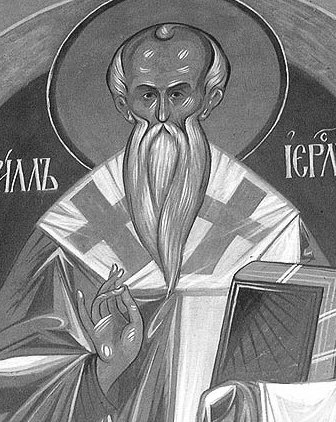
Cyril of Jerusalem is the only bishop of the ancient church whose classroom we can still sit in. He left the very words he spoke, one Lent in the fourth century, to the men and women about to be baptized in the church built over the tomb of Christ. He was a teacher first, and remained one through a life the quarrels of his age made very hard. He was driven from his city three times, accused of theft, suspected of heresy by friends and enemies alike, and only cleared in his old age. Through all of it he went on doing the plain work of a pastor: telling ordinary people what the Church believes, and helping them to believe it.
A child of the holy city
Almost nothing is known of his early years, and it is honest to say so. He was born about 313 — the year is a reasonable guess, not a record — probably in or near Jerusalem. The names of his parents have not survived. The old calendars of the saints say only that he was “born of pious parents, professing the orthodox Faith,” and his lectures bear that out: he never speaks as a convert from paganism, and he writes of honouring father and mother with the warmth of a son who had been given a Christian upbringing and knew it.
He seems to have known Jerusalem before the great buildings went up. In his lectures he recalls that the place of the Nativity had lately been wooded, and that a rock-cut cave once stood before the door of the Sepulchre until it was cut away for the Emperor Constantine’s new church. If he spoke from memory, he saw the holy places as a boy, before the empire dressed them in marble. An early tradition adds that he lived as an ascetic, one of the “Solitaries” — Christians vowed to chastity who lived not in the desert but in their own houses in the city, giving themselves to strict discipline and works of charity.
He was ordained a deacon, probably by Bishop Macarius, around 335. That same year Jerusalem saw one of the most splendid and troubling scenes of the age. Bishops gathered from every province to dedicate Constantine’s Church of the Resurrection, and in that glittering assembly Arius, the priest who taught that the Son of God was a creature and not truly God, was received back into communion, while Athanasius, his great opponent, had just been deposed. The young deacon watched it all. It is to his credit that the triumph of the Arian party did not carry him with it.
Forty days of teaching
Later he was ordained priest by Bishop Maximus, and by about 348 he had been given one of the weightiest tasks in the Jerusalem church: preparing the candidates for baptism. Those who wished to be baptized at Easter gave in their names at the start of Lent and gave the forty days to it — fasting, prayer, confession, exorcism and daily instruction. Gifford’s careful dating points to the Lent of 348; it cannot have been much later.
Cyril opened the course with an address to the whole congregation, and it is full of the tenderness and bluntness that mark everything he says. He knew why some of them had come. A young man might be there to court a young woman, a slave to please his master, a friend to oblige a friend. Cyril did not turn them away. He welcomed them, and told them what had really happened to them:
Jesus is angling for thee, not in order to kill, but by killing to make alive: for thou must die and rise again.
— Cyril of Jerusalem, Procatechesis
Then, over the following weeks, he walked them through the Creed of the Jerusalem church, article by article: the one God, the Father; the Son, eternally begotten; the cross, the burial and the resurrection; the Holy Spirit; the Church, the forgiveness of sins, the resurrection of the body. The Creed itself he would not write down. The candidates were to learn it by heart and keep it there, not on paper, and to say nothing of the mysteries to outsiders. He was building a house, he told them, stone by stone. And he was clear about whose work it finally was:
For it lies in me to speak, but in thee to set thy mind upon it, and in God to make perfect.
— Cyril of Jerusalem, Procatechesis
He asked them to pray as well as listen, and he did not mean only in church.
What comes through most in the lectures is a teacher who loves his hearers and wants them safe. He warns them against the serpent by the roadside, and he describes the coming of the Holy Spirit not as something fearsome but as a gentle arrival, fragrant and light, coming “to save, and to heal, to teach, to admonish, to strengthen, to exhort, to enlighten the mind.”
Bishop of Jerusalem
Around 350, on the death of Maximus, Cyril became bishop himself. He was consecrated with the approval of Acacius, the bishop of Caesarea, who leaned to the Arian side, and enemies later said he had bought his see with compromise. Jerome, plainly hostile, repeated the rumours; the shadow lay over him for thirty years.
His episcopate opened with a wonder. On the morning of Pentecost, 7 May 351, a great cross of light appeared in the sky over Jerusalem, stretching from Golgotha to the Mount of Olives and visible for hours. The whole city crowded into the church, and Cyril wrote to the Emperor Constantius of it as a sign of God’s favour. Gifford, the translator of the lectures, thinks it was probably some rare natural phenomenon; the event itself is too well attested to doubt.
When famine struck Jerusalem and the poor came to their bishop in crowds, Cyril, who had no money of his own to give, sold the church’s treasures and sacred hangings to buy them bread. It was this act of mercy that his enemies turned into a crime. Acacius, as metropolitan of the province, claimed authority over Jerusalem; Cyril, as bishop of “the Mother of all the Churches,” refused it. The dispute festered, and the sale of church goods became the charge.
Three times driven out
For two years Cyril refused to stand trial before Acacius and his allies, judges who could hardly be impartial. Around 357 they deposed him in his absence, and he was driven out of Jerusalem. He took refuge in Tarsus, where Bishop Silvanus let him go on preaching because the people loved his teaching, and appealed to a higher court. In 359 the Eastern bishops met at Seleucia; Acacius refused to answer for his own charges and was himself deposed, and Cyril seems to have returned home. It did not last. Acacius carried his complaints to the imperial court, and in 360 a council at Constantinople deposed Cyril a second time, and the emperor sent him into exile.
The death of Constantius in 361 brought him back. The new emperor, Julian, recalled every exiled bishop — in the hope, the historians suspected, that the Christians would tear one another apart. One small story from that return survives. The son of a pagan priest at court had secretly become a Christian, and his father beat him and burned him with hot irons. The young man escaped, was hidden by a deaconess and brought to Bishop Meletius of Antioch, who handed him to Cyril; and they set out by night for Palestine. When Julian later tried to rebuild the Temple, Cyril was said to have foretold its failure. Gifford finds no proof of any prophecy — only a bishop who, on the strength of the Gospels, calmly said the work could not stand.
Then, around 367, the Emperor Valens, who favoured the Arians, ordered every bishop exiled under Constantius and restored under Julian to be driven out again. Cyril’s third exile was his longest, about eleven years, and almost nothing is known of it. He came home only after Valens died at the battle of Adrianople in 378. He found his church split by rival factions and, by the grieving report of Gregory of Nyssa, who visited soon after, sunk in every kind of vice. The old bishop, now in his mid-sixties, set about gathering it together again.
Cleared at last
In 381 the Emperor Theodosius summoned the bishops of the East to Constantinople to settle the long quarrel over the Nicene faith. Cyril came, and was counted among the leaders of the orthodox party. The question that had dogged him was whether he truly held the faith of Nicaea. For years he had been wary of the council’s key word, homoousios — “of one substance” with the Father — fearing it as an addition to the creeds. But his lectures had taught its meaning all along: that the Son is truly God, equal with the Father. Some historians said he changed his mind at Constantinople; Gifford rejects that as unfounded. Either way, he stood with the Nicene faith at the council that confirmed it.
The next year the same bishops, writing to the bishops of the West, did him the justice he had waited thirty years for:
Of the Church in Jerusalem, the Mother of all the Churches, we make known that Cyril the most reverend and most beloved of God is Bishop; and that he was canonically ordained long ago by the Bishops of the province, and that he has very often fought a good fight in various places against the Arians.
— The Synod of Constantinople, 382
It is the last thing the records tell us of him. Jerome says he held his see in peace for eight years under Theodosius, and he died, by the traditional reckoning, on 18 March 386, the day the Church still keeps as his feast. He was not a flawless man. He could be stubborn about the rights of his see, and he once named a bishop for Caesarea on authority that Gifford thinks doubtful. But Gifford’s judgment on him is generous and seems right: it was his prudence, moderation and love of peace that exposed him, in those days of bitter controversy, to suspicion he did not deserve. In 1883 Pope Leo XIII named him a Doctor of the Church; he is honoured as a saint in the Catholic, Orthodox and Anglican traditions alike.
The lectures he left
The book we publish is The Catechetical Lectures, in the nineteenth-century translation of E. H. Gifford. It holds the opening address, or Procatechesis, and eighteen lectures to the candidates during Lent, followed by five Mystagogic Lectures — talks to the newly baptized in Easter week, explaining the baptism, anointing and communion they had just received. Scholars still debate whether the Mystagogic Lectures are Cyril’s own, perhaps from later in his life, or the work of his successor John; Gifford defends them as Cyril’s. Together they are the only complete course of instruction for new Christians to survive from the early centuries.
But they are worth reading less as history than because they still do what they were meant to do. Cyril wrote for beginners, and he never talks down to them. If you have recited a creed for years without quite knowing why each line is there, or if you are coming to the faith for the first time, he will walk you through it as patiently as he walked those candidates long ago — one stone at a time, until the house stands.
Questions and Answers
Who was Cyril of Jerusalem?
Cyril was a fourth-century bishop of Jerusalem, born about 313 and died in 386, best remembered for the lectures he gave to candidates for baptism. He was exiled three times during the Arian controversy and is honoured as a saint in the Catholic, Orthodox and Anglican traditions.
What is known about Cyril of Jerusalem’s early life?
Very little. He was probably born in or near Jerusalem, the names of his parents are unknown, and the old calendars of the saints say he was born of pious, orthodox parents. His lectures suggest he saw the holy places as a boy, before Constantine’s great buildings went up.
When was Cyril ordained?
He was ordained a deacon, probably by Bishop Macarius, around 335, and later a priest by Bishop Maximus. By about 348 he had been given the task of preparing the candidates for baptism in the Jerusalem church.
How were candidates for baptism prepared in Cyril’s Jerusalem?
They gave in their names at the start of Lent and spent the forty days in fasting, prayer, confession, exorcism and daily instruction on the Creed. They were baptized at Easter, and in Easter week were taught the meaning of the sacraments they had received.
When did Cyril become bishop of Jerusalem?
He succeeded Bishop Maximus around 350. His first recorded act as bishop was a letter to the Emperor Constantius about a cross of light seen in the sky over Jerusalem on 7 May 351.
Why was Cyril accused of selling church property?
During a famine, having no money of his own, he sold church treasures and sacred hangings to feed the poor of Jerusalem. Acacius, the bishop of Caesarea, who claimed authority over Jerusalem, used this as the charge on which he deposed him.
Why was Cyril exiled three times?
He was deposed by Acacius around 357, deposed again by a council at Constantinople in 360 and exiled by Constantius, and driven out a third time around 367 under the Arian Emperor Valens. He returned for good after Valens died in 378.
Did Cyril accept the Nicene faith?
For years he avoided the Nicene word homoousios, of one substance, but his lectures teach that the Son is truly God, equal with the Father. At the Council of Constantinople in 381 he stood with the Nicene party, and in 382 the bishops wrote that he had often fought a good fight against the Arians.
What are Cyril of Jerusalem’s Catechetical Lectures?
They are an opening address, eighteen Lenten lectures on the Creed for candidates for baptism, and five Mystagogic Lectures on baptism, anointing and the Eucharist for the newly baptized. Scholars debate whether the Mystagogic Lectures are Cyril’s own or his successor John’s, and the translation published here is E. H. Gifford’s.
How did Cyril of Jerusalem die, and how is he remembered?
He held his see in peace in his last years and died in 386, traditionally on 18 March, which remains his feast day. In 1883 Pope Leo XIII named him a Doctor of the Church.