Where to start reading
Start with
The Dialogue
Books by Catherine of Siena (1)
Biography
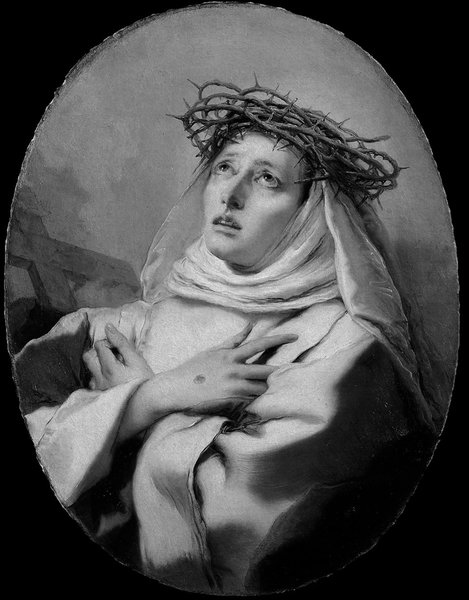
Catherine of Siena lived only thirty-three years. She was a dyer’s daughter in a Tuscan hill town, never a nun, and for most of her life she could not write. Yet she wrote — or rather spoke, to secretaries who took down her words — to popes and queens, to mercenary captains and city councils, to prisoners and housewives, and she travelled to Avignon to urge the pope himself to come home to Rome. The best way into her is the one she herself recommended: not through the fame or the politics, but through the small inner room where she met God.
The dyer’s daughter
She was born Caterina di Jacopo di Benincasa on 25 March 1347, shortly before the Black Death swept through Europe. Her father, Jacopo, was a cloth dyer who ran his business with the help of his sons; her mother, Lapa, was the daughter of a local poet. Catherine was a twin, the twenty-third or twenty-fourth child of a very large family, and her twin sister died in infancy. As a little girl she was so merry that the family called her by a Greek pet name, Euphrosyne — “joy.”
Her confessor and first great biographer, Raymond of Capua, records that at five or six, walking home with a brother from a married sister’s house, she saw a vision of Christ in glory with the apostles Peter, Paul and John, and that at seven she vowed to give her whole life to God. Those stories come to us through Raymond, writing after her death to make her holiness known, and should be received as he gave them.
A cell inside the mind
When Catherine was sixteen her older sister Bonaventura died in childbirth, and her parents soon proposed that Catherine marry the widower. She refused absolutely. She began a strict fast in protest, and when her mother urged her to make herself attractive to a husband, she cut off her long hair. Her family answered by taking away her privacy, so that she had no room of her own to pray in. Catherine’s response became one of the most lasting lessons she ever gave.
She learned, too, to serve her family as a way of serving Christ, imagining her father in his place, her mother as the Virgin, her brothers as the apostles. In the end her parents gave up and let her live as she wished, unmarried. She did not enter a convent. Instead, after a serious illness, she was allowed to join the Mantellate, a local association of devout women, mostly widows, who lived at home in the spirit of the Dominican order. They taught her to read, and for some years she lived in almost complete silence and solitude in her room in the family house, fasting hard and praying long.
Out into the streets of Siena
According to Raymond, when she was about twenty-one Catherine experienced what she called a mystical marriage with Christ, and soon after was told to leave her withdrawn life and go out into the world. She did. From about 1367 to 1374 she gave herself to the sick and the imprisoned of Siena, nursing in the great hospital of Santa Maria della Scala and in the homes of her neighbourhood. People began to call her santa donna, a holy woman, and a circle of followers gathered around her — women and men, who called her “mother.”
Her fasting deepened in these years, and it is right to name it as the struggle it was. She ate less and less, until at last she seemed to live on little more than the Eucharist, which she received almost daily. The clergy and her own sisters thought it unhealthy; Raymond ordered her to eat properly. Catherine answered that she could not, and called her inability an illness. Whatever we make of it, it would in the end help to wear her out.
Letters to a pope
By 1374 Catherine’s reputation had spread beyond Siena. That year she went to Florence, probably to be questioned by the Dominican authorities, though the details are disputed; it seems to have been then that Raymond of Capua became her confessor and director. From 1375 she began dictating letters, first to friends and disciples, then to people of power, pleading for peace between the warring cities of Italy, for the reform of the clergy, and for the pope to return from Avignon, where the papacy had lived in exile for decades. Some 382 survive. To Pope Gregory XI she wrote with startling directness, often calling him Babbo — something like “dearest daddy” — and following a bold rebuke with a humble apology.
In June 1376 she went to Avignon herself as an envoy of Florence, which was then under papal interdict. The Florentines disowned her mission and negotiated on their own terms, but while she was there Catherine pressed Gregory to go back to Rome. In January 1377 he did. How much that was her doing is still debated by historians; she was one voice among several. But her confidence that she spoke with God’s authority was unmistakable, and so was her loyalty. She criticised corrupt clergy fiercely, yet insisted that Christians must remain obedient to the pope even when churchmen failed them — not for their virtue, but for the sake of God.
The years that followed were full of danger. She founded a house for women outside Siena, spent much of 1377 on a mission of peacemaking and preaching at Rocca d’Orcia, south of Siena, and was then sent again to Florence. There, in the riots of June 1378, she was nearly killed. She also remained, as Algar Thorold’s introduction puts it, a consoler of the suffering “in the condemned cell or in the hospital ward”; one of her best-known letters describes her accompanying a young man named Niccolò di Tuldo to his execution and receiving his head into her hands.
The Dialogue and the Bridge
In the autumn of 1377, while at Rocca d’Orcia, Catherine had the experience that led to her book, and around the same time she learned to write. Over the following year she dictated The Dialogue to her secretaries; her contemporaries agree that much of it was spoken while she was in ecstasy, though she may have revised it afterwards. It opens with a soul making four requests of God — for herself, for the reform of the Church, for the peace of the world, and for one particular need — and the rest of the book is God’s answer.
At its heart is a single picture. The road between heaven and earth, the Father tells her, was broken by sin; and so He made a bridge, His own Son, reaching from heaven to earth, joining our humanity to God:
I have made a Bridge of My Word, of My only-begotten Son, and this is the truth.
— the Father speaking, in Catherine of Siena’s Dialogue
Again and again the book returns to what Catherine calls “the cell of self-knowledge” — the place where the soul learns both its own smallness and the greatness of God’s goodness. It is the inner cell of her girlhood, grown into a whole teaching. And when, at the very end, the soul turns to give thanks, Catherine’s own voice breaks out in one of the great prayers of the Christian tradition:
You, oh eternal Trinity, are a deep Sea, into which the deeper I enter the more I find, and the more I find the more I seek; the soul cannot be satiated in Your abyss, for she continually hungers after You, the eternal Trinity, desiring to see You with light in Your light.
— Catherine of Siena, The Dialogue
Rome, and the long dying
Peace between Florence and the pope was agreed in July 1378, but by then Gregory XI was dead, and that autumn the Church split. Rival popes claimed the throne of Peter in what became known as the Great Western Schism. In late November 1378 Pope Urban VI summoned Catherine to Rome, and she spent her last months there, meeting nobles and cardinals and writing letter after letter to persuade princes that Urban was the true pope.
It cost her everything. Her disciple Barduccio Canigiani, who was with her, wrote an account of her last months that survives at the end of this book. From the beginning of 1380 she could hardly eat or drink at all. Yet her prayer, he wrote, was so fervent that it seemed a miracle.
From the third Sunday of Lent she could no longer rise. She lay for eight weeks in terrible pain, and whenever a new torment came, Barduccio says, she raised her eyes to God and thanked Him. Near the end she passed through a dark hour of spiritual struggle.
She asked pardon of her spiritual children, blessed them, and prayed for the Church and for Pope Urban. Her last prayer, as Barduccio set it down, was this:
You, oh Lord, call me, and I come to You, not through my merits, but through Your mercy alone, which I ask of You, in virtue of Your Blood!
— Catherine of Siena, on her deathbed, as recorded by Barduccio Canigiani
Then, with the words “Father, into Your Hands I commend my soul and my spirit,” she died, on 29 April 1380.
What she leaves us
She was buried in Rome in the church of Santa Maria sopra Minerva, where her body lies today, while Siena keeps her head. Pope Pius II canonised her in 1461. She was named a patron of Rome in 1866, of Italy in 1939, and of Europe in 1999, and on 4 October 1970 Pope Paul VI declared her a Doctor of the Church, days after Teresa of Ávila had become the first woman to receive that title.
The Dialogue appears here in the English translation of Algar Thorold, first published in 1896; this text follows the abridged edition he prepared in 1907. Thorold tried to translate as literally as he could while keeping the rhythm of Catherine’s Tuscan speech, and he warns the reader that she “has no style as such” — a sea, a vine and a plough may tumble into the same sentence. This is not a polished treatise but a woman talking with God about the things every Christian is taught: sin and mercy, tears and prayer, the bridge that is Christ, and the obedience that leads home. Read slowly, it is like being let into her cell.
It is easy to be dazzled by Catherine — the visions, the fasts, the letters to popes. Underneath all of it is something simpler and nearer. A girl with no room of her own made a room inside herself and met God there; and she spent the rest of her short life inviting everyone she could reach to find the same deep sea, where the more you find, the more you seek.
Questions and Answers
Who was Catherine of Siena?
Catherine of Siena was an Italian Catholic mystic who lived from 1347 to 1380. A dyer’s daughter who never became a nun, she nursed the sick, wrote hundreds of letters to popes and rulers, and dictated The Dialogue, and she is honoured as a saint and a Doctor of the Church.
What was her family background?
She was born Caterina di Jacopo di Benincasa on 25 March 1347 in Siena, the daughter of Jacopo, a cloth dyer, and Lapa, the daughter of a local poet. She was a twin and one of the youngest of some two dozen children, and her family nicknamed her Euphrosyne, meaning joy.
Why did Catherine refuse to marry?
From childhood she wanted to give her life to God, and when her sister Bonaventura died in childbirth her parents proposed that Catherine marry the widower. She refused, fasted in protest and cut off her hair, and eventually her parents allowed her to live unmarried.
What does it mean to build a cell inside the mind?
When her family took away her time and place for prayer, Catherine made an inner place of recollection where she could always be with God. She later advised Raymond of Capua, ‘Build a cell inside your mind, from which you can never flee,’ and the idea runs through The Dialogue as the cell of self-knowledge.
Was Catherine of Siena a nun?
No. She joined the Mantellate, a local association of devout women, mostly widows, who lived at home in the spirit of the Dominicans. From about 1367 to 1374 she cared for the sick and imprisoned of Siena, including at the hospital of Santa Maria della Scala.
How did Catherine influence the pope’s return from Avignon?
From 1375 she dictated letters urging peace in Italy, reform of the clergy and the pope’s return to Rome, and in June 1376 she went to Avignon as an envoy of Florence. Pope Gregory XI returned to Rome in January 1377, though historians still debate how much this was due to her.
What is The Dialogue of Catherine of Siena?
The Dialogue is a conversation between God the Father and a soul, dictated by Catherine to her secretaries in 1377 and 1378, much of it reportedly while she was in ecstasy. It begins with her four petitions and teaches about self-knowledge, tears, prayer, providence and obedience, with Christ pictured as the Bridge between heaven and earth. The edition published here is Algar Thorold’s English translation.
What did Catherine do during the Great Western Schism?
When the Church divided in 1378, Pope Urban VI summoned her to Rome in late November. She spent her last months there, meeting nobles and cardinals and writing letters to persuade others that Urban was the true pope.
How did Catherine of Siena die?
Worn out by fasting, illness and labour for the Church, she could barely eat or drink from early 1380 and was bedridden for her last eight weeks. Her disciple Barduccio Canigiani recorded that she died praying, with the words ‘Father, into Your Hands I commend my soul and my spirit,’ on 29 April 1380 in Rome, aged thirty-three.
When was Catherine of Siena made a saint and a Doctor of the Church?
Pope Pius II canonised her in 1461, and on 4 October 1970 Pope Paul VI declared her a Doctor of the Church, days after Teresa of Ávila. She is a patron saint of Rome, of Italy with Francis of Assisi, and since 1999 of Europe.