Where to start reading
Start with
The Consolation of Philosophy
Books by Boethius (1)
Biography
Sometime around the year 524, in a cell near Pavia in northern Italy, a condemned man sat down to write. A few years earlier he had been one of the most honoured men in the Roman world: a consul, the father of two consuls, the chief minister of the king. Now his property was gone, his name was disgraced, and he was waiting to die for a treason he swore he had not committed. What he wrote in that cell was not a protest or a plea, but a long conversation with Wisdom about fortune, happiness, evil and the providence of God. For a thousand years afterward, almost every educated person in Europe read it. Its author was Anicius Manlius Severinus Boethius, and the book was The Consolation of Philosophy.
A child of old Rome
Boethius was born in Rome around 480, a few years after the last emperor of the West had been forced from his throne. Italy was now ruled by barbarian kings, but the great Roman families still kept their wealth, their titles and their pride. His own family, the Anicii, had produced emperors and many consuls, though by his birth its fortunes had faded. His father, also a consul, died while Boethius was still young, and the boy was taken in and raised by another noble, Quintus Aurelius Memmius Symmachus, who introduced him to philosophy and literature. The bond between them was deep. Boethius later married Symmachus’s daughter, Rusticiana, and they had two sons.
He grew up with a rare gift for that age in the West: a complete command of Greek. Older writers claimed that he studied for many years in Athens, and some modern historians have suggested Alexandria, but the evidence for either is weak, and he may have learned all he knew without leaving Italy. What is certain is the use he made of it. As a young man he set himself an enormous task: to translate all the works of Plato and Aristotle into Latin, with commentaries, and to show that the two great philosophers were, at bottom, in agreement.
Scholar and statesman
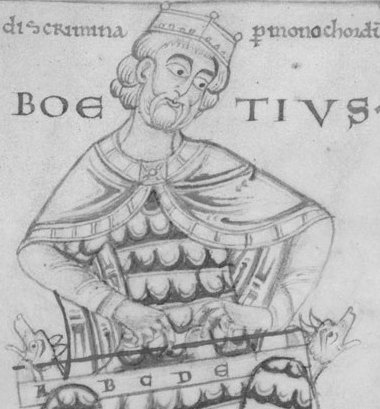
He never finished that work, but what he did finish shaped the mind of Europe. His Latin versions of Aristotle’s writings on logic were, for some six hundred years, almost the only Aristotle that Western Christians could read. He wrote handbooks on arithmetic and on music that were studied in schools throughout the Middle Ages; a modern historian called him “the schoolmaster of medieval Europe.” It was largely through him that the West kept any thread of connection with Greek philosophy at all.
Yet Boethius did not think a philosopher should stay in his library. Plato had taught that cities would be happy if wise men governed them, and Boethius took the lesson to heart. He entered the service of Theodoric, the Ostrogothic king of Italy, a capable ruler who governed his Roman subjects with considerable respect. Boethius rose quickly. He was a senator young and consul in 510. In 522 came the proudest day of his life, when both his sons were made consuls together and he stood between them in triumph before the people. In the same period he became master of offices, head of the king’s government and household.
He used the post to fight corruption, and he made enemies doing it. In the Consolation he recalls standing up to powerful officials who were plundering the poor, and using the king’s authority to stop a requisition of grain that would have deepened a famine in the south. These were honourable acts. They were not safe ones.
A Christian thinker
Boethius was a Christian, and a learned one. Alongside his philosophy he wrote short theological treatises, the Opuscula sacra, on the central doctrines of the faith. The most important, On the Trinity, defends the Catholic teaching that God is three persons in one undivided nature. Another, Against Eutyches and Nestorius, works out how Christ can be both fully God and fully man. In these little works he brought the precise tools of Greek logic to bear on Christian doctrine, and later medieval theologians learned much of their method from him.
This mattered politically. Theodoric and his Goths were Arian Christians, who held that the Son was not fully equal with the Father. Boethius, like most of the old Roman aristocracy, held the Catholic faith of the creed. In the last years of Theodoric’s reign, as Catholic Romans looked increasingly toward the emperor in Constantinople, the king grew suspicious of the senators around him, and a learned Catholic nobleman with ties to the East was an easy man to suspect.
Accused at Verona
The blow fell in 523. At a meeting of the royal council in Verona, an official named Cyprianus accused a former consul, Albinus, of treasonous letters to the emperor. Boethius sprang to his defence, declaring, according to the ancient accounts, that if Albinus had done it, then so had he and the whole Senate with him. It was a brave and loyal thing to say. Cyprianus promptly accused Boethius too, and produced witnesses whom Boethius later described as disgraced men, one dismissed for debt and two exiled for fraud. He was charged, in his own words, with having “desired the safety of the Senate”, and with forged letters hoping for the freedom of Rome. He was condemned without being allowed to answer for himself in person.
Nay, I did desire the safety of the Senate, nor shall ever cease to desire it.
— Boethius, The Consolation of Philosophy, Book I
He was imprisoned near Pavia, and there, awaiting death, he wrote the Consolation.
The visitor in the cell
The book opens with Boethius in tears, writing sad verses about his fall. Then a woman appears standing over him, of great majesty, her eyes burning, her robe torn and dimmed with neglect. She drives away the weeping Muses, sits on the end of his bed, and dries his eyes with a fold of her dress. He realises who she is: Philosophy, the nurse in whose rooms he had spent his life. What follows, in five books of alternating prose and verse, is her treatment of a sick soul.
She begins gently. He pours out his grievances, and the deepest of them is not the loss of wealth but the memory of happiness:
For of all suffering from Fortune, the unhappiest misfortune is to have known a happy fortune.
— Boethius, The Consolation of Philosophy, Book II
Philosophy answers that Fortune never truly belonged to him. Fortune is a wheel, and its whole nature is to turn; to complain that it has turned is to complain that it is Fortune. Wealth, office, fame and pleasure all promise happiness and cannot give it, because each can be lost and none is complete. True happiness can only be found in the highest good, which cannot be lost because it is God himself.
At the turning point of the whole work, in the third book, Philosophy asks how they should seek that highest good. Boethius answers, “Call … upon the Father of all, for if we do not do so, no undertaking would be rightly or duly begun.” And Philosophy sings a hymn, known by its Latin opening O qui perpetua, to the One who rules the universe by everlasting law. It ends in plain petition:
Thou art our beginning, our progress, our guide, our way, our end.
— Boethius, The Consolation of Philosophy, Book III
The last two books take up the hardest questions: why the wicked seem to prosper and the good to suffer, and how God can know the future without forcing it. Philosophy’s answer to the second has been admired ever since. God does not see events before they happen, as we do with our guesses; he lives in an eternal present, and sees all of time at once, as we see a man walking and the sun rising in the same glance, without making either happen by our seeing. Providence is better called a looking forth than a looking forward. Human freedom is real, and so prayer is not wasted.
Hopes are not vainly put in God, nor prayers in vain offered: if these are right, they cannot but be answered.
— Boethius, The Consolation of Philosophy, Book V
The question of his faith
Here an honest reader meets a puzzle. The Consolation never mentions Christ. It does not quote Scripture, speak of the cross, or name the Church. The comfort it offers is the comfort of reason, given by Philosophy rather than by a priest. Some scholars have concluded that in his last extremity Boethius’s Christianity simply fell away. Others reply that his theological works prove beyond doubt that he was a Christian, and orthodox. The editor of the old English translation published here observed that there is no Christian doctrine relied upon in the book, but also nothing that conflicts with Christianity.
Perhaps the fairest reading is that Boethius set out to show how far reason alone could carry a suffering man toward God, and found that it carried him a long way: to a good and loving Father who governs the world, to prayer, to the hope of seeing God face to face. He wrote as a philosopher, in the language his education had given him. Many Christian readers since have found that this makes the book more useful, not less, because it meets the grieving where they are and leads them, step by reasoned step, toward the One whom faith names more fully.
Death and remembrance
Boethius was put to death in 524 at an estate in the countryside near Pavia. The ancient sources disagree about how; the most likely account is that he was tortured with a cord tightened around his head and then beaten to death. Not long afterwards Theodoric had Symmachus, his father-in-law, executed as well. His wealth was confiscated and Rusticiana was left in poverty. His remains were laid in the church of San Pietro in Ciel d’Oro in Pavia, where the bones of Augustine of Hippo also rest.
The centuries that followed honoured him as a martyr who had died at the hands of an Arian king. That judgement is debated, since his condemnation was political rather than plainly religious. But the devotion was real and lasting. In the diocese of Pavia he has long been venerated as Saint Severinus Boethius, and in 1883 the Church confirmed that local custom, with a feast day on 23 October. Dante placed him in Paradise among the great teachers, in the heaven of the Sun.
His book had an even longer life. King Alfred the Great translated it into Old English; Chaucer and Queen Elizabeth I translated it after him; it fed the poetry of Dante, Chaucer and many others, and gave the Middle Ages its favourite image of Fortune’s wheel.
The translation on these pages is W. V. Cooper’s English version of 1902. It is a book for anyone who has lost what they loved and wondered whether God is still in charge. Boethius does not pretend that grief is small or injustice unreal; he begins in tears and is allowed to say everything. But he is led, patiently, out of self-pity toward a larger view: that Fortune is not God, that nothing we can lose was ever our true good, and that the eternal Father sees us, governs all things, and hears our prayers. He wrote it under sentence of death. Few books on suffering have been written with more right.
Questions and Answers
Who was Boethius?
Anicius Manlius Severinus Boethius (c. 480–524) was a Roman senator, consul and philosopher who served Theodoric, the Ostrogothic king of Italy. He translated Greek philosophy into Latin, wrote Christian theological treatises, and is best remembered for The Consolation of Philosophy, written in prison before his execution.
Where did Boethius come from?
He was born in Rome around 480 into the Anicii, an ancient noble family that had produced emperors and many consuls. His father died while he was young, and he was raised by the nobleman Symmachus, whose daughter Rusticiana he later married; they had two sons.
What did Boethius do as a scholar?
He set out to translate all of Plato and Aristotle into Latin, with commentaries, and to show that the two philosophers agreed. He never finished, but his versions of Aristotle’s logic were for about six centuries almost the only Aristotle available in the Latin West, and his handbooks on arithmetic and music were studied throughout the Middle Ages.
What offices did Boethius hold?
He became a senator young and consul in 510. In 522 both his sons were made consuls together, and he became master of offices, the head of Theodoric’s government and household, where he made enemies by opposing corrupt officials.
Was Boethius a Christian?
Yes. He wrote short theological treatises, including On the Trinity, defending the Catholic doctrine of God as three persons in one nature, and Against Eutyches and Nestorius on the two natures of Christ. Because The Consolation of Philosophy never mentions Christ, some scholars have doubted how much his faith shaped his final years, but many scholars hold that he was an orthodox Christian to the end.
Why was Boethius arrested?
In 523, at the royal council in Verona, he defended the former consul Albinus against a charge of treasonous correspondence with the emperor in Constantinople, and was then accused of the same crime himself. Theodoric, an Arian Christian increasingly suspicious of the Catholic Senate, had him imprisoned near Pavia.
What is The Consolation of Philosophy about?
Written in prison, it is a dialogue in prose and verse between the grieving Boethius and Philosophy, who appears to him as a majestic woman. She teaches him that Fortune is a turning wheel, that no earthly good can give true happiness, that the highest good is God, and that God’s providence sees all time in an eternal present without destroying human freedom.
Does The Consolation of Philosophy contain prayers?
Yes. In Book III Philosophy sings the hymn known as O qui perpetua to the Father who rules the universe by everlasting law, ending with the petition that our minds may rise to his throne and reach the fount of good. The book closes by urging the reader to send up prayers, since they are not offered in vain.
How did Boethius die?
He was executed in 524 at an estate near Pavia; the sources disagree on the method, but he was most likely tortured with a cord around his head and beaten to death. His property was confiscated, his father-in-law Symmachus was executed soon afterwards, and his remains were laid in San Pietro in Ciel d’Oro in Pavia.
Is Boethius a saint, and what is his legacy?
He is venerated in the diocese of Pavia as Saint Severinus Boethius, a local cult confirmed in 1883 with a feast on 23 October, though whether his death counts as martyrdom is debated. The Consolation was translated by King Alfred, Chaucer and Queen Elizabeth I, and Dante placed him in Paradise.