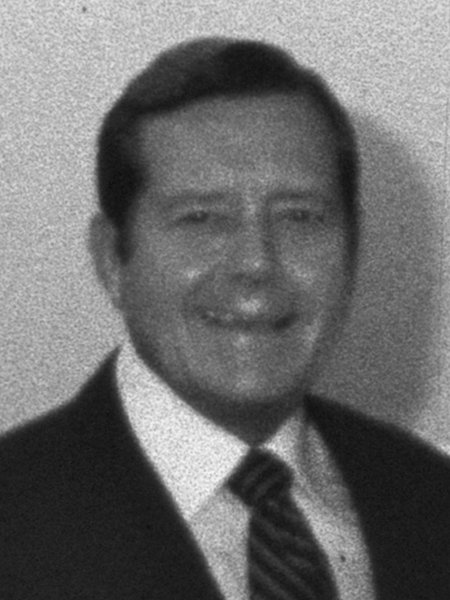
Biography
- 1921 Born
- 1951 Campus Crusade
- 1965 Four Laws
- 1979 JESUS film
- 1994 40-day fast
- 2003 Died
That Sunday afternoon, like Paul, we chose to become slaves of Jesus.
Most great men of prayer are known for one thing they did on their knees. Bill Bright is known first for a machine — a student ministry that grew into one of the largest in the world, a four-point gospel tract carried into more than two hundred languages, a film about Jesus that Guinness records as the most translated in history. It would be easy to make him a biography of numbers. But the numbers are the least reliable and the least interesting thing about him, and he knew it. The Bill Bright who has most to teach about prayer is the old man of the 1990s who set the machine to one side, stopped eating for forty days at a stretch, and spent the last decade of his life pleading with God — and with his own country — for revival.
An Oklahoma ranch, and a business he gave away
He was born William Rohl Bright on 19 October 1921, near Coweta, Oklahoma, and grew up on a ranch, at a small rural school, in a country of cattle and hard work. He graduated from Northeastern State University in Oklahoma in 1944, having studied economics and business, and then did what an ambitious young man does: he went west. In Los Angeles he built a successful specialty foods company — Bright's California Confections, gourmet foods and fine confections — and was, by his mid-twenties, a rising Southern California businessman with a future in front of him.
The turn came through a church. In the mid-1940s, at First Presbyterian Church of Hollywood, Bright came to faith — drawn in and discipled largely through Henrietta Mears, the church's formidable director of Christian education, in a circle that also brought him into the orbit of the young Billy Graham. Sensing a call to ministry, he studied at Princeton Theological Seminary and then at Fuller Theological Seminary in Pasadena, but he left without finishing a degree, convinced God wanted him reaching university students directly rather than sitting in a classroom. He set the promising business aside for good. In 1948, on the 30th of December, he married Vonette Zachary, a schoolmate from back home in Coweta. She is not a footnote to this story. She was his partner in all of it, and in one of its most important chapters she went ahead of him.
The Sunday they became slaves
The founding act of Bright's life was not the launch of an organization. It was a surrender.
On a Sunday afternoon in the spring of 1951, Bill and Vonette knelt together in their home and signed a written contract giving their whole lives to God — choosing, as Bright always told it, to become the bond-servants of Jesus Christ. He described it plainly in his 1996 Templeton Prize address:
That Sunday afternoon, like Paul, we chose to become slaves of Jesus.
— Bill Bright, Templeton Prize acceptance address, 1996
The devotional retellings add detail — that they each first wrote down what they most wanted from life, and that the vision for a student ministry came to Bright not long after — and some of that is reconstructed from memory rather than documented word for word. What is certain, in his own words, is the shape of it: two people, a written act of total surrender, and the language of slavery chosen freely. Out of that afternoon came Campus Crusade for Christ, begun in 1951 as a ministry to students at UCLA. It grew into one of the largest parachurch ministries in the world — thousands of full-time staff and many times that number of trained volunteers, working across scores of nations. In 2011, eight years after his death, the American organization renamed itself Cru.
Four laws, one film, and the trouble with counting
Two things Bright made carried his name furthest. The first was the Four Spiritual Laws, a short booklet that reduced the gospel to four plain sentences a student could read in a few minutes. It opens with the line that became his most quoted:
God loves you and offers a wonderful plan for your life.
— the first of the Four Spiritual Laws
He developed the content in the late 1950s and published it in its enduring booklet form in 1965. It went on to become one of the most widely distributed pieces of Christian literature ever printed — hundreds of millions, and by the ministry's own count billions, of copies in more than two hundred languages. The second was the JESUS film, produced by Campus Crusade in 1979 and drawn from the Gospel of Luke, which became the engine of a worldwide evangelism effort. Guinness World Records lists it as the most translated film in history, rendered into well over a thousand languages and screened worldwide on a scale few films have ever matched.
Here honesty asks for a word of restraint, and Bright would not have minded it. The distribution and viewership totals attached to his work are ministry estimates, not audited figures, and they have climbed steadily with the retelling. The one claim that rests on independent ground is Guinness's. A devotional reader is better served by the plain fact that these were among the most far-reaching gospel tools of the century than by any billion-count, and better served still by what Bright did once the machine was running and famous. He let it go, and went looking for God.
Forty days, and a call to a nation
In July 1994, at the age of seventy-two, Bill Bright stopped eating. He believed God had prompted him to fast and pray for forty days for a spiritual awakening in America — something he had never attempted, and something that frightened him. His own prayer, as he later recalled it, was not heroic:
He got through it. Somewhere in the third week, by his account, an assurance settled on him that God would indeed send revival — and with it a conviction that he was to summon two million Christians across North America to fast for forty days by the end of the year 2000, praying for revival and for the finishing of the Great Commission. It was not a one-time exercise. He went on to undertake a series of annual forty-day fasts through the rest of the 1990s, and he began to convene large gatherings of Christian leaders to fast and pray together — in Orlando in December 1994, in Los Angeles in 1995, thousands of leaders in all. He wrote to press the case: The Coming Revival: America's Call to Fast, Pray, and "Seek God's Face" in 1995, and later The Transforming Power of Fasting and Prayer, along with practical guides for those who had never tried it.
This is the Bright the older man became: not the entrepreneur of methods but the intercessor who thought his country's deepest need was not another program but a return, on empty stomachs and bent knees, to the God it had drifted from. He put the discipline near the center of everything:
No other Christian discipline meets the conditions of God's promises to heal our land as powerfully as fasting with prayer.
— Bill Bright, Templeton Prize acceptance address, 1996
A prize, given away
In 1996 Bright received the Templeton Prize for Progress in Religion, a monetary award of over a million US dollars, its citation naming him among the most vigorous Christian evangelists in the world. He kept none of it. He gave the entire prize away to fund the very cause the last decade of his life had become — the promotion of prayer and fasting for revival.
It was in keeping with how the Brights had long lived. A 1997 profile found them on a modest combined salary, owning neither a house nor a car, taking no book royalties or speaking fees personally — the royalties went to the ministry. For a man whose name sat atop an organization of that size, the smallness of his own footprint was the point.
The center of his teaching, running under all the activity, was that a Christian is not asked to imitate Christ from a distance but to be inhabited by him. He put it simply at Templeton:
He actually takes up residence in us. He lives inside of us, at the deepest level of our spirit, filling that former void and emptiness.
— Bill Bright, Templeton Prize acceptance address, 1996
What he leaves
Bill Bright died on 19 July 2003 in Orlando, Florida, of pulmonary fibrosis, at the age of eighty-one. Vonette, who had co-founded everything with him and led major prayer initiatives of her own — a driving force in the movement that gave the American National Day of Prayer a fixed date on the calendar — outlived him by more than a decade.
He wrote no book that will be read as literature, and much of what made him famous is stated in numbers that no one can verify. Strip those away and what remains is sturdier than any of them. A young businessman gave up a career because a sentence about the love of God had gone through him. A husband and wife knelt on a Sunday afternoon and signed themselves over as slaves. And an old man at the height of his renown decided the thing his life still lacked was not another method but hunger — and spent his last years teaching a distracted church the oldest way back to God there is. The gospel he reduced to four short lines had a first line, and he lived as though it were true to the end: that God loves you, and offers a wonderful plan for your life.
Also appears in
Questions and Answers
Who was Bill Bright?
Bill Bright (1921–2003) was an Oklahoma-born businessman who gave up his career for ministry and, with his wife Vonette, founded Campus Crusade for Christ in 1951. He wrote the Four Spiritual Laws and originated the JESUS film, but devoted his later years to fasting and prayer for revival — undertaking a series of 40-day fasts and giving away his 1996 Templeton Prize to the cause. The Bright who has most to teach about prayer is the old man who set the machine aside and spent his last decade pleading with God for revival.
What was his early life?
Born William Rohl Bright on 19 October 1921 near Coweta, Oklahoma, he grew up on a ranch, graduated from Northeastern State University in 1944 having studied economics and business, and went west to build a successful specialty foods company in Los Angeles. By his mid-twenties he was a rising Southern California businessman with a future in front of him. The turn came through First Presbyterian Church of Hollywood, where he came to faith, discipled largely through Henrietta Mears, and set the promising business aside for good.
What was the Sunday they "became slaves"?
The founding act of his life was not the launch of an organization but a surrender. On a Sunday afternoon in the spring of 1951, Bill and Vonette knelt together and signed a written contract giving their whole lives to God — choosing, as Bright always told it, to become the bond-servants of Jesus Christ. "That Sunday afternoon, like Paul, we chose to become slaves of Jesus," he said. Out of that afternoon came Campus Crusade for Christ, begun in 1951 as a ministry to students at UCLA, which grew into one of the largest parachurch ministries in the world.
What were the Four Spiritual Laws?
A short booklet that reduced the gospel to four plain sentences a student could read in minutes, opening with the line that became his most quoted: "God loves you and offers a wonderful plan for your life." Developed in the late 1950s and published in its enduring form in 1965, it became one of the most widely distributed pieces of Christian literature ever printed — hundreds of millions, and by the ministry's count billions, of copies in more than two hundred languages.
What was the JESUS film?
Produced by Campus Crusade in 1979 and drawn from the Gospel of Luke, it became the engine of a worldwide evangelism effort. Guinness World Records lists it as the most translated film in history, rendered into well over a thousand languages. Honesty asks for restraint about the viewership totals attached to his work — they are ministry estimates that have climbed with the retelling — but the Guinness claim rests on independent ground, and these were among the most far-reaching gospel tools of the century.
What was his forty-day fast?
In July 1994, at seventy-two, Bright stopped eating, believing God had prompted him to fast and pray for forty days for a spiritual awakening in America — something he had never attempted and that frightened him. His prayer was not heroic: "Lord, I'll fast for 40 days, but you'll have to help me." Somewhere in the third week an assurance settled on him that God would send revival, and a conviction that he was to summon two million Christians across North America to fast by the end of the year 2000.
Did he keep fasting?
It was not a one-time exercise. He went on to undertake a series of annual forty-day fasts through the rest of the 1990s and convened large gatherings of Christian leaders to fast and pray together. He wrote to press the case — "The Coming Revival" in 1995 and later "The Transforming Power of Fasting and Prayer" — believing his country's deepest need was not another program but a return, on empty stomachs and bent knees, to the God it had drifted from: "No other Christian discipline meets the conditions of God's promises to heal our land as powerfully as fasting with prayer."
What did he do with the Templeton Prize?
In 1996 he received the Templeton Prize, a monetary award of over a million US dollars, and kept none of it — giving the entire prize away to fund the very cause the last decade of his life had become, the promotion of prayer and fasting for revival. It was in keeping with how the Brights lived: a 1997 profile found them on a modest combined salary, owning neither house nor car, taking no book royalties or speaking fees personally. For a man atop an organization of that size, the smallness of his own footprint was the point.
What was the center of his teaching?
That a Christian is not asked to imitate Christ from a distance but to be inhabited by him: "He actually takes up residence in us. He lives inside of us, at the deepest level of our spirit, filling that former void and emptiness." All the activity of his life rested on that — a young businessman changed because a sentence about the love of God had gone through him, and an old man who decided the thing his life still lacked was not another method but hunger.
How did he die, and what does he leave?
He died on 19 July 2003 in Orlando, Florida, of pulmonary fibrosis, aged eighty-one; Vonette, who co-founded everything with him, outlived him by more than a decade. Strip away the unverifiable numbers and what remains is sturdier than any of them: a businessman who gave up a career because a sentence went through him, a couple who signed themselves over as slaves, and an old man who, at the height of his renown, spent his last years teaching a distracted church the oldest way back to God there is. He lived as though the first of his four laws were true to the end.