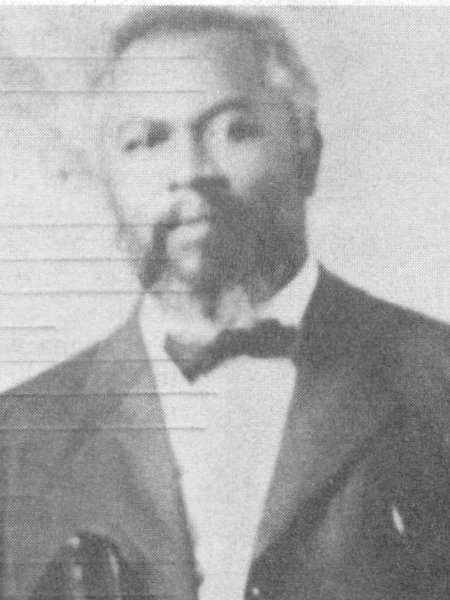
Biography
Above all, let us honor the blood of Jesus Christ every moment of our lives, and we will be sweet in our souls.
William Joseph Seymour was born on May 2, 1870, in Centerville, Louisiana, in the sugar country of St. Mary Parish. His parents, Simon and Phillis Seymour, had both been born into slavery and freed by the war. He grew up poor, in the hard years when Reconstruction was being torn down and the South was building the walls of segregation around its Black citizens. He was raised a Baptist and had little formal schooling. Those who knew him later spoke of a boy given to dreams and visions, and of a hunger for God that seems to have been with him from the start.
As a young man he went north looking for work. In Indianapolis he waited tables and worked as a railroad porter, and there and in Cincinnati he found the holiness movement. He joined a group called the Evening Light Saints, who preached that God was gathering one holy people out of the divided churches, Black and white alike. He took from them a conviction he never gave up: that the blood of Christ makes believers one. In Cincinnati he caught smallpox. He survived, but it cost him the sight of his left eye. He accepted a call to preach and began to travel.
A student in the hallway
In 1903 he moved to Houston, Texas, partly to look for relatives, and there he became friends with Lucy Farrow, a Black holiness pastor. Through her he heard about Charles Parham, a white Kansas preacher who taught that the baptism in the Holy Spirit was a distinct gift after salvation and sanctification, marked by speaking in other tongues as on the day of Pentecost. When Parham opened a short-term Bible school in Houston in the winter of 1905–06, Farrow urged Seymour to attend.
Texas law and custom kept Black and white students apart, and Parham was a man of his time and place. Seymour was allowed to listen, but not to sit with the others. He took his lessons from the hallway, outside the classroom door. He did not let the humiliation drive him away. He studied the Scriptures Parham opened, became convinced that the teaching was true, and began to seek the experience for himself.
Locked out
Early in 1906 a woman from a small holiness mission in Los Angeles met Seymour while visiting Houston, and the congregation invited him to come as its pastor. He arrived on February 22, 1906, and preached in the mission on Santa Fe Street. He preached from Acts 2:4, that the baptism in the Holy Ghost would be accompanied by tongues. Many in the congregation believed they had already received the Spirit when they were sanctified, and they would not accept it. Months later he told the story in his own paper: “one night they locked the door against me.” The leaders of the local holiness association were called in to correct him. Seymour stood his ground, though he did not yet have the experience he was preaching.
He was now a stranger in a strange city with no pulpit and no income. A church member, Edward Lee, took him in, and the little group began to meet for prayer in homes, soon at the house of Richard and Ruth Asberry at 214 North Bonnie Brae Street. Most of those who came were Black working people, many of them domestic servants and washerwomen. Seymour told them plainly that he had not received what he preached. He was seeking it too, and wanted them all to pray with him until every one of them had received it. Every afternoon at three o’clock they met to ask God for the power from on high. Lucy Farrow came from Houston to join them.
312 Azusa Street
The house could not hold the people, and within days the meetings moved to 312 Azusa Street, an old Methodist church building near downtown. Part of it had been turned into a tenement, and the meetings were held in the large room left on the ground floor, which the paper called “unplastered, barn-like.” On April 18, 1906, the same day an earthquake devastated San Francisco, the Los Angeles Times ran a mocking story under the headline “Weird Babel of Tongues.” The ridicule only drew more people. For the next three years meetings ran almost every day, often from morning until long after midnight. Visitors came from across the country and then from around the world, and many of them carried the message home with them, to Chicago and Memphis, and as missionaries to India, China and Africa.
What visitors noticed first was who was in the room. In a city and a country ruled by the color line, Black and white, Mexican and Chinese, rich and poor knelt together at the same altar, and women as well as men testified, prayed for the sick and went out as preachers. The journalist Frank Bartleman, a white holiness evangelist who was there almost from the beginning, wrote years later that at Azusa Street “the ‘color line’ was washed away in the blood.” The mission’s own paper said it simply: “No instrument that God can use is rejected on account of color or dress or lack of education.” It saw in this a sign of the times: “One token of the Lord’s coming is that He is melting all races and nations together.”
Seymour himself stayed in the background. He did not want the movement to depend on him. When people asked who had founded the work, the paper answered that the Lord was its founder, and that “Bro. Seymour is simply a humble pastor of the flock.” William H. Durham of Chicago, who received the baptism at Azusa in 1907, wrote of him in the paper: “He is the meekest man I ever met. He walks and talks with God.”
The Apostolic Faith
In September 1906 the mission began to publish a free paper, The Apostolic Faith. There was no money for it. The first issue told how the workers had knelt in the little office upstairs to ask for it.
Seymour wrote much of the paper’s teaching himself, in plain, warm sermons signed “W. J. Seymour.” He wrote about the atonement, sanctification, healing and the Spirit’s power, and he kept turning back to the cross. He warned against counterfeits, against treating the Spirit’s gifts as a show, and against faith that could not reach past the boundaries of human creeds.
Above all, let us honor the blood of Jesus Christ every moment of our lives, and we will be sweet in our souls.
— William J. Seymour
He also wrote practical counsel for the poor and the zealous. He warned new believers not to abandon their families in the name of faith and not to borrow what they could not repay. For those called out to preach with nothing, he gave the advice he had lived by:
Get down and pray. Make your wants known unto God and He will send it in.
— William J. Seymour
Wounds from friends
The trials, when they came, came mostly from friends. In October 1906 Seymour invited Charles Parham, his old teacher, to preach at Azusa Street, and the paper had at first called him the movement’s leader. Parham was disgusted by what he found. He objected to the noise and, above all, to the mixing of Black and white worshippers, and he denounced the meetings from Seymour’s own pulpit. The mission’s leaders asked him to leave, and he never stopped condemning the revival. Two months later the paper admitted that it had been hasty, and that “the Lord should be our leader.”
On May 13, 1908, Seymour married Jennie Evans Moore, one of the first to receive the Spirit on Bonnie Brae Street, who became his partner in the ministry. Some in the mission objected to the marriage. Florence Crawford, a gifted white evangelist who had begun a work in Portland, Oregon, believed the Lord’s return was too near for marrying, and she was not alone. That year Clara Lum, the white secretary who edited The Apostolic Faith, joined Crawford in Portland. She took the paper with her, and with it the national and international mailing list. Seymour lost his voice to the movement he had helped to start, and the loss was never undone.
More trouble followed. In 1911, while Seymour was away preaching, William Durham returned to preach at Azusa with a new teaching on sanctification, and many of the congregation followed him. Seymour came home and locked the doors against him, and much of the crowd left with Durham. Then, after 1913, came the “Oneness” controversy, which swept through the young Pentecostal churches with teaching that rejected the Trinity and baptized in the name of Jesus only. Seymour would not follow it. He held to baptism “in the name of the Father, and of the Son, and of the Holy Ghost.”
The love that is Pentecost
By 1915 the mission was a small, mostly Black congregation. That year Seymour published The Doctrines and Discipline of the Azusa Street Apostolic Faith Mission, a manual for its life and order. It shows a man who had thought hard about what had happened in those years. The tongues he had once preached as the necessary sign of the Spirit were no longer at the center of his teaching. Instead he wrote that the baptism in the Holy Ghost “means to be flooded with the love of God and power for service, and a love for the truth as it is in God’s word.” The book also records his hurt. Its constitution required that the bishop, vice bishop and trustees of the mission be “people of color.” After years of watching white colleagues leave and take the work with them, he gave the leadership of Azusa Street to the people who had stayed. He still preached that the blood of Jesus makes one family.
He had never lost that conviction. In its last Los Angeles issue, in May 1908, his paper printed a sentence that sums up the revival at its best: “The Pentecostal power, when you sum it all up, is just more of God’s love. If it does not bring more love, it is simply a counterfeit.”
William Seymour died in Los Angeles on September 28, 1922, after heart attacks. He was fifty-two, and he died in Jennie’s arms. He was buried in Evergreen Cemetery in East Los Angeles. Jennie Seymour pastored the mission until her own death in 1936, and soon afterward the old building was torn down. Outside Pentecostal circles, few people at the time noticed his death. Today hundreds of millions of Pentecostal and charismatic Christians around the world trace their story back to the revival he led. He had little schooling, one good eye and few friends among the powerful, and he started a movement that went around the world by spending long hours on his knees.
Sermons by William J. Seymour (11)
Questions and Answers
Who was William J. Seymour?
William Joseph Seymour (1870–1922) was a Black holiness preacher, the son of formerly enslaved parents, who led the Azusa Street revival in Los Angeles from 1906. The revival, where Black and white believers worshipped together, became one of the main sources of the worldwide Pentecostal movement. He pastored the Apostolic Faith Mission on Azusa Street until his death.
What was his early life like?
He was born on May 2, 1870, in Centerville, Louisiana, to Simon and Phillis Seymour, who had both been enslaved. He grew up poor in the years when segregation was being built across the South and had little formal schooling. As a young man he worked as a waiter and railroad porter in Indianapolis and Cincinnati, where he joined the Evening Light Saints, a holiness group that taught that Christ makes believers one. In Cincinnati smallpox cost him the sight of his left eye.
How did he come to Charles Parham's Bible school?
In 1903 he moved to Houston, where the Black holiness pastor Lucy Farrow introduced him to Charles Parham's teaching on the baptism in the Holy Spirit with speaking in tongues. When Parham opened a short Bible school in Houston in the winter of 1905–06, segregation kept Seymour from sitting with the white students, so he listened from the hallway. He became convinced the teaching was true and began to seek the experience himself.
How did he come to Los Angeles?
A small holiness mission on Santa Fe Street invited him to be its pastor, and he arrived on February 22, 1906. When he preached that the baptism in the Spirit would be accompanied by tongues, the congregation rejected the teaching, and he later wrote that one night they locked the door against him. Edward Lee took him in, and he began to lead prayer meetings in homes, soon at 214 North Bonnie Brae Street.
What happened at Bonnie Brae Street?
The small group, mostly Black working people, met every afternoon at three o'clock to pray for the power from on high, and they fasted as well. Seymour told them openly that he had not yet received what he preached. On April 9, 1906, as the mission's paper later put it, the fire of God fell in the cottage on Bonnie Brae, and three days later Seymour received the experience he had long sought.
What was the Azusa Street Mission like?
Within days the meetings moved to 312 Azusa Street, an old Methodist church building, and for about three years they ran almost daily. Black and white, Mexican and Chinese, men and women worshipped and prayed together, and Frank Bartleman wrote that there the color line was washed away in the blood. Seymour stayed in the background; Bartleman remembered him sitting behind two stacked shoe boxes with his head inside the top one, in prayer.
What was The Apostolic Faith?
It was the mission's free paper, first published in September 1906. The workers began with no money and knelt in the upstairs office to ask God for the means, and the money came in. The first printing was five thousand copies, and within a year tens of thousands were going out around the world. Seymour wrote many of its sermons, urging readers above all to honor the blood of Jesus Christ every moment of their lives.
What trials did he face?
His old teacher Charles Parham visited in October 1906 and denounced the revival, especially the mixing of races. After Seymour married Jennie Evans Moore on May 13, 1908, Clara Lum, who edited the paper, joined Florence Crawford in Portland and took the paper and its mailing list with her, cutting Seymour off from most of his readers. In 1911 William Durham drew away much of the congregation, and Seymour locked the doors against him.
What did he teach in his later years?
In 1915 he published The Doctrines and Discipline of the Azusa Street Apostolic Faith Mission. In it he described the baptism in the Holy Ghost as being flooded with the love of God and power for service, and he did not make tongues the center of it. He held to baptism in the name of the Father, the Son and the Holy Ghost against the Oneness teaching. Wounded by the departures of white colleagues, he required the mission's bishop, vice bishop and trustees to be people of color.
How did he die, and what is his legacy?
He died in Los Angeles on September 28, 1922, after heart attacks, at the age of fifty-two, and was buried in Evergreen Cemetery. Jennie Seymour led the mission until her death in 1936. Today hundreds of millions of Pentecostal and charismatic Christians trace their story to the revival he led, and he is remembered as a man of long prayer and a preacher of the love that makes believers one.