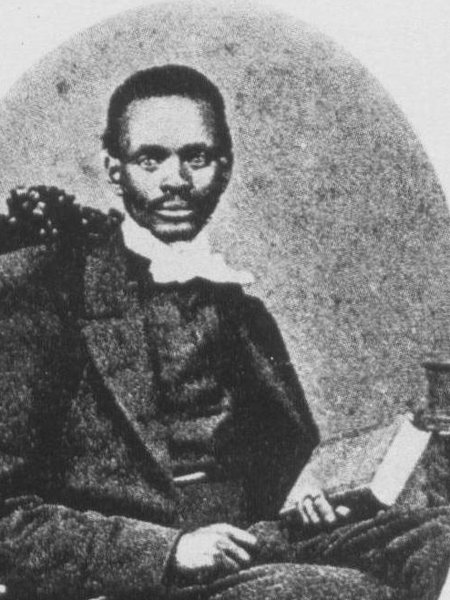
Biography
Tiyo Soga was born in 1829 at Gwali, in the green Tyhume valley of the Eastern Cape, in the homestead of a powerful man. His father, Soga, was one of the chief councillors of the Ngqika chief — a tall, fierce-eyed traditionalist with eight wives and thirty-nine children, who dreaded the new religion of the missionaries as the herald of a revolution. Yet the same man was the first of his people, it was said, to drive a plough and to lead the water of a running stream onto his fields. Tiyo’s mother, Nosuthu, was Soga’s great wife, and Tiyo was the seventh of her nine children.
Nosuthu became a Christian. She separated from her husband’s marriage bed while remaining at his homestead, and she let the boy go to live with the missionary at the nearby Chumie station, the Rev. William Chalmers, who had grown fond of the slender, truthful child in a sheepskin kaross. When Tiyo was a very small boy, an old Christian later recalled, his mother had said she did not know what to do with him — when they knelt to pray, he would take the prayer out of her mouth and offer it himself.
“The salvation of mankind”
In 1844 Chalmers had to choose which of his pupils to send to compete for a free place at the Lovedale seminary. He asked the boys which was the greatest work of God. Each answered, “The work of creation.” Tiyo answered, “The salvation of mankind, because it shows God’s love” — and his teacher, as Tiyo told it, clapped his hands and shouted, “Well done, well done, Tiyo!” At Lovedale itself the frightened boy failed the examination, but Chalmers would not give him up, and William Govan took him into the seminary anyway. He climbed from the bottom of his class to the top.
Then, in 1846, came the War of the Axe. Lovedale was broken up, the Chumie station was burned to the ground, and Tiyo and his mother were refugees at Fort Armstrong. Night after night she gathered sneezewood splinters so her son could read by the firelight. When the homeless missionaries resolved that Govan should take the boy to Scotland, the Rev. James Laing went to ask her consent. Her answer has come down to us whole: “My son is the property of God; wherever he goes, God goes with him.” If he was willing to go, she said, she would not object, for he was as much in God’s keeping across the sea as he was near to her. Her husband and kinsmen were at that moment in arms against the colony.
A son of Africa in Glasgow
Tiyo sailed with Govan in July 1846. In Glasgow he was taken up by the John Street United Presbyterian Church and its minister, Dr. William Anderson, who — Tiyo wrote long afterwards — took possession of his soul and feelings in a Sunday school one evening, not by anything he said, but by his “exceeding fellow-feeling towards a strange boy.” There, far from home, the seed sown at the Chumie came up. On 7 May 1848 Tiyo Soga made his public confession of faith in Christ and was baptized by Dr. Anderson in John Street Church.
He went home that year as a young catechist, interpreting for the missionary George Brown — with whom he also read Jonathan Edwards’s Religious Affections — and then teaching and preaching at the new station of Uniondale among people who had never heard the gospel. His message to old warriors and young braves alike was the one word “Repent,” and it was mostly ignored. Because he had refused the initiation rite of manhood, parents pulled their children from his school, and some threatened his life. It was in these lean years that he began to write hymns in Xhosa; the 1850 hymnbook already contained some from his pen.
On Christmas Day 1850 war broke out again. The Uniondale station was looted and burned, and Tiyo escaped through the Amatole bush by night, outrunning men who chased him in the dark. When the chief Maqoma sent him captured letters to translate, he returned every one: he would have no part in a contest that carried death to his fellow-creatures.
Before he sailed for Scotland a second time, in 1851, he was offered the post of government interpreter at a good salary. He turned it down.
I had rather beg my bread from door to door in your streets to gather up what will pay my fees at College, and thereafter attend the Theological Hall in order to learn better how to preach Christ as my known Saviour to my heathen countrymen who know Him not.
— Tiyo Soga
The first of his race
He studied at the University of Glasgow and the United Presbyterian Theological Hall in Edinburgh. He was never a prize-winner — he had begun English at fifteen, and his schooling had been broken by two wars — but his professors vied to praise his diligence, and his fellow students loved him. One of them, Robert Johnston, said that meeting Tiyo turned his whole life toward the mission field. He taught Sunday school in a poor district and did city mission work, where at least once he was cursed down a staircase for his colour.
On 23 December 1856, in a crowded John Street Church, the Presbytery of Glasgow ordained him to the ministry — the first Black South African to be ordained. On 27 February 1857 Tiyo married Janet Burnside, a Scotswoman, and in April they sailed together for the Cape. From London he wrote that she had made all the sacrifice, not he, and that he trusted the sense of it would make him “a tenderly affectionate husband.”
Coming home to a famine
He landed at Algoa Bay in July 1857 into two kinds of storm. A Black minister with a white wife drew stares in every street. And his own people were dying. In 1856–57, following the prophecies of Nongqawuse, the Xhosa had killed their cattle and burned their grain, believing the ancestors would rise and the land be renewed. Tiyo called it, with grief, a nation that had believed a lie. Near Peelton he helped dig the grave of a mother and two little children who had lain down under one blanket and starved in their sleep. He wrote to Glasgow begging the John Street people for money to feed the starving. Yet he refused despair: “It is by terrible things that God sometimes accomplishes His purposes,” he wrote; affliction might yet soften hearts toward the truth.
In September 1857 he and Robert Johnston reached the Mgwali stream, in a valley emptied by famine, with the scattered Christians of the old Chumie mission following them. The two young graduates cut poles and sods with their own hands and finished the little church themselves. At its opening in 1858 Tiyo served the Lord’s Supper to about forty communicants — among them his eldest brother, who had first taught him the alphabet — and they sang the old hymn of Ntsikana, the early Xhosa Christian prophet, until the little church was full of sobs. The Mgwali grew; Alexander Duff, the great Scottish missionary to India, wrote after visiting in 1864 that he had found no mission station in all South Africa more orderly than his.
The dark years
The work was not easy, and Tiyo felt every blow. Members fell into sin, and a group of Christian boys took up the initiation rite and openly defied him, with two elders taking their side. “I have had disappointment after disappointment,” he wrote in 1862. That year his throat and chest broke down, and he lay for weeks at King William’s Town unable even to speak aloud. His second son was growing up lame. And through the colony there ran the steady humiliation of colour — a grieving father who at first refused to let a Black minister bury his child, policemen who demanded his pass, an innkeeper who ordered him out. He bore most of it in silence.
His private journal from these years, written partly in Greek letters so no one else would read it, is one of the most searching records any missionary has left. He accused himself of irresolution, coldness, temper and unbelief, and cried out like a child to his Father: “O God, by Thy spirit move me, and Thou shalt have the entire glory.” Slowly he came to see that his trouble was looking at his sins so long that he could not see Christ. “The promises are all on my side,” he wrote in May 1863. “Why should I doubt?” Those who knew him said that this hidden struggle was the secret of the humility that shone in his face.
Pilgrim’s Progress in Xhosa
Bunyan had been Tiyo’s companion since his student days, and he had already roughed out a translation in Scotland. On the night of 21 November 1866 he wrote in his journal that he had finished, “through the goodness of Almighty God,” the first part of John Bunyan’s Pilgrim’s Progress — “my fingers aching with writing.” Printed at Lovedale as U-Hambo lom-Hambi, it was read aloud at mission stations everywhere. One reader, hearing the fight with Apollyon, refused to believe that the writer had not seen it with his own eyes. His hymns — not translations, but his own meditations on Scripture — entered the worship of his people. The hymn “Lizalis’ idinga lakho,” traditionally ascribed to him, is still sung in South African churches today. From 1869 he also sat on the board of seven missionaries from seven churches revising the Xhosa Bible, insisting that the text be pure and idiomatic. “It is no task,” he wrote, “but a delightful privilege and duty.”
To the Tutura
In 1867 the Xhosa paramount chief Sarhili asked for a missionary who spoke his language, and named Tiyo as the man he wanted. In June 1868 Tiyo left the Mgwali with his family to found a new station at the Tutura, beyond the Kei, among people who often stared blankly at the hymns he sang. In 1870, knowing his strength was failing, he sent his three eldest sons — William Anderson, John Henderson and Kirkland Allan — to be educated in Scotland. For them he wrote a small book, “The Inheritance of My Children,” of sixty-two short counsels. Never be ashamed, he told them, that your father was a Xhosa; take your place in the world as Black men; love all men; set your face against scandal; insult no one, but fear no one when you are in the right.
God has made from creation no race of men mentally and morally superior to other races.
— Tiyo Soga
Trust in no right hand of your own, but in the living God, to do anything great or honourable.
— Tiyo Soga
Sunset
In mid-1871 he sent the Bible board his translation of Acts as far as chapter twenty-three, with a line in Xhosa at the end: strength had failed him at that point. Though desperately weak, he left his bed on two days that July to vaccinate the people who came to him for help, and relapsed.
On the night of 11 August he gathered his strength and prayed aloud in Xhosa: trusting himself wholly to Christ, and pleading for his scattered countrymen, for every preacher of the gospel, for the little church at the Tutura, for the children in the schools, for those who had grieved him, and for his sons across the sea — that they might come home and teach his people. When a friend asked whether he found the Saviour precious, he whispered “Yes.” He died the next afternoon, 12 August 1871, aged forty-two, in the arms of his old Lovedale schoolfellow Richard Ross. His aged mother, who had nursed him day and night, stood calmest of all at the grave in the orchard he had planted.
His long illness is identified by later historians as tuberculosis. His prayer for his sons was answered: William Anderson Soga came home as a doctor and medical missionary in the Transkei, and John Henderson Soga served as a missionary and completed the second part of the Xhosa Pilgrim’s Progress that his father had begun. On the wall of the church at the Mgwali a tablet called Tiyo Soga “the first ordained preacher” of his people, “a Friend of God,” “a Lover of His Son,” and “a Devoted Missionary who spent himself in his Master’s service.” It is a fair summary of a man who carried the gospel, the burdens of his nation and the wounds of his colour, and asked only that all of it be sanctified to the good of his soul.
No books or sermons in the library yet for this writer.
Questions and Answers
Who was Tiyo Soga?
Tiyo Soga (1829–1871) was a Xhosa minister, missionary, translator and hymn writer from the Eastern Cape. Ordained in Glasgow in 1856, he was the first Black South African to be ordained to the Christian ministry. He founded mission stations at Mgwali and Tutura and translated the first part of John Bunyan's Pilgrim's Progress into Xhosa.
What was his early life like?
He was born in 1829 at Gwali in the Tyhume valley, the son of Soga, a chief councillor of the Ngqika, and of Nosuthu, Soga's great wife. His mother became a Christian, and as a boy he went to live with the missionary William Chalmers at the nearby Chumie station. In 1844 he entered the Lovedale seminary, where he rose from the bottom of his class to the top.
How did he come to go to Scotland?
When the War of the Axe broke up Lovedale in 1846, the missionaries resolved that William Govan should take him to Scotland to be educated. His mother consented, saying that her son was the property of God and that wherever he went, God went with him. He studied in Glasgow from 1846 to 1848.
When did he become a Christian?
The faith sown in him at the Chumie came to open profession in Scotland. On 7 May 1848 he publicly confessed his faith in Christ and was baptized by Dr. William Anderson in John Street United Presbyterian Church, Glasgow.
What did he do between his two visits to Scotland?
From 1849 he worked as a catechist, interpreter and schoolteacher, first at the Chumie and then at Uniondale in the Amatole, preaching repentance to people who largely ignored him. When war broke out on Christmas Day 1850 the station was burned and he escaped through the bush by night. He refused to translate captured letters for the chief Maqoma and turned down a paid post as government interpreter.
How was he trained and ordained?
Returning to Scotland in 1851, he studied at the University of Glasgow and the United Presbyterian Theological Hall, supported by John Street Church. He was licensed to preach in December 1856 and ordained by the Presbytery of Glasgow on 23 December 1856. In February 1857 he married Janet Burnside, and they sailed for South Africa that April.
What did he find when he returned home in 1857?
He arrived during the famine that followed the Xhosa cattle-killing of 1856–57, when thousands died after following prophecies that the dead would rise. He helped bury starving families, appealed to Glasgow for money for food, and in September 1857 founded the Mgwali mission with Robert Johnston among the returning survivors.
What trials did he face as a missionary?
He suffered discouragement from moral failures and defiance at his station, a serious breakdown of his throat and chest in 1862, a lame son, and repeated insults because of his colour. His private journal records long struggles with doubt and coldness of heart, and his prayer that his affliction would be sanctified for the good of his soul.
What were his literary achievements?
He finished translating the first part of Pilgrim's Progress into Xhosa in November 1866, and it was printed at Lovedale as U-Hambo lom-Hambi. He wrote original Xhosa hymns, including Lizalis' idinga lakho, traditionally ascribed to him and still sung today. From 1869 he served on the board revising the Xhosa Bible and helped complete the four Gospels.
How did his life end?
In 1868 he moved to found a station at Tutura among the people of the chief Sarhili, and in 1870 he sent his three eldest sons to Scotland with a book of counsel called The Inheritance of My Children. Weakened by long illness, which later historians identify as tuberculosis, he died at Tutura on 12 August 1871, aged 42. His last letter said that the Lord Jesus Christ had enabled him to commit all to Him without fear.