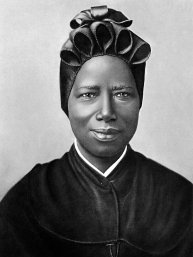
Biography
If I were to meet the slave-merchants who kidnapped me and even those who tortured me, I would kneel and kiss their hands. If what happened to me had never taken place, how could I become a Christian and a religious?
She never knew her own birthday, and she could not remember the name her mother gave her. Josephine Bakhita was born around 1869 in Olgossa, a village in Darfur in the west of present-day Sudan, one of the Daju people. Her father, a respected and reasonably prosperous man, was brother to the village chief; she grew up among three brothers and three sisters, and when she came to dictate her memories forty years later she began with that lost home: “I lived a very happy and carefree life, without knowing what suffering was.”
Taken
Slave raiders had already carried off her eldest sister. Then, around 1877, when she was perhaps eight or nine, they came for her. She was marched barefoot hundreds of miles toward El Obeid and sold and bought twice before she even reached the town. The Canossian account says that terror drove her own name out of her memory, and that the name she bore for the rest of her life was the one her captors gave her: Bakhita, Arabic for “fortunate.” Only much later would it come to seem, without anyone intending it, a true word.
Over the following years she was sold again and again — five times in the slave markets of Sudan, Pope Benedict XVI would later write. She once tried to escape, and was recaptured. In El Obeid an owner’s son beat and kicked her so savagely that she lay for more than a month unable to rise from her straw mat. Her worst years were in the household of a Turkish general, serving his wife and his mother-in-law. “During all the years I stayed in that house,” she remembered, “I do not recall a day that passed without some wound or other. When a wound from the whip began to heal, other blows would pour down on me.”
There, too, came the ordeal she named as the most terrifying of all. With their mistress standing over them, whip in hand, Bakhita and the other slave girls were marked: a woman drew patterns on their skin in white flour, cut along the lines with a razor, and filled the wounds with salt so that the scars would never fade. “I felt I was going to die any moment,” she said, “especially when they rubbed me in with the salt.” She carried those marks, and the marks of the lash, to her grave; Benedict XVI counted 144 scars. Yet even in that darkness, by her own testimony, something in her was reaching toward God before she knew his name. “Seeing the sun, the moon and the stars,” she remembered, “I said to myself: Who could be the Master of these beautiful things? And I felt a great desire to see him, to know Him and to pay Him homage.”
A different kind of master
In the early 1880s the Mahdist uprising swept toward El Obeid, and the general sold off his slaves before leaving. In Khartoum Bakhita was bought by the Italian consul, Callisto Legnani — and for the first time since her capture, she noticed, no one used the lash when giving her orders. In his house she knew peace and even moments of joy, though they were shadowed by longing for the family she would never see again. When the siege of Khartoum forced Legnani to flee, Bakhita begged to go with him. They escaped across the desert by camel to the Red Sea port of Suakin and sailed for Italy, arriving at Genoa in 1885.
She was not yet free. At Genoa, Legnani gave her to the wife of his friend and fellow-refugee Augusto Michieli, and she went with the Michieli family to their villa at Zianigo, near Mirano, in the Veneto. When their daughter Alice — called Mimmina — was born in 1886, Bakhita became her nanny and devoted friend. Then Augusto Michieli bought a hotel at Suakin and resolved to move his family to Africa for good. While the Italian property was being sold, his wife needed somewhere to leave the child and her nurse, and on the advice of the family’s agent, Illuminato Checchini, she placed both with the Canossian Sisters at the Institute of the Catechumens in Venice in late November 1888.
It was there, from the sisters, that Bakhita heard of Jesus Christ. She later said they had introduced her to “that God who from childhood I had felt in my heart without knowing who He was,” and she spoke of their teaching as given “with heroic patience.” Pope Benedict, retelling her story at the opening of his encyclical on hope, put his finger on what that teaching meant to someone who had known only owners. Learning the Venetian dialect, Bakhita called God by the word for a master of a household — paron. All her life she had known masters who despised her, beat her, or at best found her useful. Now she heard of a Paron above all masters, who was good, who knew her, who had made her and loved her — and who had himself been flogged, and was waiting for her at the Father’s right hand.
“Here, I became a daughter of God”
When Signora Michieli came back for her daughter and her slave, Bakhita did something no one had ever allowed her to do: she said no. With a firmness that startled everyone, she refused to leave the sisters and the God she had found among them. For three days Michieli tried to force the matter. The superior of the catechumenate appealed to the Patriarch of Venice, and the question went to the authorities. On 29 November 1889 the ruling came: slavery had been outlawed in Sudan before Bakhita was born, and Italian law had never recognized it at all. In the eyes of the law she had never been anyone’s property. For the first time in her life her future was her own, and she chose to stay.
Freedom did not send her away from the sisters but deeper among them. She remained at the catechumenate, felt the call to give her whole life to Christ, and in December 1893 entered the novitiate of the Canossian Daughters of Charity. On 8 December 1896, in Verona, she made her vows. Her heart, even then, was in Africa.
Madre Moretta
She never did fly south. In 1902 she was sent to the Canossian house at Schio, a small industrial town in the foothills of the Alps near Vicenza, and there, apart from a few years away, she spent the rest of her life. Her work was the plainest work a convent has: cooking, sewing and embroidery, the sacristy, and above all the door. As portress she greeted everyone who knocked, and she would lay her hands gently on the heads of the children coming in each day to the Canossian school. During the First World War part of the convent became a military hospital, and she helped care for wounded soldiers. The people of Schio came to love her. They called her Sor Moretta and Madre Moretta — “our little brown sister,” “our black mother” — and the names were affection, not mockery.
What they remembered was her gentleness, her musical Venetian with the rhythm of another country in it, and a smile that did not seem to wear out. Her counsel was always short and always pointed toward God: “Be good, love the Lord, pray for those who do not know Him. What a great grace it is to know God!”
In 1910, in obedience to her superiors, she dictated the story of her life, and it is from that notebook that nearly everything we know of her childhood comes. In 1931 Ida Zanolini published it as Storia meravigliosa — “a wonderful story” — and the book made her famous across Italy. From 1935 to 1939 her order sent her travelling from house to house, based at the missionary novitiate at Vimercate near Milan, to tell her story and help prepare young sisters for Africa. She went because, as Benedict XVI wrote, the hope that had redeemed her was not something she could keep to herself.
Forgiveness
The question people most wanted to ask her was the hardest one. A student once asked what she would do if she ever met the men who had kidnapped her. She answered at once.
If I were to meet the slave-merchants who kidnapped me and even those who tortured me, I would kneel and kiss their hands. If what happened to me had never taken place, how could I become a Christian and a religious?
— Josephine Bakhita
It would be easy to misread those words as if she thought the slavers had done well. She did not. She simply refused to let them have the last word over her life, and she refused to hate them. “I pity them!” she said on another occasion. “No doubt they were unaware of the anguish they caused me.” When a priest pressed her — even those who tortured you? — she replied, “Why not? poor things! They did not know the Lord.” The mercy that had found her was the measure of the mercy she extended. Her grief, when she spoke of her slavery, was not for what she had suffered but for the years she had lived without knowing Christ: “If I were to kneel my whole life, it would not be enough to express my gratitude to the good Lord.”
As the Master desires
Through the Second World War, when Schio, a centre of industry, came under bombing, the townspeople looked on the old African sister as a kind of shelter among them. When her superior, worn down by the hardships of those years, confided her troubles, Bakhita answered in her usual way: “Dear Mother, why do you wonder that the Lord is giving you some trouble? If He were not to come to us for sharing some of his sufferings, to whom will He go?” She would pray, she said, “but only that the Will of God be done.”
Her last years were long and painful. Illness confined her to a wheelchair, but the smile stayed. When visitors asked how she was, she gave the answer that became her motto: “As the Master desires.” Asked whether she was afraid to die, she said, “When a person loves another very much, she greatly wished to meet that person. Why then should I be afraid of death? Death brings us to God.”
He is the Master, I am only his humble creature.
— Josephine Bakhita
At the very end, her mind went back to the slave roads of her childhood. More than once she begged the nurse beside her, “Please, loosen the chains... they are heavy!” Then the old terror passed, and she died peacefully at the convent in Schio on 8 February 1947, about seventy-eight years old, with her sisters around her. Crowds came for three days to see their Madre Moretta for the last time.
Fortunate
The Catholic Church opened her cause twelve years after her death, beatified her in 1992 and canonized her on 1 October 2000; as the process requires, the Church credited healings to her intercession, but her life needs no wonders added to it to speak. When John Paul II visited Khartoum in 1993 he honoured her on her own soil — “Rejoice, all of Africa! Bakhita has come back to you” — and she is now regarded as patron of Sudan and of those who work against human trafficking. In 2007 Benedict XVI chose her, of all the saints, to open his encyclical Spe Salvi, as the clearest modern picture of what Christian hope is: not the small hope of finding a kinder owner, but the great hope of knowing oneself “definitively loved” by God.
That is the strange truth hidden in the name her kidnappers gave her. The girl who forgot her own name was found, named and claimed by a Master who wounds no one and was wounded for all. She spent fifty years opening a convent door to strangers, and through that small door a great many people have since glimpsed the God she called Paron — and found that he is good.
Also appears in

Questions and Answers
Who was Josephine Bakhita?
Josephine Bakhita (c. 1869–1947) was a Sudanese woman kidnapped into slavery as a child who, after being brought to Italy, came to faith in Christ, won her freedom in an Italian court, and spent fifty years as a Canossian sister in the town of Schio. Her forgiveness of those who enslaved her and her quiet joy made her one of the best-loved Christian witnesses of modern Africa, and she was canonized by the Catholic Church in 2000.
Where did she come from?
She was born around 1869 in Olgossa, a village in Darfur in the west of present-day Sudan, one of the Daju people; she never knew her exact birth date. Her father was brother to the village chief, and she grew up among three brothers and three sisters, remembering later that she lived a very happy and carefree life without knowing what suffering was.
How did she become a slave, and where does the name Bakhita come from?
Around 1877, when she was perhaps eight or nine, slave raiders who had already taken her eldest sister kidnapped her and marched her toward El Obeid. The Canossian account says the terror made her forget her own name, and she kept the one her captors gave her: Bakhita, Arabic for "fortunate." She was sold five times in the slave markets of Sudan.
What did she suffer in slavery?
She was beaten so badly by one owner's son that she lay for more than a month unable to rise, and in the house of a Turkish general she was whipped almost daily. She and other slave girls had patterns cut into their skin with a razor and filled with salt so the scars would last; she said she felt she was going to die, especially when the salt was rubbed in. Pope Benedict XVI counted 144 scars on her body.
How did she come to Italy?
In Khartoum she was bought by the Italian consul Callisto Legnani, in whose house no one used the lash. When the Mahdist siege forced him to flee, she begged to go with him, and they reached Genoa in 1885. There he gave her to the wife of his friend Augusto Michieli, and she became nanny to the Michielis' daughter Mimmina at their villa near Mirano.
How did she come to faith in Christ?
In late 1888 Signora Michieli left Mimmina and Bakhita with the Canossian Sisters at the Institute of the Catechumens in Venice while she joined her husband in Sudan. There the sisters introduced her, as she put it, to the God she had felt in her heart from childhood without knowing who He was. Learning Venetian, she called God "Paron" — the Master — a good Master who knew and loved her, unlike every master she had known.
How did she win her freedom?
When Signora Michieli returned to take her back to Africa, Bakhita refused to leave the sisters, and for three days the matter was contested until it reached the authorities. On 29 November 1889 the ruling came that slavery had been outlawed in Sudan before her birth and had never been recognized in Italy, so she had never legally been a slave. On 9 January 1890 she was baptized as Josephine, and afterwards she would kiss the font, saying, "Here, I became a daughter of God!"
What was her life as a sister?
She made her vows as a Canossian Daughter of Charity on 8 December 1896, praying that God would let her fly south to tell her people of His goodness. From 1902 she lived at the convent in Schio, near Vicenza, working as cook, seamstress, sacristan and doorkeeper, and the townspeople called her Madre Moretta, their black mother. Her memoir, dictated in 1910 and published by Ida Zanolini in 1931, made her known across Italy, and from 1935 to 1939 she travelled telling her story to help prepare sisters for Africa.
What did she say about the people who enslaved her?
Asked what she would do if she met her kidnappers, she said she would kneel and kiss their hands, because if those things had not happened she would not have become a Christian and a religious. She did not excuse the evil, but she refused to hate: "I pity them," she said, and of her torturers, "Poor things! They did not know the Lord."
How did she die, and how is she remembered?
In her last years illness confined her to a wheelchair, and when asked how she was she would answer, "As the Master desires." She died at Schio on 8 February 1947, at the end reliving her slavery and begging that the chains be loosened. The Catholic Church canonized her in 2000, and in 2007 Pope Benedict XVI opened his encyclical on hope, Spe Salvi, with her story as a picture of a soul that knows itself definitively loved by God.