John Cassian Biography
360–435
John Cassian spent roughly fifteen years walking from cell to cell in the Egyptian desert, asking old men how to pray. Then he spent the rest of his life writing down what they told him, in Latin, for monks in southern France who would never see Egypt. Almost everything the Western church came to know about the desert fathers, it knows because Cassian took notes. Benedict, writing his Rule a century later, told his monks to read Cassian's Conferences aloud every evening, and for a thousand years they did.
He was born around AD 360, most likely in Scythia Minor, the province at the mouth of the Danube in what is now Romania — the Greek tradition calls him John the Roman, and his Latin is the Latin of a man educated well and early. He came from a family with money. As a young man, with a friend named Germanus whose name will appear on nearly every page he ever wrote, he left for the Holy Land and entered a monastery near Bethlehem.
It was not enough. The two of them had heard that the real thing was further south, and they got permission to go to Egypt for a short visit. They stayed for something like fifteen years.
The desert
What they found in the settlements of Scetis and the Cells was the first generation after Antony: hundreds of men living alone or in twos and threes across miles of desert, weaving baskets, reciting the psalms, and possessing between them a body of practical knowledge about the human interior that nothing in Cassian's education had prepared him for. He and Germanus went from elder to elder and asked questions. The record of those conversations is the Conferences — twenty-four dialogues, each with a named abba, on chastity, on discouragement, on friendship, on the will, on Scripture, and above all on prayer.
The two conferences with Abba Isaac, the ninth and tenth, are the reason people still read the book. Isaac's teaching is that prayer is not an activity you perform at intervals but a state you can live in, and that the obstacle is not sin so much as the mind's inability to stay still. His remedy is startlingly practical: take one verse of Scripture and use it, constantly, as the mind's ballast.
Isaac then walks through an ordinary day, showing the verse in use: at waking, at the first temptation, at the fixed hour of prayer, before supper, in the small hours when sleep will not come. It is one of the earliest descriptions of what later ages would call the practice of the presence of God, and the line runs from this page through the Rule of Benedict — which opens every office with exactly this verse — to the Jesus Prayer, to the Cloud of Unknowing, to a great deal of modern contemplative practice.
Cassian also describes prayer that has gone past words. He writes about a state in which the soul, kindled beyond speech, pours itself out with unspeakable groans, and he is careful to say that this cannot be manufactured and should not be sought for its own sake. He also insists, against a natural misreading, that the man weeping over his sins in terror and the man silent in delight at the goodness of God are equally far along; what matters is not which you feel but that you have stopped performing.
Constantinople, and a letter to Rome
Around the year 400 the peace of the Egyptian desert broke apart in the Origenist controversy, and Cassian and Germanus left. They went to Constantinople, and there the story joins another already in this library: they were taken in by the archbishop, John Chrysostom, who ordained Cassian a deacon and put the two friends in charge of the cathedral treasury.
They were therefore in the city for everything that followed — the Synod of the Oak, the false charges, the deposition, the exile. Cassian took Chrysostom's side without hedging. When the clergy loyal to the archbishop needed someone to carry their appeal to Pope Innocent I in Rome, describing what had been done, they chose Germanus and Cassian to take it. He was, in other words, not only a contemplative but a man who had watched the church behave abominably at close range and had walked across a continent to say so.
Of his years in Rome little is known. Somewhere around 415 he arrived at Marseilles and settled, founding two monasteries — one for men, one for women — and beginning to write.
The books
The Institutes came first: the practical manual, covering how a monastery is actually run, what the monks wear, how the offices are kept, and then, in its second half, the eight principal faults — gluttony, lust, avarice, anger, dejection, listlessness, vainglory, pride. That list, revised by Gregory the Great, became the seven deadly sins of the medieval West. Cassian's treatment of them is not moralising; it is closer to clinical observation, and the chapters on acedia, the listlessness that empties out the middle of the afternoon and makes a man certain he is in the wrong place, are still quoted by people who have never read another word of patristic literature.
Then the Conferences, in three instalments, which are the deeper book. What holds them together is a single conviction, stated in the first conference: the immediate goal of the monastic life is purity of heart, and everything else — fasting, vigils, poverty, solitude — is an instrument, worthless the moment it is mistaken for the point.
Not everyone approved. The thirteenth conference deals with grace and free will, and its refusal to say that the first movement toward God is always and only God's brought Cassian into conflict with the followers of Augustine; Prosper of Aquitaine attacked him in print. The label later attached to his position, semi-Pelagianism, is a sixteenth-century coinage and a poor summary of what he actually says, which is the observation of a man who had watched hundreds of people struggle and could not bring himself to describe their striving as nothing. It is worth knowing about, and it is worth not letting it obscure the rest.
Why he is worth reading
The temptation with the desert fathers is to read them as extremists whose lives have nothing to do with ordinary Christian existence, and Cassian quietly forecloses that. He is writing for men in Gaul with rain and mud and neighbours, not for hermits in Scetis, and the translation is deliberate: he keeps what transfers and says plainly when something does not. Egyptian fasting, he notes, does not suit Gallic bodies or Gallic winters.
What transfers is the diagnosis. He is extraordinarily good on the mind that will not stay where it is put — on the way a wandering thought during prayer is not a moral failure to be flogged but a symptom to be understood, and on the fact that what you think about all day is what you will find yourself thinking about the moment you kneel. That observation is fifteen hundred years old and has not aged a day.
What he was for
Cassian is the hinge between the Christian East and the Christian West. Without him, the desert tradition would have stayed in Greek and Coptic, and Benedict — and therefore European monasticism, and therefore a great deal of Europe — would have been built on something else. He knew he was a translator rather than an originator, and he says so constantly: this was delivered to us by a few of those who were left of the oldest fathers, and it is only divulged by us to a very few.
He is also, for a writer so old, unusually easy to be with. He does not command; he reports a conversation, including the parts where he and Germanus did not understand and had to ask again. When Abba Isaac finishes his teaching on unceasing prayer, the two of them go away and come back the next day to say, in effect, that it was wonderful and they cannot do it — and the tenth conference exists because they admitted that.
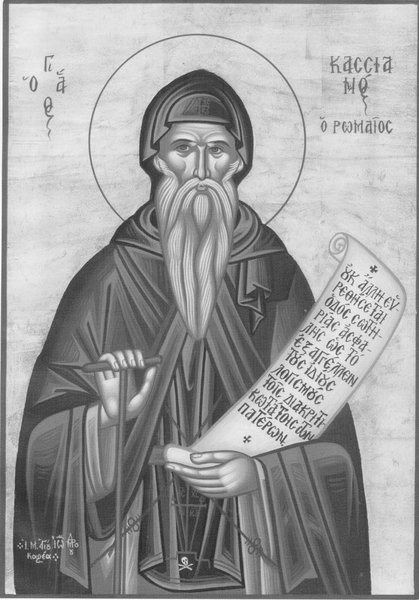
He died at Marseilles around 435, an old man who had begun as a boy in a monastery on the Danube frontier and had spent his working life carrying one thing a very long way. There is no reliable likeness of him; the devotional images that survive are icons made long after, so this page carries his initials instead of a face. What he would have wanted carried is not his face anyway. It is the verse: O God, make speed to save me.
No books or sermons in the library yet for this writer.