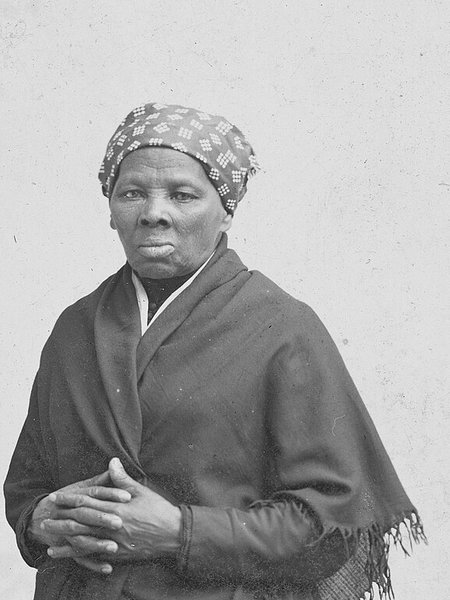
Biography
Harriet Tubman was born Araminta Ross, called “Minty,” in Dorchester County on the Eastern Shore of Maryland, around 1822. Her parents, Ben Ross and Harriet “Rit” Green, were enslaved, and so were their children; no one wrote down the day she was born. Her first biographer, Sarah Bradford, who knew her well, wrote that she was brought up by parents “possessed of strong faith in God,” and that she seemed never to have known a time when she did not trust Him. Before she could read a word — and she never learned to — she knew that God heard the prayers of slaves.
Childhood was hard and short. She was hired out from a very young age to other households, and she carried the scars of it all her life. Bradford tells of a mistress who made the little girl sit up all night rocking a sick baby, with a whip under the pillow for the moment her head nodded. Later she was sent into the fields, where she grew so strong that grown men wondered at her. Then, as a young girl, she was struck on the head by a heavy iron weight thrown in a fit of rage — by the account most historians follow, an overseer’s throw at another slave who had run from a village store. It broke her skull. For the rest of her life she suffered sudden spells in which she fell into a deep sleep that no one could rouse her from, and with them came dreams and visions that she understood as coming from God.
Praying for her master
The injury left her so weak that her owner, Edward Brodess, tried to sell her and could find no buyer. All that winter, as men came to look her over and name their price, she lay sick and prayed for the man who owned her. It was, she told Bradford, a kind of praying without ceasing: at the horse-trough, washing her face, she asked the Lord to wash her clean; taking up the broom, she asked Him to sweep every sin out of her heart.
It is to her credit that she told this story against herself. In March 1849 Brodess died, and she never forgot it. “Oh, den it ’peared like I would give de world full of silver and gold, if I had it, to bring dat pore soul back,” she said. “I would give myself.” She had wanted him converted, not dead, and the memory grieved her for the rest of her life.
Around 1844 she had married John Tubman, a free Black man, and taken the first name of her mother, Harriet. But her husband scoffed at her fears, and with Brodess dead the danger of being sold away was real. Two of her sisters had already been carried off south. In her dreams she kept seeing a line, with green fields and open arms on the other side of it, and she could never quite reach it.
Across the line
In the autumn of 1849 she fled. A first attempt with two of her brothers ended when they lost their nerve and turned back, taking her with them. Soon afterward she went alone, guided by the North Star and passed along by people she learned to trust, and walked the long way into Pennsylvania. She remembered the moment of crossing for the rest of her life: “When I found I had crossed dat line, I looked at my hands to see if I was de same pusson. There was such a glory ober ebery ting.”
The joy did not last. She was free, but everyone she loved was still in Maryland, and there was no one to welcome her. “I was free, and they should be free,” she told Bradford. “I would make a home in the North and bring them there, God helping me.” Then she prayed: “I said to de Lord, ‘I’m gwine to hole stiddy on to you, an’ I know you’ll see me through.’”
Moses
She found work in Philadelphia and at Cape May, cooking and scrubbing, and spent her wages on going back. In December 1850 she helped her niece Kessiah and Kessiah’s two children escape from Baltimore — the first of her rescues. Over roughly the next ten years she made about thirteen trips into Maryland and brought out some seventy people, most of them family and friends, and gave directions to dozens of others who found their own way. Older books said she rescued three hundred people on nineteen trips; careful historians have since shown the real number was smaller, and no less astonishing. Thomas Garrett, the Quaker merchant of Wilmington who helped her on many journeys, guessed from what he knew of her work that she had brought away “from 60 to 80 persons,” and that no one under her care had ever been caught.
She travelled by night and usually began on a Saturday, so that a Sunday would pass before advertisements could be printed. She hid her parties in woods, swamps and potato holes, and signalled to them with hymns: one tune meant the way was clear, another meant danger. When frightened people wanted to turn back, and so endanger everyone, she carried a revolver and made it plain that they would go on. In 1851 she went back for her husband and found that he had taken another wife; she let him go, and took others north instead. After the Fugitive Slave Act of 1850 made the free states unsafe, she led her people all the way to St. Catharines, in Ontario, and made her own home there for a time. At Christmas 1854 she brought out three of her brothers just before they were to be sold, and in 1857 she carried away her aged parents in a makeshift cart drawn by an old horse.
Asked how she dared go back with a price on her head, she always gave the same answer: “Don’t, I tell you, Missus, ’twan’t me, ’twas de Lord!”
I trust to you. I don’t know where to go or what to do, but I expect you to lead me.
— Harriet Tubman
That was her prayer, she said, “an’ he always did.” Garrett, who did not believe easily, wrote in 1868 that he had “never met with any person, of any color, who had more confidence in the voice of God, as spoken direct to her soul.” She told him that she talked with God and He talked with her every day of her life, and that she went only where God sent her. Garrett recalled a cold March night when she was leading two men some thirty miles below Wilmington. She said God told her to stop, then to leave the road and turn left; she came to a stream with no boat or bridge, and was told to go through. She waded in up to her armpits, and the men followed. The next day, they learned, a reward had been posted for those very men at the railway station on the road she had left.
Garrett told another story he could not explain. Tubman walked into his store one day and said, “God tells me you have money for me.” He had in fact just received money sent for her by friends in Scotland — and she asked for almost exactly the sum he held. The Quaker would not say whether it was clairvoyance or “the divine impression on her mind from the source of all power,” but he was sure she had a guide within herself.
Scout, spy and nurse
In 1858 she met John Brown, who called her “General Tubman” and trusted her with his plans; she grieved deeply when he was hanged at Charles Town in 1859. When the Civil War came, friends in Massachusetts sent her south to the Union lines on the coast of South Carolina in 1862. There she nursed sick and wounded soldiers and freed people, washing wounds through long days in the heat, then baking pies and gingerbread at night and selling them to support herself, for she drew almost no pay. She knew roots that eased dysentery and went without fear among those sick with smallpox and fever. The Lord, she said, would take care of her until her time came.
She also scouted and spied. On 2 June 1863 she guided Colonel James Montgomery’s Black troops up the Combahee River in a raid that destroyed plantations and supplies and carried some seven hundred enslaved people to freedom. She remembered them streaming down to the gunboats, mothers with children on their backs and pots of rice still smoking on their heads. When the crowds clung to the rowboats and would not let go, Montgomery called out, “Moses, you’ll have to give ’em a song,” and she sang them aboard.
On the way home at the war’s end, with her pass as a government nurse, she was thrown out of a railway car by a conductor and three other men and badly injured. William Seward, who had sold her a small property in Auburn, New York, wrote of her that “a nobler, higher spirit, or truer, seldom dwells in the human form.” Frederick Douglass, writing to her in 1868, put it more simply: “The midnight sky and the silent stars have been the witnesses of your devotion to freedom and of your heroism.”
Auburn
Auburn was home for the rest of her life. She cared for her aged parents there until they died, took in the poor, the sick and the old, and was rarely without hungry people at her table. In 1869 she married Nelson Davis, a Union veteran, and later adopted a little girl named Gertie. Sarah Bradford wrote Scenes in the Life of Harriet Tubman that same year, and the proceeds helped save the mortgaged house; a second book, Harriet, the Moses of Her People, followed in 1886. For decades she pressed the government for the wages and pension she had earned, and only in 1899 did Congress grant her a pension, partly for her service as a nurse.
She belonged to the African Methodist Episcopal Zion church in Auburn and spoke for her people and for the rights of women. At a suffrage convention in 1896 she summed up her years on the Underground Railroad in a sentence that has been repeated ever since.
I never ran my train off the track and I never lost a passenger.
— Harriet Tubman
Her last great work was a home for the aged and poor. She bought land beside her own in 1896 and later deeded it to the AME Zion church so that the church would run it. She had told Bradford that this was “her last work,” and that she only prayed the Lord to let her live until it was well started. The Harriet Tubman Home for the Aged opened in 1908.
A place prepared
In her final years she became a resident of the home she had founded. She died there of pneumonia on 10 March 1913, at about ninety years old, with friends and ministers of her church around her. Those at her bedside reported that among her last words were the words of Jesus: “I go to prepare a place for you.” She was buried in Fort Hill Cemetery in Auburn with military honors.
She had told her worried friends long before, when they begged her not to go south again, that she was not afraid to die. The apostle John had seen twelve gates in the heavenly city, she reminded them, and three of them were on the south side; if they killed her down there, she reckoned she would get into one of those. She had asked the Lord to lead her, and He had. Bradford wrote in her first book of her hope that one day a gentle voice would say to Harriet, as to the guest in Christ’s parable, “Friend, come up higher.”
No books or sermons in the library yet for this writer.
Questions and Answers
Who was Harriet Tubman?
Harriet Tubman (c. 1822–1913) was an American Christian woman who escaped slavery in Maryland in 1849 and then went back again and again to lead others to freedom on the Underground Railroad. She later served the Union Army as a nurse, scout and spy, and spent her last decades in Auburn, New York, caring for the poor and the aged. Those who knew her said her courage rested on a constant, childlike trust in God.
What was her early life like?
She was born Araminta Ross, called Minty, around 1822 in Dorchester County on Maryland's Eastern Shore, to enslaved parents Ben Ross and Harriet Green. She was hired out as a small child and later worked in the fields. As a young girl she was struck on the head by a heavy weight thrown in anger, an injury that left her with sudden sleeping spells, dreams and visions for the rest of her life.
How did she pray for her master?
While she lay sick and her owner, Edward Brodess, tried to sell her, she prayed through the nights that the Lord would convert him and change his heart. When she heard she was to be sold south, she changed her prayer and asked God to take him out of the way if his heart would not change. When he died in March 1849, she grieved and said she would have given anything to bring him back.
How did she escape from slavery?
In the autumn of 1849, fearing she would be sold away, she fled north. A first attempt with two brothers ended when they turned back, so she went alone, following the North Star and helped along by people she learned to trust. She said that on crossing into freedom she looked at her hands to see if she was the same person.
How many people did she lead to freedom?
Historians today estimate that over about ten years she made around thirteen trips into Maryland and brought out some seventy people, mostly family and friends, while giving directions to dozens more. Older books gave a figure of three hundred, which careful research has not supported. Her friend Thomas Garrett estimated sixty to eighty, and said no one under her care was ever caught.
What part did faith play in her rescues?
She said that she talked with God and He talked with her every day, and that she went only where God sent her. When people asked how she dared to go back, she answered that it was not her but the Lord, and that she had always told Him she trusted Him to lead her. She prayed through dangers, as when a suspicious boat clerk suddenly let her and a young fugitive buy their tickets.
What did she do in the Civil War?
From 1862 she worked with Union forces on the South Carolina coast as a nurse to soldiers and freed people, and as a scout and spy. On 2 June 1863 she guided Colonel James Montgomery's troops up the Combahee River in a raid that freed some seven hundred enslaved people. She received almost no pay for her service.
What was her life in Auburn like?
She settled on a small property in Auburn, New York, bought from William Seward, where she cared for her aged parents and took in the poor and sick. In 1869 she married Nelson Davis and later adopted a daughter, Gertie. Sarah Bradford's books about her, published in 1869 and 1886, helped support her, and in 1899 Congress finally granted her a pension.
What was the Harriet Tubman Home for the Aged?
It was her last great work: a home for elderly and poor Black people on land she bought beside her own in 1896. She deeded the property to the AME Zion church, to which she belonged, so the church would run it, and it opened in 1908. She had prayed that the Lord would let her live until it was well started.
How did her life end?
She became a resident of her own home for the aged and died there of pneumonia on 10 March 1913, at about ninety. Those at her bedside reported that among her last words were Jesus' words, "I go to prepare a place for you." She was buried in Fort Hill Cemetery in Auburn with military honors.