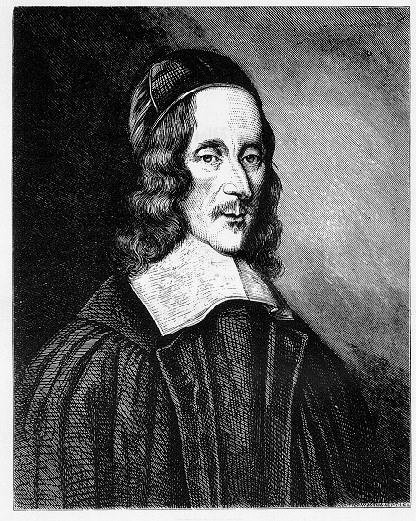
Biography
- 1593 Born
- 1609 To Cambridge
- 1620 Orator
- 1630 Ordained
- 1633 Died
A servant with this clause / Makes drudgery divine; / Who sweeps a room, as for thy laws, / Makes that and th’ action fine.
Some lives are remembered for what a man built or won. George Herbert is remembered for what he gave up. He was born into an aristocratic Welsh-border family, educated at the best schools England had, and elected to one of Cambridge’s most coveted offices — a post that pointed, as everyone around him understood, toward the royal Court and a career in the service of the King. He walked away from all of it to become the rector of two tiny country churches in Wiltshire, a post so obscure that most of his own century would have thought it a waste. He held it for less than three years before he died. And yet the book of poems he never saw printed, and the small manual he wrote for his own use, have outlived every courtier he might have become.
The fifth son of a great house
He was born on 3 April 1593 at Montgomery, in the Welsh Marches, the fifth son of a family that stood near the top of the country’s life. His elder brother Edward — later Lord Herbert of Cherbury — became a philosopher and diplomat of real note. His mother, Magdalen Herbert, was a woman of learning and a patron of poets; she was a friend and patron of John Donne, who would one day preach at her memorial. Into that cultured, well-connected household George was born the youngest of a crowd of sons, and he was marked early as the clever, delicate, bookish one.
His father died when George was three, and Magdalen raised the children herself. He went to Westminster School, and from there to Trinity College, Cambridge, admitted in 1609. He took his degrees in course — a bachelor’s in 1613, a master’s in 1616 — and was made a Fellow of Trinity in 1614. He was, by every outward sign, a young man of the university, at home in Latin and music and the manners of learned men, moving smoothly toward whatever the world might offer him.
What the world offered, in 1620, was the office of Public Orator of the University of Cambridge. It is hard now to convey what that meant. The Orator was the university’s public voice — the man who wrote and delivered its formal addresses, who spoke for Cambridge to the great and, above all, to the Court. It was understood to be a stepping-stone. The two men who had held it before Herbert had both gone on to become Secretaries of State. He sat briefly in Parliament for Montgomery in 1624. Everything was arranged. A brilliant young aristocrat, holding the university’s most public office, with the ear of the Court and the favour of the King almost within reach.
The blocked road, and the turn
Then the road closed. Herbert’s worldly hopes had rested on royal favour, and within a short span the men who might have carried him upward were gone: two of his patrons, the Duke of Richmond and the Marquis of Hamilton, died, and then in 1625 King James I himself died. The “Court-hopes,” as they were called, quietly collapsed. At the same time Herbert’s health, never strong, was failing — the consumption that would eventually kill him was already at work in him.
It would be too simple, and untrue, to say he became a priest because his ambitions were disappointed. The honest picture is a convergence. A genuine and deepening piety, a set of blocked prospects, and a body that was plainly not made for the long climb of public life all pressed him the same way at once. He turned from the Court to the Church. He was ordained deacon around 1626 and made a canon of Lincoln Cathedral that same year. And on 19 September 1630 he was ordained priest — the pivot of every account of his life, the well-connected aristocrat and Public Orator becoming, deliberately, an obscure country parson.
Contemporaries were baffled. For a man of his birth and gifts, the parish of a rural church was not a step down so much as a disappearance. He seems to have known exactly what he was choosing, and to have chosen it as the more excellent thing.
Bemerton
In 1630 he was instituted rector of Fugglestone St Peter with Bemerton, a small country parish just outside Salisbury. He had married Jane Danvers the year before. And there, in under three years, he became the enduring English picture of what a devoted country priest could be.
He did not treat the smallness of the place as beneath him. He paid, out of his own means, for the restoration of the decayed Bemerton church. He catechised the children and the unlearned. He visited the poor of his parish and supported them materially, out of his own pocket. Whatever he had given up in worldly scale, he poured into this handful of souls with a thoroughness that made the parish, and not the university, the true theatre of his life.
He was also a real musician — an accomplished lutenist and player of the viol, and a composer. By the account of his early biographer Izaak Walton, written some thirty-seven years after Herbert’s death, he walked the mile or so into Salisbury about twice a week for the Cathedral’s Evensong, and stayed afterward to make music with friends. Walton tells us he called that his “Heaven upon earth.” Walton also tells a much-loved story of Herbert ringing the church bell and praying the daily offices at set hours so that the labourers in the surrounding fields, hearing it, might pause and pray along with him. These warm scenes come to us through Walton, a devout admirer writing long after the fact, and are best received as his testimony rather than as documented record — but they are testimony that has shaped how the English church has remembered its country parson ever since.
The book he never saw
Out of those few years came two works, both published only after he was dead. The first was A Priest to the Temple, or The Country Parson, a plain prose manual of pastoral ministry, written at Bemerton around 1632 for his own guidance and printed in 1652. The second, and the reason the world still says his name, was The Temple: Sacred Poems and Private Ejaculations — a collection of more than a hundred and sixty English devotional poems, printed in 1633, the year he died.
The poems are the record of a soul’s dealings with God: struggle, rebellion, comfort, surrender, all in a plain and exact English that has never gone out of fashion. In “The Elixir” he set down the whole doctrine of hallowing ordinary work that his own life at Bemerton had become:
A servant with this clause / Makes drudgery divine; / Who sweeps a room, as for thy laws, / Makes that and th’ action fine.
— George Herbert, “The Elixir”
In “The Collar” he wrote the great poem of resistance dissolving into obedience — a man raging against the restraints of his calling until a single word undoes him:
Methought I heard one calling, Child! / And I replied, My Lord.
— George Herbert, “The Collar”
And in “Love (III)”, the last poem in the book, the soul that draws back “guilty of dust and sin” is welcomed anyway, and sat down, and fed. It is one of the tenderest treatments of grace in the language. Herbert’s whole theology of prayer he compressed into a single sonnet, “Prayer (I)”, which piles image upon image and then, refusing every definition, closes on two quiet words.
The message to Little Gidding
The consumption that had shadowed him for years took him quickly at the last. He died at Bemerton on 1 March 1633, not yet forty years old. His ministry there had lasted less than three years.
The most cherished account of his dying comes, again, from Walton, and should be received as his. Walton tells that as Herbert lay near death he sent the manuscript of his poems — the collection we now call The Temple — to his friend Nicholas Ferrar, the founder of the devout community at Little Gidding. His instruction, by Walton’s report, was that Ferrar should read it and judge; if it might “turn to the advantage of any dejected poor soul,” let him publish it, and if not, let him burn it. He would not press it on the world as a thing of value in itself.
Publish it if it may turn to the advantage of any dejected poor soul, else burn it; for I and it are less than the least of God’s mercies.
— George Herbert’s dying message to Nicholas Ferrar, as reported by Izaak Walton
Ferrar did not burn it. He had The Temple printed that same year, 1633. What its author called less than the least of God’s mercies has fed dejected souls for four centuries.
What he leaves
Herbert left no dynasty and won no office worth recording. He held the most promising post at Cambridge and let it go; he took a country parish that his peers thought a burial; he served it for a handful of years and died young. By the measure he was raised to, it was a small life thrown away.
By another measure it is one of the most complete lives the English church has produced. He had discovered — and, more rarely, had lived — that the sweeping of a room could be made divine, that the ordinary offices of a country priest were not a step down from greatness but the substance of it, and that a man might do the humblest work “as for thy laws” and so make it fine. He did not tell his poems they were good; he thought them, and himself, less than the least of God’s mercies, and asked that they be burned if they helped no one. That they were not burned, and that they have never since stopped helping, is the quiet answer his life was given.
Also appears in
Questions and Answers
Who was George Herbert?
George Herbert (1593–1633) was a Welsh-born English poet and Anglican priest who left an aristocrat's path to court to become a humble country parson at Bemerton. His devotional poems, published after his death as "The Temple," and his pastoral manual "The Country Parson" made him the enduring English picture of the devout parish priest. He is remembered less for what he built or won than for what he gave up.
What was his background?
He was born on 3 April 1593 at Montgomery, in the Welsh Marches, the fifth son of a family near the top of the country's life; his elder brother Edward became a noted philosopher, and his mother Magdalen was a woman of learning and a patron and friend of the poet John Donne. His father died when George was three, and Magdalen raised the children. He went to Westminster School and then Trinity College, Cambridge, becoming a Fellow in 1614 — a young man at home in Latin, music, and the manners of learned men.
What was the office of Public Orator?
In 1620 Herbert was elected Public Orator of the University of Cambridge — the university's public voice, who wrote and delivered its formal addresses and spoke for Cambridge to the great and, above all, to the Court. It was understood to be a stepping-stone: the two men who had held it before him both went on to become Secretaries of State. With the ear of the Court and the favour of the King almost within reach, everything seemed arranged for a brilliant public career.
Why did he turn from the Court to the Church?
The road closed. His worldly hopes rested on royal favour, and within a short span two of his patrons died and then, in 1625, King James I himself; the "Court-hopes" quietly collapsed. At the same time his health was failing — the consumption that would kill him was already at work. It was a convergence, not a simple disappointment: a deepening piety, a set of blocked prospects, and a body not made for the long climb of public life all pressed him the same way, and he was ordained priest on 19 September 1630.
What was his ministry at Bemerton?
In 1630 he was instituted rector of a small country parish just outside Salisbury, and there, in under three years, he became the enduring picture of a devoted country priest. He did not treat the smallness of the place as beneath him: he paid out of his own means for the restoration of the decayed church, catechised the children and the unlearned, and visited and materially supported the poor of his parish, pouring into a handful of souls the thoroughness he had once been destined to spend on the Court.
What was his life of music and prayer?
He was an accomplished lutenist and player of the viol, and a composer. By Izaak Walton's account, written some thirty-seven years after his death, he walked the mile into Salisbury about twice a week for the Cathedral's Evensong and stayed to make music with friends, calling it his "Heaven upon earth." Walton also tells of Herbert ringing the church bell and praying the daily offices at set hours so the labourers in the fields, hearing it, might pause and pray along with him.
What is The Temple?
It is the collection of more than a hundred and sixty English devotional poems, printed in 1633, the year he died — the reason the world still says his name. The poems are the record of a soul's dealings with God: struggle, rebellion, comfort, surrender, all in a plain and exact English that has never gone out of fashion. Alongside it he wrote "A Priest to the Temple, or The Country Parson," a plain prose manual of pastoral ministry, printed in 1652; both works were published only after his death.
What do his poems teach?
In "The Elixir" he set down the doctrine of hallowing ordinary work that his own life at Bemerton had become: "Who sweeps a room, as for thy laws, / Makes that and th' action fine." In "The Collar" he wrote the great poem of resistance dissolving into obedience — a man raging against his calling until one word undoes him: "Methought I heard one calling, Child! / And I replied, My Lord." And "Love (III)" is one of the tenderest treatments of grace in the language, the soul "guilty of dust and sin" welcomed anyway, and fed.
What did he write about prayer?
He compressed his whole theology of prayer into a single sonnet, "Prayer (I)," which piles image upon image — "Prayer the church's banquet, angel's age, / God's breath in man returning to his birth" — and then, refusing every definition, abandons them all at the end for two quiet words: "something understood." It is prayer described not as a technique but as a communion the mind cannot finally pin down.
How did he die, and what became of his poems?
The consumption took him quickly; he died at Bemerton on 1 March 1633, not yet forty, after less than three years there. By Walton's cherished account, as he lay dying he sent the manuscript of his poems to his friend Nicholas Ferrar of Little Gidding, telling him to publish it if it might "turn to the advantage of any dejected poor soul, else burn it; for I and it are less than the least of God's mercies." Ferrar did not burn it — he had it printed that same year, and it has fed dejected souls for four centuries.