Where to start reading
Start with
Introduction to the Devout Life
Books by Francis de Sales (2)

Biography
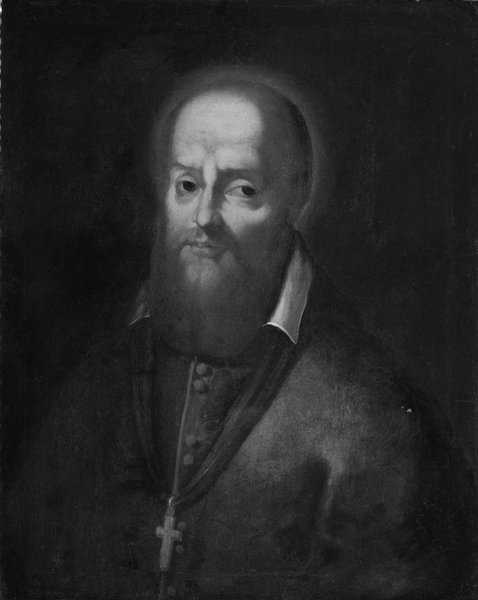
Francis de Sales was Bishop of Geneva for twenty years and was never able to live in Geneva. The city was in Calvinist hands, its cathedral closed to him, and he governed his diocese from the little town of Annecy, some twenty miles to the south. It is a fitting picture of the man. He spent his life on the far side of a divide he did not make, among people who often distrusted him, and he answered that distrust not with force or with sharpness but with a patience so steady that it became proverbial. The book he is best loved for grew out of that same patience. It was written for people who could not leave the world — wives, courtiers, soldiers, tradesmen — and it told them, kindly and firmly, that holiness was meant for them too.
A son of Savoy
He was born two months early on 21 August 1567, at the Château de Sales in the Duchy of Savoy, the mountainous country between France and Italy. His family was among the noblest in the land. His father, known as M. de Boisy, had plans for him from the start: Francis was the first of six sons, and he was to be a magistrate, a man of law and public standing. In 1578, after schooling at La Roche-sur-Foron and Annecy, he was sent to Paris to study rhetoric and the humanities at the Jesuit Collège de Clermont. To please his father he also took lessons in riding, dancing and fencing, the accomplishments of a gentleman. He is described as tall and well built, with blue-grey eyes, intelligent, reserved and quiet.
The dark winter in Paris
Then, in 1586, something broke. Francis attended a theological discussion on predestination — the question of whether God has, from all eternity, chosen some souls for salvation and passed over others — and came away convinced that he himself was among the lost. For weeks he lived inside that conviction. The despair was so heavy that it made him physically ill, and for a time he could not leave his bed. The man later famous for calm and sweetness first knew, as a young student, what it is to believe oneself shut out from the love of God.
The turn came at the end of that year or the beginning of the next, in the old Paris church of Saint-Étienne-des-Grès.
His later teaching, sometimes called the Way of Divine Love, is in a sense the long working-out of what he learned on his knees that winter.
The heir who chose the altar
Francis finished at Clermont and went on to the University of Padua, in Italy, where he studied law and theology together, taking a Jesuit priest, Antonio Possevino, as his spiritual director. In 1592 he received his doctorate, and with it he settled what had been forming in him for years: he would be a priest. After a pilgrimage to Loreto he went home to Savoy.
Home was not easy. His father had arranged a seat for him as a senator and had chosen a wealthy noble heiress to be his bride. Francis refused the marriage, and his father at first refused to accept a priesthood in place of the career he had planned. What eased the deadlock was a cousin, Canon Louis de Sales, who persuaded the Bishop of Geneva to secure for Francis the post of provost of the cathedral chapter — the highest office in the diocese. M. de Boisy yielded. Francis signed over his title and his rights as heir to a younger brother, and in December 1593 he was ordained.
He preached in Annecy’s cathedral and its parish churches, and people came to hear him. His voice was deep and rich, his speech slow and measured, and his sermons were short and plain, without the displays of learning his age admired. He avoided controversy and took one thing at a time: a duty, a virtue, a vice to be corrected. Though only twenty-seven, he was soon made the diocese’s chief confessor, and found himself spending long hours hearing confessions.
A mission in the Chablais
In 1594 the Duke of Savoy asked for a missionary to go to the Chablais, the country along the southern shore of Lake Geneva that had long been held by the Swiss and had become almost wholly Calvinist. The work would be hard and could be dangerous. Francis volunteered, over his family’s objections, and set out with only his cousin Louis for company. At first they had to return each night to the fortress of Allinges; later Francis moved into the town of Thonon and lodged with a widow.
The welcome was cold and sometimes worse. Ministers from Geneva called him a sorcerer. His landlady once hid him from armed men, and more than once he escaped men who meant to kill him. When his mother managed to send him linen and money, he gave them to the poor. He began writing short pamphlets setting out the Catholic faith, which were later gathered into the book known as The Catholic Controversy — the reason the Church would one day name him patron of writers and journalists. Much of his teaching was done quietly, person to person. Slowly, and only slowly, the mission began to bear fruit.
This was a contest between Christians, in a bitter age, and Francis held his Church’s convictions without apology. What set him apart was the manner of it, summed up in his motto: “He who preaches with love, preaches effectively.”
In 1599 he was named coadjutor to the Bishop of Geneva, and in 1602 he was sent to Paris to negotiate with King Henry IV over the restoring of Catholic worship in the district of Gex. He preached the Lenten sermons at the royal chapel, before a notoriously worldly court, and the king grew fond of him and is said to have called him “a rare bird” — devout, learned and a gentleman all at once.
That same year Bishop Granier died, and on 8 December 1602 Francis was consecrated Bishop of Geneva. Shut out of his cathedral city, he made Annecy his home, and the diocese he built there became known across Europe for its good order, its zealous clergy and its well-taught people. He is remembered too for a small, telling kindness: wanting to teach a deaf man about God, he worked out signs to do it, and so is honoured as patron of the deaf. His goodness, patience and mildness, the record says simply, became proverbial.
Friendship, letters and a book for the world
Preaching the Lenten sermons at Dijon in 1604, he met a widow, Jane Frances de Chantal, who placed herself under his direction. Their friendship, carried on largely through letters, became one of the great spiritual friendships of the Church, and on 6 June 1610 the two of them founded at Annecy the Order of the Visitation of Holy Mary, a community of women. Archbishop Denis-Simon de Marquemont required its sisters to keep a strict cloister.
Out of the same habit of patient direction came his most famous book. A woman bound to him by various ties — usually identified as Madame de Charmoisy, the wife of a cousin — asked his private help to live more devoutly, and he let her keep written notes of his counsels. She showed them to a learned religious, who pressed Francis to publish them, and he gathered and enlarged the papers, “with scarce a moment’s leisure,” as he admits in his preface. The Introduction to the Devout Life appeared in 1609. Unusually for its time, it was written for lay people, and above all for women, and it put love before penance as the way to grow in holiness. He said plainly whom he meant it for:
It is an error, nay more, a very heresy, to seek to banish the devout life from the soldier’s guardroom, the mechanic’s workshop, the prince’s court, or the domestic hearth.
— Francis de Sales, Introduction to the Devout Life, Part I
Nor did he write as one who had arrived. In the same preface, the bishop of an important diocese told his reader frankly that he was still learning what he taught:
It is too true that I who write about the devout life am not myself devout, but most certainly I am not without the wish to become so, and it is this wish which encourages me to teach you.
— Francis de Sales, Preface to the Introduction to the Devout Life
The gardener’s hut at Lyon
He went on writing — a longer, more mystical Treatise on the Love of God, and a great many letters of spiritual direction — while carrying the ordinary load of a bishop. In December 1622 he was required to travel with the Duke of Savoy on the duke’s Christmas journey through his lands. At Lyon he chose to stay in the gardener’s hut at the Visitation convent there. While he was there he suffered a stroke, and he died on 28 December 1622, at the age of fifty-five.
Lyon kept his heart; his body was carried home and buried in January 1623 in the Visitation church at Annecy, where Jane de Chantal was later buried too. He was beatified in 1661 and canonised in 1665, and in 1877 Pope Pius IX declared him a Doctor of the Church. Vincent de Paul, who met him in Paris, was profoundly shaped by his writings, and in the nineteenth century a whole family of religious communities, the Salesians of Don Bosco among them, took his name and spirit as their own.
A gentle guide for ordinary lives
The Introduction to the Devout Life, published here in a public-domain English translation, is addressed to “Philothea,” a name he chose because it means one who loves God, and so belongs to any reader. It leads her in five parts: from a first desire for God to a settled resolution; into prayer and the sacraments; through the practice of particular virtues such as patience, humility and gentleness; past the temptations that would turn her back; and finally to a time of rest and renewal. It is full of homely pictures — bees and honey, birds and their nests — and never asks a reader to be anyone but who they are. What makes it worth reading four centuries on is its tenderness toward human weakness. Francis knew that people grow angry with themselves for being angry, and despair over their own falls, and he would have none of it. When you fail, he says, speak to your heart as a kind parent would:
Poor heart! so soon fallen again into the snare! Well now, rise up again bravely and fall no more.
— Francis de Sales, Introduction to the Devout Life, Part III
That is the voice of a man who once lay sick with the fear that God had shut him out, and who found instead that God is love. He spent the rest of his life saying so, gently, to anyone who would listen — and he is saying it still.
Questions and Answers
Who was Francis de Sales?
Francis de Sales was a Catholic priest from the Duchy of Savoy who served as Bishop of Geneva from 1602 until his death in 1622. He is known for his gentle approach in a land divided by the Reformation and for his books on the spiritual life, above all the Introduction to the Devout Life.
Where and when was Francis de Sales born?
He was born two months premature on 21 August 1567 at the Château de Sales in the Duchy of Savoy, into one of its noblest families. He was the first of six sons, and his father intended him for a career as a magistrate.
What was his crisis of despair as a student?
While studying in Paris in 1586, he attended a discussion on predestination and became convinced that he was damned, a despair so heavy that it made him ill. Around the turn of 1587 he prayed the Memorare before the statue of Our Lady of Good Deliverance in the church of Saint-Étienne-des-Grès, gave himself to God, and came away trusting that God is love.
How did he become a priest?
After earning a doctorate in law and theology at Padua in 1592, he refused the marriage and the senator’s seat his father had arranged. His cousin helped secure him the post of provost of the Geneva cathedral chapter, his father gave way, and he was ordained in December 1593.
What happened on his mission to the Chablais?
In 1594 he volunteered to preach in the Chablais, a largely Calvinist region on Lake Geneva, with only his cousin Louis beside him. He was called a sorcerer, was hidden once from armed men, and escaped would-be assassins, and he wrote pamphlets later gathered as The Catholic Controversy. Slowly the mission began to show fruit.
Why did the Bishop of Geneva live in Annecy?
Geneva was controlled by the Calvinist Republic of Geneva and was closed to him, so after his consecration on 8 December 1602 he governed the diocese from Annecy. His diocese became known across Europe for its good organisation, zealous clergy and well-instructed laity.
What was his friendship with Jane Frances de Chantal?
He met Jane Frances de Chantal, a widow, when he preached the Lenten sermons at Dijon in 1604, and became her spiritual director, largely by letter. Together they founded the Order of the Visitation of Holy Mary at Annecy on 6 June 1610.
What is the Introduction to the Devout Life about?
Published in 1609, it grew out of counsels he gave to a woman seeking to live more devoutly, and it is addressed to Philothea, a name meaning one who loves God. Unusually for its time it was written for lay people, and it teaches in five parts how anyone, in any calling, can grow in prayer, virtue and gentleness toward others and oneself.
How did Francis de Sales die?
In December 1622 he travelled with the Duke of Savoy on the duke’s Christmas journey and, at Lyon, stayed in the gardener’s hut at the Visitation convent. There he suffered a stroke and died on 28 December 1622, aged fifty-five; his body was buried at Annecy and his heart kept in Lyon.
Why is Francis de Sales a Doctor of the Church and patron of writers?
He was canonised in 1665 and declared a Doctor of the Church by Pope Pius IX in 1877 for the lasting value of his teaching. In 1923 Pope Pius XI named him patron of writers and journalists because of his use of broadsheets and books, and he is also honoured as patron of the deaf for devising signs to teach a deaf man about God.