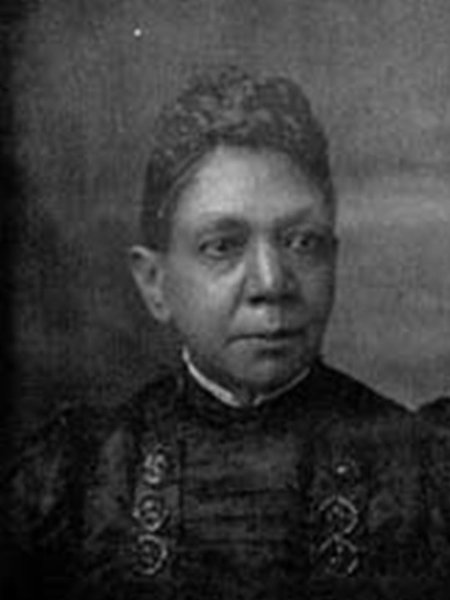
Biography
Fanny Jackson Coppin was born in 1837 in Washington, D.C., born a slave. Her earliest memory was of a one-room cabin where she had been sent to keep her grandmother company, and of a ladder up to the loft where they slept. “Mammy,” as the children called her, made a long prayer every night before bed. The little girl remembered only one word of it — “offspring” — because she wondered what it meant. Her grandmother was asking God to bless her children and her children’s children. The girl in the loft would spend her life helping to answer it for thousands of other people’s children.
Her grandfather had saved money and bought himself, then four of his children. He would not buy Fanny’s mother. So it was an aunt, Sarah Orr Clark, working for six dollars a month, who saved one hundred and twenty-five dollars and bought the child’s freedom, when Fanny was about twelve. Long afterward Fanny inscribed her book to that aunt, “my beloved aunt Sarah Orr Clark, who, working at six dollars a month, saved one hundred and twenty-five dollars, and bought my freedom.”
Deep in her soul
Freed, she was sent north to relatives in New Bedford and then Newport, Rhode Island, where at fourteen she found a place as a servant in the household of George Henry Calvert, a writer, and his wife Elizabeth. Mrs. Calvert grew fond of her, taught her to sew and darn, and took her along to bathe in the sea, after which the shaking agues of her sickly childhood went away. Fanny was given one hour every other afternoon for private lessons, and without telling anyone she took music lessons on a piano at her aunt’s house until she could play the little organ in the Union Church. When Mrs. Calvert found out, she did not scold her: “Well, Fanny, when people will go ahead, they cannot be kept back.”
She was happy there, and when the time came to leave, Mrs. Calvert asked whether money would keep her. It would not.
It was in me to get an education and to teach my people. This idea was deep in my soul.
— Fanny Jackson Coppin
She passed the examination for the Rhode Island State Normal School at Bristol, where her eyes were “first opened on the subject of teaching.” Then, with her aunt still helping and a scholarship of nine dollars a year from Bishop Daniel A. Payne of the African Methodist Episcopal Church — a debt she said she would never forget — she went in 1860 to Oberlin College in Ohio.
Oberlin: “Are you a Christian?”
Oberlin was one of the few colleges in the country that admitted Black students and women, and it was steeped in the revival preaching of its president, Charles G. Finney. Fanny remembered that when Finney met a new student, his first words were, “Are you a Christian? and if not, why not?” — and that he would follow the question up with a persistence that could not be resisted until it was settled. She lived for years in the homes of two Oberlin professors, and credited those “two Christian homes,” where she was treated as one of the family, with forming the character that would carry her through what came after.
She took the “gentleman’s course” — Latin, Greek, and as much mathematics as one could shoulder — which the faculty did not forbid to women but did not advise. She felt the weight of every recitation: “I never rose to recite in my classes at Oberlin but I felt that I had the honor of the whole African race upon my shoulders.” In 1863 the faculty gave her a preparatory class to teach, warning her that if the white pupils rebelled they would not force the matter. No one rebelled. The class grew so large it had to be divided. And in her last year, as freed people began to arrive in Ohio from the South, she opened an evening class to teach them to read and write. It moved her deeply to see old men “painfully following the simple words of spelling; so intensely eager to learn.” She graduated in August 1865.
The Institute for Colored Youth
A Quaker school in Philadelphia, the Institute for Colored Youth, had written to Oberlin asking for a Black woman who could teach Greek, Latin, and higher mathematics. The answer came back: “We have the woman, but you must wait a year for her.” She arrived in 1865 to head the girls’ department, and in 1869, when the principal, Ebenezer Bassett, was appointed United States Minister to Haiti, she was made principal of the whole school — among the first Black women anywhere in the country to lead such an institution. She would hold the post for more than thirty years.
Philadelphia met her with the old humiliations: on her arrival a streetcar conductor made her stand in a rainstorm until a car marked for colored people came by. On a later visit to Oberlin, Finney asked her how she was growing in grace. She told him she was growing “as fast as the American people would let me.” It was a joke with a wound in it.
In Philadelphia she worshipped first as an Episcopalian, at the Church of the Crucifixion, a mission of St. Thomas, where she sang alto in the choir. Her teaching was frankly Christian. She wanted children to learn the Ten Commandments in verse, and said that Scripture a child could understand — “Jesus loves me this I know, for the Bible tells me so” — would be the teacher’s “first ally.” She taught that love was the root of discipline: “Love wins when everything else will fail.” And she knew that a teacher could not guard a child’s heart by technique alone.
She also saw that most of her people could not live on Greek. In Philadelphia, she told the city’s school directors, the only places a Black boy could learn a trade were the House of Refuge and the penitentiary. For years she spoke in churches and halls across the city and beyond, taking up a collection everywhere — but asking no one for more than a dollar, because she wanted the poor to have a share before the rich were asked. The fund grew in quarters and dollars, the Quaker managers joined the cause, and an Industrial Department was built at the Institute teaching a dozen trades. In 1879, raising money for the struggling Christian Recorder, she wrote that self-help was “the best help that any man can have, next to God’s,” and that her people’s “faith is firmly fixed in that ‘Eternal Providence’” that would in its own time justify the ways of God to man.
Marriage, and a wider field
At that very fair for the Recorder she met the Rev. Levi Jenkins Coppin, a young A.M.E. pastor, who walked her home and kept walking her home. “Her intellect was great,” he wrote later, “but her heart was greater.” They were married on December 21, 1881, by Bishop Payne, the same man who had once given her nine dollars toward Oberlin. She joined her husband’s African Methodist Episcopal Church, and asked him what work it would expect of her. He told her that the church gave a certain portion of its missionary work to its women.
She took that seriously. She became president of the A.M.E. Woman’s Home and Foreign Missionary Society, and her husband recorded that in 1892 she brought the General Conference a new constitution organizing the church’s women into conference branches and local auxiliaries, which gave their missionary giving new life. In 1888 the Society sent her to London as its delegate to the Centenary of Missions. She dreaded the voyage, knowing no one aboard.
In London she sat entranced among the gray-headed missionaries who had carried the gospel to the far places of the earth. When a minister warned the women there not to assume ecclesiastical functions, she rose to answer that “the Lord God alone gives the limit to the functions of woman’s religious work” — though she added that she had always considered the pulpit a sacred place and had never sought to speak from it. Black women only lately out of slavery, she told the assembly, had already sent missionaries to Haiti, Trinidad, and Sierra Leone, though they had only a crust to share.
The spirit of missionaries, the spirit of mission work, is the spirit of sharing all we have.
— Fanny Jackson Coppin
Africa
In 1900 her husband was elected a bishop and assigned to South Africa. After thirty-seven years in the schoolroom, she laid down her work at the Institute and followed him, counting it a privilege to end her active life in “the home of the ancestors” of the young people she had taught. They anchored in Table Bay on Sunday morning, November 30, 1902. In Cape Town, where her husband had bought a building for a school and mission house, Bethel Institute, she gathered the Christian women of the congregation and began temperance and missionary societies among them, and then in mission stations across the Cape. At the first conference at Port Elizabeth she watched women who had never before spoken in public for Christian work stand and speak — some in Dutch, some in broken English, “and some in their own God-given native language.”
She travelled with the bishop as far as Bulawayo, more than thirteen hundred miles north. There, worn out, she fainted while speaking through an interpreter — the first time, she said, she had ever “fallen at my post” — and was carried out tenderly by African women while her husband went on with the meeting. Government informers sat in on such meetings, fearing the missionaries would stir up the people; she answered that they were missionaries, not politicians, and that if people grew discontented, the fault lay in injustice and “a general lack of the Christian spirit of brotherhood.” Yet she counselled patience, not violence.
The Kingdom of God does not proceed in its conquests by the employment of carnal weapons, and right can afford to be patient because it is bound to win in the end.
— Fanny Jackson Coppin
The long evening
They returned to America in the spring of 1904, and her strength began to give way. For about eight years she was largely confined to the house in Philadelphia — no single illness, her husband wrote, but a gradual breaking down of a constitution that had answered every call of duty. Her mind stayed clear to the end. She read the papers and, above all, the Bible. In those quiet years she wrote Reminiscences of School Life, and Hints on Teaching.
Fanny Jackson Coppin died on January 21, 1913. Her funeral was held at Bethel Church, and her friends founded a scholarship in her name for struggling students, which they thought she would have liked best of all. In South Africa, A.M.E. women later raised money to name a building at Wilberforce Institute the Fanny Jackson Coppin Hall, and in 1926 a teacher-training school in Baltimore took her name. — today’s Coppin State University. One eulogy said that for forty years she had been “the inspiration of thousands,” and that her name “was a synonym for character.” But the root of it all is in her own pages: a slave grandmother praying in the dark for her offspring, an aunt’s six dollars a month, a college president asking whether she was a Christian, and a woman who believed that whatever God had given her — mind, learning, or a crust — he had given in order that it be shared.
No books or sermons in the library yet for this writer.
Questions and Answers
Who was Fanny Jackson Coppin?
Born enslaved in Washington, D.C., in 1837, Fanny Jackson Coppin became one of the most respected Christian educators of nineteenth-century America. She led Philadelphia's Institute for Colored Youth for more than thirty years, organized the missionary work of the A.M.E. Church's women, and ended her active life as a missionary in South Africa.
How did she gain her freedom?
Her grandfather bought himself and four of his children but would not buy Fanny's mother. Her aunt, Sarah Orr Clark, working for six dollars a month, saved one hundred and twenty-five dollars and bought Fanny's freedom when she was about twelve. Fanny later inscribed her book to that aunt.
What first taught her about prayer?
Her earliest memory was of her grandmother, whom the children called Mammy, making a long prayer every night in a one-room cabin. Fanny remembered only one word of it, offspring, because she wondered what it meant: her grandmother was asking God to bless her children and her children's children.
Why did she pursue an education?
Working as a servant in Newport, Rhode Island, in the household of the writer George Henry Calvert, she studied whenever she could. She said it was in her to get an education and to teach her people, an idea deep in her soul, and no offer of comfort could turn her from it. She went on to the Rhode Island State Normal School and then, in 1860, to Oberlin College.
What did Oberlin mean for her faith?
Oberlin's president, Charles G. Finney, greeted new students with the question, "Are you a Christian? and if not, why not?" Fanny lived for years in two Christian professors' homes and credited them with forming her character. While still a student she taught a preparatory class and, in her last year, an evening class for freed people learning to read.
What did she do at the Institute for Colored Youth?
She arrived at the Quaker-founded Institute in Philadelphia in 1865 to head its girls' department and became principal of the whole school in 1869. She taught Greek, Latin and mathematics, trained teachers, and campaigned for years, a dollar at a time, to add an Industrial Department where young people could learn trades.
How did her faith shape her teaching?
She wanted children to learn the Ten Commandments in verse and called simple Scripture the teacher's first ally. She taught that love wins when everything else fails, and urged teachers to pray that the Lord of the Harvest would protect a child's mind from the sower of evil.
What was her missionary work in America?
After marrying the Rev. Levi Jenkins Coppin in 1881 she joined the African Methodist Episcopal Church and became president of its Woman's Home and Foreign Missionary Society. In 1888 she represented it at the Centenary of Missions in London, and in 1892 she brought the church a new plan for organizing its women's missionary societies.
What did she do in South Africa?
When her husband became a bishop assigned to South Africa, she retired from the Institute and arrived in Cape Town in November 1902. She organized temperance and missionary societies among African and Coloured Christian women and travelled as far as Bulawayo, speaking on righteousness, temperance and the judgment to come.
How did her life end and how is she remembered?
After returning in 1904 her strength slowly failed, and for about eight years she was largely confined at home, still reading the Bible and writing her Reminiscences of School Life. She died on 21 January 1913. A scholarship, a hall at Wilberforce Institute in South Africa, and Coppin State University in Baltimore all bear her name.