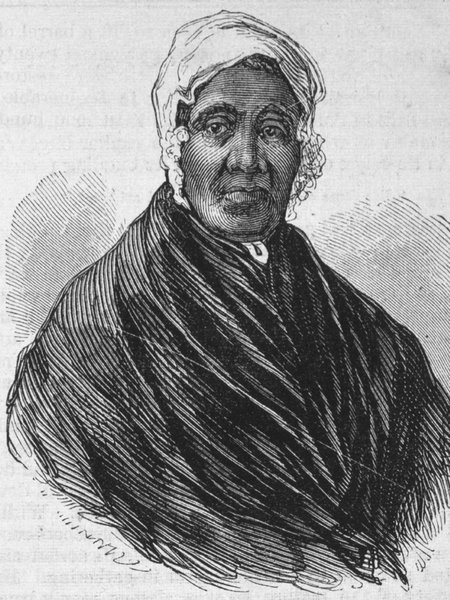
Biography
Catherine Ferguson — “Katy” to everyone who knew her — was born a slave, and she was born on the move. Her mother gave birth to her while being carried from Virginia to New York City, where the two of them belonged to a man known in the records only as “R. B.,” who lived on Water Street and was an elder in one of the city’s Presbyterian churches. Her name then was Katy Williams. The year is uncertain: the man who later wrote down her story gave her age at death once as about seventy-five and once as about eighty, so she was born around 1774 or 1779. Almost everything we know of her comes from that one man, the antislavery merchant Lewis Tappan, who sat with her on 25 March 1850 and took down the facts of her life “from Mrs. Ferguson’s own lips.” The record is thin. But what it holds is luminous.
Given to God
When Katy was still a little girl — about eight, according to Benson Lossing, who retold her story a year after her death — her master sold her mother away. They never saw each other again. Decades later, an old woman, Katy still remembered the last thing her mother did.
Before we were torn asunder, she knelt down, laid her hand on my head, and gave me to God.
— Catherine Ferguson
The grief marked her for life, and it turned into something holy. The memory of her own anguish at that parting, she told Tappan, was what made her feel such compassion for children. Her mistress told her that if she turned out as good as her mother, she would do well. At ten she went to her master with a bargain of her own: if he would give her her liberty, she would serve the Lord for ever. He refused.
She was never taught to read. “My mistress,” she said, “would not let me learn.” Yet she was quick — her mistress once admitted, “You know more now than my daughters,” and one of the sons in the house complained that if he read the Bible wrong or stumbled over his catechism, Katy caught it at once. She was allowed to attend public worship, and what she heard there she kept. Lossing says her retentive memory stored up a great treasury of Scripture, which she gave away for the rest of her life to anyone who would listen.
A trembling girl at the pastor’s door
At about fourteen she came under conviction of sin. She resolved to go and see the minister whose church she attended, Dr. Mason of the Scotch Presbyterian congregation — the elder John Mason, Lossing says. She was frightened: afraid the family would find out, afraid she would not be let in, afraid that a great man would have no time for a little slave girl.
“While I stood at the door ringing the bell,” she remembered, “I can not describe my feelings; and when the door opened, and Dr. Mason himself stood before me, I trembled from head to foot.” If he had spoken harshly or turned her away, she said, she might almost have died of grief, and perhaps lost her soul. He did neither. Before she could say a word, he asked her, “Have you come here to talk to me about your soul?” The question lifted the weight from her. She went in and opened her heart to him, and she left his house, in Lossing’s words, with a heart full of joy. A history of the congregation records that she was received into its membership as a girl of fifteen.
Freedom, marriage and loss
When she was sixteen or seventeen, a lady of the city bought Katy’s freedom for two hundred dollars, giving her six years to pay it back. Later the lady agreed to take eleven months of Katy’s work for half the sum, and the merchant Divie Bethune raised the other hundred dollars. Historians identify the lady as Isabella Graham, Bethune’s mother-in-law, a Scottish widow and schoolmistress who belonged to the same church and who spent her life founding societies for widows, orphans and the poor. The liberty Katy had asked for at ten had come at last, through the generosity of fellow believers.
At eighteen she married a man named Ferguson. She bore two children, and she lost them both. Nothing more is recorded of her husband; he too seems to have died early. In 1850 she summed it up for Tappan without self-pity: “They are dead, and I have no relations now, and most of my old friends are gone.” For almost fifty years she earned her living as a cake-maker, and she became one of the best known in New York: her wedding and party cakes were, Tappan said, unrivalled, and many who ate them also remembered her sensible conversation and her godly talk.
Forty-eight children
Bereaved of her own, Katy gathered other people’s. Over the course of her life she took in forty-eight children — twenty of them white — some from the almshouse and some from parents who could not or would not keep them. She raised them in her home, or kept them until she could find good places for them, spent her money on them, and followed them afterward with her prayers. When Tappan asked whether she had laid up any property for her old age, she answered at once.
How could I, when I gave away all I earned?
— Catherine Ferguson
While she lived at 51 Warren Street, she noticed the neighborhood children running wild in the street on the Lord’s day. She began collecting them into her house every Sunday, black and white together, and since she could not read to them herself she found suitable people to come in and hear them say their catechism. Isabella Graham would sometimes invite Katy and her scholars to her own house to recite and be taught. Then the minister of the congregation — by now Dr. John Mitchell Mason, the son, who was building a new church on Murray Street — heard of the school and walked in on it one Sunday. “What are you about here, Katy,” he said, “keeping school on the Sabbath?” She feared it was a rebuke. It was not. “We must not leave you to do all this,” he told her, and he had the church’s lecture room opened and the children moved into it, with helpers found for her. That, Tappan wrote, was the origin of the Sunday school of the Murray Street church, and it was believed that Katy’s was the first Sunday school in the city. Isaac Ferris, later chancellor of New York University, told Lossing that he had given his first expositions of Scripture as a theological student in Katy’s Sunday school.
Later writers fixed the founding in 1793, and she is often called the founder of New York’s first Sunday school. No document from her lifetime confirms either the date or the claim; Tappan himself only says it was “believed,” and ties the move to the years when the Murray Street church was built, around 1810. What is certain is that a freed slave who could not read gathered the neglected children of her street and made sure they heard the Word of God.
A house of prayer
Tappan, who had known many reformers, put the secret of her usefulness down to a “fervent, uniform, and consistent piety” — no one, he said, could be with her even briefly without feeling it. She grieved over the vice and poverty of the city and was blunt about what was ruining it: “The ruination of both white and colored people, in this city, is gambling.” She had told one gambler she would rather live on bread and water than do it.
Her heart reached past New York. In the last years of her life a young missionary bound for West Africa with the American Missionary Association came to her little meetings once or twice before he sailed, and Katy took him and all his companions into her care in the only way she could.
I have never missed a day but I have prayed for those dear missionaries.
— Catherine Ferguson
“All is well”
In the summer of 1854 cholera was in New York. On Tuesday morning, 11 July, after feeling unwell for several days, Katy went out to see a physician, came home and lay down, and grew rapidly worse. Within a few hours it was plain that it was cholera and that she was dying, at her home at 74 Thompson Street. The summons was sudden, Tappan wrote, but she was ready, her mind calm and clear. “Oh!” she said to a friend standing by, “what a good thing it is to have a hope in Jesus!” Her last words were, “All is well.”
Ten days later Tappan went to her rooms to look through a barrel of pamphlets she had left behind. While he was there a little girl from the neighborhood came in and asked for a book “to remember Aunt Katy by,” and he gave her one. Tappan’s obituary, printed in the New York Daily Tribune and the American Missionary, carried her story far beyond Warren Street; Lossing set her portrait — engraved from a daguerreotype Tappan had arranged in 1850 — among his eminent Americans, and the American Tract Society published her life as Katy Ferguson; or, What a Poor Colored Woman May Do. In 1920 a home for young Black women in Harlem was named for her. She left no writings, no property, and no children of her own. She left instead a neighborhood changed, forty-eight children brought up in her house, and the witness of a woman whose mother had given her to God — and who, once free, gave herself away.
No books or sermons in the library yet for this writer.
Questions and Answers
Who was Catherine Ferguson?
Catherine "Katy" Ferguson (c. 1774–1854) was a formerly enslaved Black Christian woman in New York City who earned her living as a cake-maker and gave her life to neglected children. She took forty-eight children into her home, gathered street children for Sunday catechism teaching that grew into the Murray Street church's Sunday school, and held a weekly prayer meeting in her house for more than forty years.
What was her early life like?
She was born a slave while her mother was being taken from Virginia to New York City, and was owned by a Presbyterian elder on Water Street. When she was about eight her mother was sold away and they never met again. Her mistress would not let her learn to read, but she memorized a great deal of Scripture.
What did her mother do before they were parted?
Katy remembered that before they were separated her mother knelt down, laid her hand on her head, and gave her to God. She said the memory of her own anguish at that parting was what gave her such compassion for children.
How did she come to faith?
At about fourteen, under conviction of sin, she went trembling to the house of her pastor, Dr. Mason of the Scotch Presbyterian Church, afraid he would turn her away. Before she could speak he asked whether she had come to talk to him about her soul, and she opened her heart to him and left full of joy. She joined the congregation at about fifteen.
How did she gain her freedom?
At sixteen or seventeen a lady of the city, identified by historians as Isabella Graham, bought her freedom for two hundred dollars. Katy repaid half of it with eleven months of work, and the merchant Divie Bethune raised the other hundred dollars.
What happened to her own family?
She married at eighteen and had two children, but both died, and nothing more is recorded of her husband. Late in life she said she had no relations left and most of her old friends were gone.
How many children did she care for?
Over her life she took in forty-eight children, twenty of them white, from the almshouse or from parents who could not keep them, and raised them or kept them until she found good homes. Asked if she had saved any property, she replied that she could not, because she gave away all she earned.
Did she found New York's first Sunday school?
While living on Warren Street she gathered neighborhood children into her home each Sunday and brought in helpers to hear their catechism. Dr. John Mitchell Mason found her at it and moved the school into the lecture room of his Murray Street church, and Lewis Tappan wrote that hers was believed to be the first Sunday school in the city. The often-quoted founding date of 1793 and the claim to be first have never been confirmed by documents from her lifetime.
What was her prayer life like?
For more than forty years she held a prayer meeting in her home every Friday evening, and in her last years another on Sunday afternoons, for poor children and adults who attended no church. City missionaries said the whole neighborhood changed wherever she lived. In her last years she prayed every day for the missionaries of the Mendi Mission in West Africa.
How did she die and how is she remembered?
She died of cholera at her home on Thompson Street on 11 July 1854, after only a few hours' illness, saying how good it was to have a hope in Jesus; her last words were "All is well." Lewis Tappan's obituary spread her story, Benson Lossing included her among eminent Americans, and in 1920 a home for young Black women in New York was named for her.