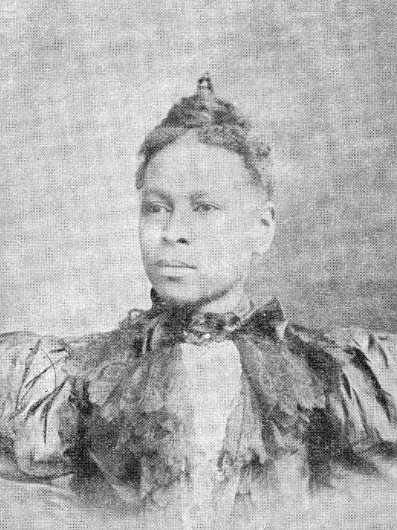
Biography
Virginia Walker was born in Nashville, Tennessee, in 1856, into a family that had paid dearly for its freedom. Her father, Nelson Walker, a native of Virginia, had been allowed by his master to hire out his own time, and with what he earned he bought his own freedom and then his wife’s. Virginia was named for the state he never stopped praising. Writing of herself fifty years later, she counted it “the godly heritage of being well born of honorable parents who had secured their freedom at great cost.” Before the Civil War she attended a private school, and she was still a child “when the new day of freedom dawned upon the race.”
When Fisk opened its doors to the freedpeople in 1867, she was among its very first pupils. Ten years of steady study later, in May 1875, she graduated from Fisk’s college department in its first graduating class. She believed she was “the first college graduate of womankind south of Mason and Dixon line,” and later historians have repeated her claim. Immediately after graduation a telegram called her to Memphis and a place in its public schools. For twelve years she taught in the Memphis public schools, rising to principal of the North Memphis school and then assistant principal of the Kortrecht grammar school, the most advanced public school for Black children in the city. She married Julius A. O. Broughton, and the couple raised a family of daughters and a son.
A meeting for women only
In January 1886 a white Baptist missionary named Joanna P. Moore came to Memphis, holding Bible readings in the churches by night. One day Moore called on her and invited Mrs. Broughton to a missionary meeting “for women only.” Such a thing, she remembered, “was an entirely new thing under the sun,” and she went chiefly out of curiosity. Out of that meeting came what they called a Bible Band, a circle of women pledged above all to “the daily study of the Bible.” The bands spread through the city; soon, she wrote, “every Monday afternoon women could be seen in all sections of the city with Bibles in their hands.” By March, Moore recorded, a city union of fifteen churches had enrolled 136 women, and “V. W. Broughton” was chosen its president.
She had no thought yet of missionary work. Then her mother died, “the deepest sorrow Virginia had ever known,” and the world seemed lonely and drear. Her own health failed. In the spring of 1887 she fell so seriously ill that her life was despaired of; she chose her burial clothes and gave everything up — “husband, children and all other earthly ties.”
She came back to the Bible class so full of joy that at her first meeting she spoke twice. When a district association asked for a Bible woman to visit its country churches, her church sent her. Her first journey went up the Mississippi. She was afraid of water, and she set out only after being assured of something she never forgot.
God is on the water as well as on the land.
— Virginia W. Broughton
That first trip took her across the river in a leaking skiff, by night in an ox wagon, and on horseback through flooded bottomland to a settlement where, she said, “a women missionary of no race had ever gone.” She came home rejoicing, all her expenses met. For several years afterward she taught school five days a week and gave the other two to the country churches as far as fifty miles away, often walking from the railroad station into her classroom on Monday morning without having slept or eaten.
Opposition in the churches
In the spring of 1888 the board of the Bible and Normal Institute in Memphis, a new Baptist school left in debt by the murder of its benefactor, sent two Bible women out through West Tennessee to organize the women and children: Broughton and her friend Emma King. Everywhere they went, she wrote, “the people were aroused, some for them and many against them.” In September 1888 the first women’s district meeting gathered at Stanton, the first of ten annual meetings. The women urged on one another simple living, temperance, the education of “heart, head and hand,” and “above all things, loyalty to Christ.”
The deeper the work took root, the fiercer the resistance became. Most of the men, she said, “really believed the work unlawful and forbidden by the Scriptures” because of Paul’s words about women keeping silence in the churches. As the Bible women spoke out against drink, snuff-dipping and church fairs, ministers rose against them. Church houses were locked, and some women were beaten for trying to hold meetings. Another man said he would rather “flail the life out of a woman than to hear her speak in the church.” Some of these opponents were won over — one minister, who had come to gather evidence against her, stood up at the end to confess that he had been “washed, rinsed, starched, hung up, dried, sprinkled and ironed, and am now ready for service.” But for a season, she admitted, the work “seemed to stand still,” the women’s association broke up, and many bands disbanded while the women waited in prayer. In one dark stretch she longed to go home and rest, until Christ’s words came to her: “I must work the work of Him that sent me while it is day.” She saw, she wrote, that she was “only required to do the work assigned her and leave the results with God.”
“You two must settle it”
The hardest opposition came from home. Her husband was not yet a Christian, and he was strongly against her frequent journeys. Relatives sided with him, saying it was “unlike God to call a woman of family so frequently from her home duties.” One day he asked her, “When is this business going to stop?” Her answer became the hinge of her life.
I don’t know; but I belong to God first, and you next; so you two must settle it.
— Virginia W. Broughton
She left the matter in God’s hands, and, as she told it, God settled it. After a long struggle her husband yielded to Christ, made an open profession of faith, and was baptized on the same day as their two eldest daughters, Emma and Elizabeth. For the rest of her missionary life he looked after much of its business.
But the family talk had shaken her. At a meeting in Stanton she told one of the women that she did not know whether she would come again, “for it seems that I ought to be at home with my children.” Soon afterward her third daughter, little Selena, fell ill. Her mother stayed home, called a doctor, and sat by her bed, and still the child grew worse. Mrs. Broughton came to see, she wrote, that she could stay home with every help medicine could give and God might still take her children if He willed. The little girl died peacefully after praying, “Lord Jesus, help me,” and patting her mother’s cheek with the words “Poor little mama.” She was buried on a Friday; on Saturday morning her mother went out on her mission. God used her so powerfully that day that her bitterest critics said, “Let that woman alone, God is truly with her.” She never again let fear for her home keep her from her calling.
We praise God for afflictions; for in mercy they are all sent to bring us near to God.
— Virginia W. Broughton
A missionary of faith
Giving up her teaching post was its own struggle — “a substantial, sure support” traded for “work of faith, with no visible means of support.” For many years her custom was to read the Bible through, and it was on an afternoon when she had just finished one such reading that the call to leave the classroom came home to her, and she surrendered. Not long afterward the Woman’s Baptist Home Mission Society of Chicago commissioned her as its missionary for western Tennessee. For the Society she also toured the North, speaking at the Northern Baptist anniversary meetings at Saratoga, New York, where she was the only Black woman among the speakers.
She believed God still heals, and her book tells of prayers at sickbeds, among them those for her brother John, a physician, who recovered from a grave illness after the doctors and his family had given him up. She was careful to add that this “does not discard the use of means,” and that she believed “in the science and practice of medicine as one of the divinely appointed means to man’s physical healing.” In the later 1890s she also took up the Holiness teaching of sanctification — a deeper surrender to Christ and fullness of the Holy Spirit — at a time when the controversy was splitting Baptist churches in the South. She pressed for “holiness of heart and uprightness of daily deportment” but urged her Bible women to stay in their own churches, and the persecution that followed grew so heavy that for a time it seemed aimed at her very life.
Wider fields
In December 1899 the Broughtons moved back to Nashville, the city of her birth. For three years she worked at Sunshine Home, the headquarters of Joanna Moore’s Fireside School, as one of Moore’s secretaries and assistant editor of Moore’s Bible-study paper Hope, and for six months as its supervisor. Moore described her as one of the helpers who had “proven wise, kind and efficient,” and Broughton called those years her “post course in Bible study.”
For years she had pleaded at the National Baptist Convention for a women’s organization of their own. In 1900, at Richmond, Virginia, it was formed: the Woman’s Convention, Auxiliary to the National Baptist Convention, with Virginia Broughton as recording secretary and Nannie Helen Burroughs as corresponding secretary. When some sought to disband it the next year, the women held firm. At Birmingham she was made educational secretary, charged with preparing a course of Bible lessons for the convention’s paper. In 1904 she published Woman’s Work, as Gleaned from the Women of the Bible, setting out from Scripture the place God had given women in the home and the church. Her own sermon outline on the subject drew on Deborah, Esther, Ruth and Lydia and rested on Galatians 3:28: “All believers one in Christ.”
From 1905 she lectured for the John C. Martin Educational Fund, organizing women’s Bible unions across the South, and in 1906–07 she taught Bible at the Agricultural and Mechanical College at Normal, Alabama. In 1907 she published her life story, Twenty Year’s Experience of a Missionary, writing of herself as “Virginia” and hoping it would “encourage others to dedicate their lives to the Master’s service.”
Faithful to the end
She did not stop. She kept travelling and teaching for the women’s missionary work in Tennessee for almost three decades more. Her husband died in 1930. In 1929 the Tennessee women’s convention honored her with words that capture her life: because of “her intellectual advantages and religious fervor, she has not exalted herself but humbled herself and become one with those who did not have her advantages, and helped them to see the light.” She died on September 21, 1934, at seventy-eight.
She had begun as a schoolteacher curious about a meeting “for women only,” and she lived to see Black Baptist women organized across the South, studying their Bibles at their own firesides. She knew opposition from pulpits and from her own family, and the grief of a little grave. Through it all she held to the hymn she said God gave her when she rose from her sickbed in 1887, “How firm a foundation, ye saints of the Lord,” and to the conviction that settled every quarrel: she belonged to God first.
No books or sermons in the library yet for this writer.
Questions and Answers
Who was Virginia W. Broughton?
Virginia W. Broughton (1856–1934) was a Black Baptist teacher and missionary from Tennessee who led the Bible Band movement among Black women from the late 1880s. A member of Fisk University's first graduating class in 1875, she spent nearly fifty years organizing women for Bible study and mission work, and in 1907 told her story in Twenty Year's Experience of a Missionary.
What was her early life like?
She was born Virginia Walker in Nashville in 1856. Her father, a Virginian, hired out his own time and used his earnings to buy his freedom and then his wife's, and he named his daughter for his native state. She attended a private school before the Civil War and was among the first pupils when Fisk opened to the freedpeople in 1867.
What did she do after Fisk?
She graduated from Fisk's college department in May 1875 and believed she was the first woman college graduate south of the Mason–Dixon line. She went straight to Memphis, where she taught in the public schools for twelve years, becoming a principal and then assistant principal of the Kortrecht grammar school. She married Julius A. O. Broughton and raised a family.
How did the Bible Band work begin?
In January 1886 the Baptist missionary Joanna P. Moore invited her to a missionary meeting for women only, and out of it came a Bible Band devoted to daily Bible study. The bands spread across Memphis, and by March a city union of fifteen churches and 136 women had chosen Broughton as its president.
What happened in her illness of 1887?
After her mother's death her own health broke, and in the spring of 1887 she was so ill that she chose her burial clothes and gave up every earthly tie. She testified that God's presence came over her and made her understand that He was not ready for her yet and had a work for her to do. Her strength returned, and she began going out to the country churches as a Bible woman.
What opposition did she face?
Many Baptist ministers and laymen believed Scripture forbade women to speak in church, and they fought the women's work hard: churches were locked, some women were beaten, and for a time the women's association broke up. Some opponents were won over after hearing her, and she resolved simply to do the work assigned her and leave the results with God.
How did she answer her husband's objections?
Her husband was not yet a Christian and opposed her frequent journeys. When he asked when this business would stop, she answered that she belonged to God first and to him next, so the two of them must settle it. In time he professed faith in Christ, was baptized with their two eldest daughters, and helped with the business of her mission.
What did she believe about healing and holiness?
She believed God still heals in answer to prayer and recorded recoveries she had prayed for, including her brother John's. She also insisted that medicine is one of God's appointed means of healing. In the later 1890s she embraced the Holiness teaching of sanctification, which brought fierce persecution, but she urged her Bible women to stay in their own churches.
What were her later years of work?
From 1899 she worked in Nashville with Joanna Moore's Fireside School and helped edit its paper Hope. In 1900 she helped found the Woman's Convention, Auxiliary to the National Baptist Convention, serving as its recording secretary and later as educational secretary. She published Woman's Work, as Gleaned from the Women of the Bible in 1904 and lectured and taught Bible across the South.
How is she remembered?
She kept up her mission work in Tennessee until her death on September 21, 1934, at seventy-eight. In 1929 the Tennessee women's convention praised her for humbling herself to become one with those who lacked her advantages and helping them to see the light. Her autobiography remains a rare first-hand record of Black Baptist women's mission work in the South.