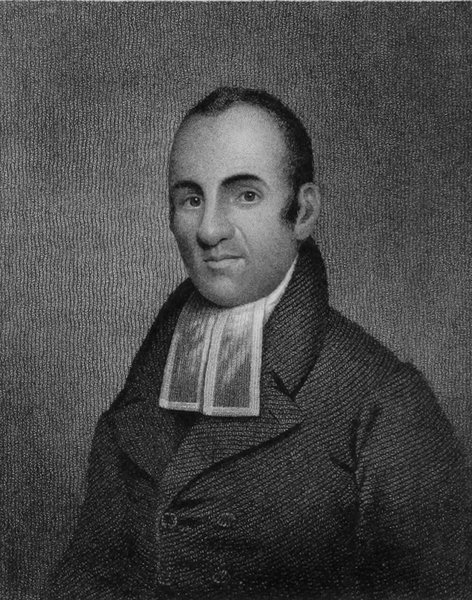
Lemuel Haynes Biography
1753–1833
I make it my rule to know something more every night than I knew in the morning.
He was born on the eighteenth of July, 1753, in West Hartford, Connecticut, and he was given away before he could remember it. His father was a Black man; his mother was a white woman of a respectable New England family. Neither of them kept him. He did not even carry their name — he bore, most likely, the name of the man in whose house he happened to be born. At five months old he was carried up into the Massachusetts hills, to Granville, and bound out as an indentured servant to a farmer named David Rose until he should turn twenty-one.
It is the sort of beginning that usually ends a story before it starts. His earliest biographer, who had known him from boyhood, wrote of him plainly: he was an orphan “not by the bereaving hand of God, but by the cold neglect of those who ought to have been his most affectionate guardians.” Tradition in Granville held that as a boy he once came upon his mother at a relative’s house in a neighbouring town, and that she slipped away rather than speak to him.
And yet the same providence that let him be abandoned set him down in a house where the Sabbath was kept, where family prayer was offered morning and evening, and where Friday nights were given to teaching the household the Scriptures. Deacon Rose was often sent for to pray beside the sick and the dying. His wife, Lemuel said afterward, “treated me as though I was her own child,” and he remembered a saying among the neighbours: that she loved Lemuel more than her own children. The boy who had been given away had been given, as it turned out, to people who would not let him go.
The chimney corner
The indenture required that he be schooled “in common with other children,” which in a frontier village meant a few winter months a year with a barely-trained master, often missed because there was work to do. So he taught himself. New England chimneys in that generation were enormous — a fireplace eight feet across and a yard deep, with a stone block inside where the children could sit. That block was Lemuel Haynes’s school. He gathered pine knots by day so that he could read by their light at night, because candles were a luxury he rarely had. He read the Bible until he could recite most of the texts bearing on the doctrines of grace and name the book, chapter, and verse of each. And no boy in the neighbourhood did more manual labour than he did.
Meeting an old schoolmate one day, he asked how the young man’s studies were coming, and then offered his own method — a sentence that explains the whole strange arc of his life.
I make it my rule to know something more every night than I knew in the morning.
— Lemuel Haynes
Under the apple tree
Religion frightened him before it comforted him. As a small boy left alone in a thunderstorm he thought the last day had come, and the fear of dying unprepared never entirely left him. Later a display of the northern lights — widely taken then for a sign of the judgment — sent him into weeks of terror. “I cannot express the terrors of mind that I felt,” he wrote long afterward to a friend who had asked him about it. Then, one evening, alone in an orchard: “One evening, being under an apple-tree mourning my wretched situation, I hope I found the Saviour.”
He never lost the modesty of that “I hope,” and he never lost the tree. All his life, whenever he came back to Granville, he went and stood under it, and when he could he picked some of the fruit and carried it home. “It is sweet to my taste,” he said.
A minuteman, and a manuscript
His indenture ran out and the Revolution came in. In 1774 he enlisted as a minuteman, drilling one day a week and holding himself ready. After Lexington he marched with the Granville company and joined the army at Roxbury. The next year he volunteered for the expedition north to Fort Ticonderoga; passing through Bennington on a Sabbath, the troops halted, and the young soldier sat and heard a sermon on Romans 5:1 that he remembered for the rest of his life. He came home and nearly died of typhus while getting in a wheat crop, and his neighbours came and finished the field for him.
That same year, 1776, with the ink hardly dry on the Declaration of Independence, he wrote something no one would print for two hundred and seven years. He called it Liberty Further Extended: Or Free Thoughts on the Illegality of Slave-Keeping. He set the Declaration’s own words at the head of it and turned them, without flinching, on the men who had written them. Tyranny, he began, “had its origin from the infernal regions,” and so “it is the duty, and honor of every son of freedom to repel her first motions.” Every privilege men enjoy comes from God, he argued, and any human law contradicting the decrees of heaven “is void.” God, he wrote, quoting Acts 17, “hath pleased to make of one Blood all nations of men.”
Liberty is equally as precious to a Black man, as it is to a white one, and Bondage equally as intolerable to the one as it is to the other.
— Lemuel Haynes
He was twenty-three when he wrote it. The manuscript was never finished and never published in his lifetime; it lay unread in an archive until a historian found it in 1983. Unlike many white antislavery men of the next generation, he never favoured shipping free Black Americans off to Africa. He wanted abolition, and he wanted them to stay.
“It’s Lemuel’s sermon”
The Rose household read a printed sermon aloud on Saturday evenings — Watts, Doddridge, Davies, Whitefield — and Lemuel was the reader. One evening he slid a manuscript of his own into the book and read that instead. The old deacon, whose eyes were dim, was delighted, and asked at the end whose work it was. Was it Davies? Watts? Whitefield? Haynes hesitated, and finally admitted: “It’s Lemuel’s sermon.”
That evening changed everything. Friends urged him toward college, and a door opened at Dartmouth, but “I shrunk at the thought.” Instead he studied Latin with the Reverend Daniel Farrand of Canaan, Connecticut, working in the fields to pay his board, then kept a school at Wintonbury while the Reverend William Bradford taught him Greek so that he could read the New Testament in the original. On the twenty-ninth of November, 1780, a group of ministers examined him “in the languages and sciences” and in “practical and experimental religion,” and licensed him to preach. He was twenty-seven.
They called him back to Granville — the parish where he had been known only as a servant boy — and he preached there five years. In 1783 he married Elizabeth Babbitt, a young schoolteacher whom he had counselled through a long spiritual darkness and who, when she came out of it, proposed to him. He commended the matter to God, asked the advice of several ministers, and accepted. They had ten children.
On the ninth of November, 1785, his old teacher Daniel Farrand preached at his ordination from 1 Chronicles 17:16 — “Who am I, O Lord God, or what is my house, that thou hast brought me hitherto?” No text was ever better chosen. Lemuel Haynes became the first Black man ordained by a mainstream Protestant denomination in America. He went next to Torrington, Connecticut, where one man was so offended that a Black man should be in the pulpit that he sat through the service with his hat deliberately on his head. Years later that man told the story on himself: “The preacher had not proceeded far in his sermon before I thought him the whitest man I ever saw. My hat was instantly taken off and thrown under the seat.” He went home converted.
Thirty years at West Rutland
On the twenty-eighth of March, 1788, he accepted a call to the West Parish of Rutland, Vermont — a raw frontier state with barely four or five Congregational ministers west of the Green Mountains and a confident unbelief circulating among its leading men. He stayed thirty years. He found forty-two members, most of them elderly, and would leave behind a church into which more than three hundred had been gathered.
He preached without regard for what was popular. His only questions about a doctrine, said the man who knew him longest, were: “Is it true? Is it profitable? Is it seasonable?” He wept in the pulpit over people in danger. He said it was “a great deal for ministers to keep ego out of the pulpit,” and when his family praised his preaching after he had gone to his room, he would stop his ears so as not to hear it.
For fifteen years almost nothing happened. Roughly thirty people joined the church in all that time. The prayer meeting was kept up week after week and hardly anyone came. “The spirits of God’s people have been sunk,” he wrote; “our harps were hung upon the willows.” By November of 1802 he had privately decided to resign.
In 1804 the trustees of Middlebury College conferred on him an honorary Master of Arts — the first such degree given to a Black man in America. The next June the Universalist preacher Hosea Ballou came to preach in Haynes’s own pulpit and afterward invited him to add remarks. Haynes rose and delivered, on the spot, a sermon he had built while listening — from Genesis 3:4, “And the serpent said unto the woman, Ye shall not surely die.” Universal salvation, he argued, was a very ancient doctrine indeed, and the devil was its first and most successful preacher: “an old preacher,” “a very cunning, artful preacher,” who “mixes truth with error, in order to make it go well.” Printed the following year, it ran through edition after edition on both sides of the Atlantic.
Dismissed
The end at Rutland was not clean. He was an unbending Federalist in a parish and a state torn by party feeling, and he preached politics with a satire that stung. On the twenty-ninth of April, 1818, an ecclesiastical council dissolved the pastoral relation. The record calls it mutual; the council commended him warmly as “a tried and faithful minister of Jesus Christ”; and to his friends he wrote calmly, “No impeachment of my moral or ministerial character was pretended. I fully acquiesce in the event.”
He also said something else. He had lived among the people of Rutland thirty years, he remarked, and they were “so sagacious that at the end of that time they found out” that he was a Black man — the word he actually used was the ugly one — “and so turned him away.” Historians still argue over how much of the dismissal was politics and how much was race. He seems to have known.
He was sixty-four, and it did not stop him. “Since my dismission I have not been idle a single Sabbath,” he wrote that September. “I am astonished, and even ashamed, at the pressing calls I have to preach. I know I am unworthy.” He served the church at Manchester, Vermont, for some three years, and in 1822 settled at South Granville, New York, where he preached for the last eleven years of his life.
Nothing in myself
Early in 1833 he wrote his last sermon, on the words “and serve him day and night in his temple.” That March gangrene appeared in one of his feet, and for three weeks he was in constant pain. When it eased he went straight back to work, and in April preached a funeral sermon on the eternal house not made with hands, looking so pale that people thought he was preaching his own. His final public sermon was from Luke 4:16 — “and, as his custom was, he went into the synagogue on the sabbath day.” Then he went home to die. The Rutland ministers appointed a committee to see that the old man lacked nothing, and the churches sent help until after his death.
I have been examining myself and looking back upon my past life, but I can find nothing in myself and nothing in all my past services to recommend me at the bar of Jehovah. Christ is my all. His blood is my only hope of acceptance.
— Lemuel Haynes
He died on the twenty-eighth of September, 1833, aged eighty. A plain marble stone was set over him. Only afterward did his family find, in his own handwriting, the epitaph he had written for himself years before, in the strength of his days.
Here lies the dust of a poor hell-deserving sinner, who ventured into eternity trusting wholly on the merits of Christ for salvation.
— Lemuel Haynes
The inscription went on to invite his children, and anyone who read it, to trust their eternal interest on the same foundation. It is a fitting last word for a man who had been handed nothing, who had learned his Greek by pine-knot light, who had argued for the liberty of his own people while a young nation congratulated itself on freedom, and who wanted it recorded on his gravestone that he had nothing of his own to offer God.
No books or sermons in the library yet for this writer.