Biography
Kateri Tekakwitha was born in 1656 in the Mohawk village of Ossernenon, on the south bank of the Mohawk River near present-day Auriesville, New York — the same village where, ten years before, the Jesuit Isaac Jogues had been put to death. Her father was a Mohawk; her mother was an Algonquin woman who had been taken captive in war and brought into the Mohawk country, and who was a baptized Christian. The girl grew up in the longhouses of the village with a Christian mother she would barely remember and a people who, for the most part, wanted nothing to do with the faith of the French blackrobes.
When she was about four, smallpox swept through the village. It took her father, her mother, and her small brother within a few days of one another, and left the child alone. She survived, but the disease marked her for life: her face was scarred, and her eyes were so weakened that for years she could not bear strong light. She learned to keep indoors, and when she had to go out she drew her blanket over her head to shade her eyes.
She was taken in by her father’s brother, a chief of the village, and by her aunts. After a French expedition burned the Mohawk towns in 1666, the family rebuilt on the north bank of the river, at a village later known as Caughnawaga, near present-day Fonda. There Tekakwitha grew into a quiet, capable young woman — shy, skilled in the crafts of the longhouse — and, to her relatives’ frustration, determined not to marry. When her aunts arranged a match and the young man came to sit beside her in the lodge, she rose and walked out of the cabin — a refusal that cost her years of hard words and harder work.
The blackrobe at the door
Jesuits had lived among the Mohawks since 1667, but her uncle disliked the French and their religion, and she did not dare to go looking for a priest. The meeting, when it came, came almost by accident. In 1675 she had injured her foot and was sitting idle in the lodge while the other women worked in the cornfields. Father Jacques de Lamberville, new to the mission, was walking through the half-empty village visiting the sick and the old, and meant to pass her uncle’s cabin by. Something moved him to step inside.
She opened her heart to him at once and told him she wanted to become a Christian whatever it cost. Lamberville, a careful man, instructed her through the winter and asked quietly around the village about her life — and was surprised to find that no one, not even those who treated her badly, could say anything against her. On Easter Sunday, 1676, at the age of twenty, she was baptized in the little bark chapel and given the name Catherine — in the Mohawk tongue, Kateri.
“The Christian”
Baptism did not bring her peace in her uncle’s lodge; it brought the opposite. Because she would not work in the fields on Sundays and feast days, her relatives refused her food on those days. Children were sent to throw stones at her on her way to the chapel, and drunken men followed her and threatened her life, until she took long roundabout paths to reach her prayers. Her uncle turned against her, and one aunt spread a slander about her that the priest saw through at once. The village children stopped calling her by name at all. Chauchetière records that they called her only “the Christian,” in a tone that meant dog, until people forgot her old name entirely — and that, far from grieving over it, “she was happy to have lost her name.”
She said plainly, when she had to, that she would die rather than give up her faith. Yet later, looking back from the safety of the Christian village, the thing she most reproached herself for was not that she had suffered but that she had sometimes given way — that she had let herself be driven into the fields on the Lord’s Day, and had, as she put it, feared death more than sin. It is an honest glimpse of a young convert who knew both courage and fear.
Lamberville saw that she could not long survive as she was, and urged her to go north to the mission of Saint-François-Xavier at the Sault Saint-Louis, on the St. Lawrence opposite Montreal — Kahnawake, where Christian Iroquois had gathered to live and pray together. In the autumn of 1677, with the help of three Christian men from that village, she slipped away. Her uncle set out after them with a loaded gun; her companions hid her in the undergrowth, and he passed by. The journey north was some two hundred miles, by trail, river, and lake.
The treasure of the Sault
She arrived at Kahnawake carrying a letter from Lamberville to the Fathers there. As the mission remembered it, its message was short: “I send you a treasure; guard it well.” She was taken into the longhouse of Anastasia Tegonhatsiongo, an older Christian woman who had known her mother, and who became her teacher and guide. She gave herself to prayer with an intensity that startled even the missionaries, in the chapel before dawn and again through the day, learning the catechism and the life of Christ with a hunger that seemed never satisfied. Her one question, the Jesuits remembered, was this:
Who will teach me what is most pleasing to God, that I may do it?
— Kateri Tekakwitha
At Christmas 1677, after only a few months at the mission, she was admitted to her first Communion — an unusual mark of trust, since new converts at the Sault were normally made to wait much longer. The next spring she was received into the Confraternity of the Holy Family, a society of the most devout women of the village. And there she found a friend. Marie-Thérèse Tegaiaguenta, an Oneida widow who had come through her own hard years, became her constant companion. The two worked and prayed side by side, and with another woman even dreamed of founding a little community of Native women on an island near the mission — until the priests judged them too young in the faith and set the plan aside.
Her relatives at the Sault, meaning only her good, pressed her again to marry: a husband, they said, would keep her from want. When she brought the matter to her confessor, Father Pierre Cholenec, he put to her, to test her, every reason she ought to marry. Her answer was immediate.
I am not any longer my own. I have given myself entirely to Jesus Christ, and it is not possible for me to change masters.
— Kateri Tekakwitha
He told her to take three days to pray about it. She came back within a quarter of an hour. “It is settled,” she said; “my part has long since been taken. No, my father, I can have no other spouse but Jesus Christ.” On 25 March 1679, the Feast of the Annunciation, with Cholenec’s consent, she made a private vow of perpetual virginity — so far as anyone knew, the first such vow made by a Native woman of North America.
Love that would not count the cost
The last part of Kateri’s life must be told honestly. In the Christian village there was a fervent, sometimes extreme movement of penance among the women, and Kateri threw herself into it. She fasted, spoiled the taste of what little she ate, exposed herself to the winter cold, and with Marie-Thérèse went out in secret to a lonely cabin by the cemetery to scourge one another. Once she held a burning brand between her toes; once she slept three nights on a bed of thorns.
These practices were not what her teachers asked of her, and they are not a pattern for anyone to follow. It was Thérèse who first, finding her pale and exhausted, warned her that she would offend God by such things without her confessor’s leave; and when Kateri went to Cholenec, he rebuked her and told her to throw the thorns into the fire, which she did at once. The priests who wrote her life admired her fervour and were also alarmed by it, and they record again and again how they tried to rein it in. What moved her was a fierce longing to give something back to the Christ who had been crucified for her. But her body, already weak from childhood illness, could not bear it, and her life was almost certainly shortened by it.
“I will love you in heaven”
Through the winter of 1679–80 she grew steadily weaker, with a low fever that would not leave her. In Holy Week, when she could no longer be carried to the chapel, Father Cholenec did what had never been done at the mission and brought Communion to her in the longhouse, the village kneeling outside.
On the morning of Wednesday in Holy Week, 17 April 1680, Thérèse knelt beside her. Chauchetière, who was there, recorded Kateri’s farewell to her friend: to take courage, to hold fast, to listen to the Fathers, and never to forget what they had done together.
I am going to die. … I will love you in heaven — I will pray for you — I will help you.
— Kateri Tekakwitha
The accounts of her very last words differ a little. Cholenec wrote that she spoke the holy names of Jesus and Mary before her voice failed; later tellings, repeated by Pope John Paul II at her beatification, give them as “Jesus, I love you.” She died about three o’clock that afternoon, peacefully, “as if she had gone to sleep.” She was twenty-four years old.
Then came the thing that the Jesuits never forgot. About a quarter of an hour after her death, Cholenec wrote, her face — “thus emaciated and marked” by smallpox, sickness, and penance — “changed all at once” and became “so beautiful and so fair” that he cried out in astonishment and called the other priest, and the whole village came to see. Chauchetière described the same change. Both men were eyewitnesses and took it as a sign of God’s favour; it is their testimony, to be weighed as such.
The Lily of the Mohawks
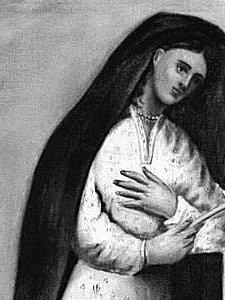
Kateri Tekakwitha left no writings of her own. Everything we know of her words comes through the two Jesuits who knew her best, Claude Chauchetière and Pierre Cholenec, who wrote her life in the years after her death, and through the memories of Marie-Thérèse and Anastasia that they gathered. Chauchetière also painted her portrait from memory — usually dated to the 1690s, it is the oldest image of her that survives. Their accounts carry the devotional habits of their age and must be read with care; but the young woman they knew stands out clearly.
Devotion to her spread quickly among Native and French Christians alike, and many healings and favours were credited to her prayers. The Catholic Church declared her venerable in 1943, and Pope John Paul II beatified her in 1980. In 2012, after the Church attributed to her intercession the recovery of Jake Finkbonner, a boy of Lummi descent in Washington State, from a flesh-eating infection, Pope Benedict XVI canonized her — the first Indigenous woman of North America to be named a saint by the Catholic Church.
For at the heart of her story is not a miracle but a choice, made again and again by a scarred and half-blind orphan who had every reason to keep her head down. She chose Christ in a village that mocked her for it, chose Him again on a two-hundred-mile road through the forest, and chose Him once more when every voice around her urged an easier life. “I am not any longer my own,” she said. Few have said it more simply, or meant it more completely.
No books or sermons in the library yet for this writer.
Questions and Answers
Who was Kateri Tekakwitha?
Kateri Tekakwitha was a Mohawk-Algonquin woman, born in 1656 in what is now upstate New York, who became a Christian at twenty in the face of fierce opposition from her own village. She fled to the Christian mission at Kahnawake near Montreal, gave her life wholly to Christ, and died there in 1680 at twenty-four. In 2012 she became the first Indigenous woman of North America canonized by the Catholic Church.
What was her childhood like?
She was born at Ossernenon, near present-day Auriesville, New York, to a Mohawk father and a Christian Algonquin mother. When she was about four, smallpox killed her parents and her little brother, and left her face scarred and her eyes so weak that she shaded them with her blanket for years. She was raised by her uncle, a village chief who disliked the French and their religion, and by her aunts.
Why did she refuse to marry?
As she grew into a shy, capable young woman, her aunts tried to arrange a marriage for her. When the young man came to sit beside her in the lodge, she rose and walked out of the cabin. The refusal cost her years of hard words and harder work, and later, after her conversion, she explained that she had given herself entirely to Jesus Christ.
How did she meet Father de Lamberville?
In 1675, laid up with an injured foot while the other women worked in the fields, she looked up to find the Jesuit Jacques de Lamberville in the doorway; he had meant to pass the cabin by. She had longed to speak to a priest but had not dared to seek one out. Father Chauchetière later wrote that the priest "found a treasure where he expected to find no one."
When was she baptized?
Lamberville instructed her through the winter and quietly asked around the village about her life, finding that no one could say anything against her. On Easter Sunday, 1676, at the age of twenty, she was baptized in the bark chapel and named Catherine, in Mohawk Kateri.
What did she suffer for her faith?
Because she would not work in the fields on Sundays, her relatives refused her food on those days. Children threw stones at her on the way to the chapel, drunken men threatened her life, and the village called her only "the Christian," in a tone that meant dog. Father Chauchetière recorded that she was happy to have lost her name.
How did she escape to Kahnawake?
Lamberville urged her to go to the Christian mission of Saint-François-Xavier at the Sault Saint-Louis, opposite Montreal. In the autumn of 1677, with the help of three Christian men from that village, she slipped away on a journey of some two hundred miles; when her uncle came after them with a gun, they hid her in the undergrowth. Chauchetière wrote that her journey was a continual prayer.
What was her life like at the mission?
She lived in the longhouse of Anastasia Tegonhatsiongo, an older Christian woman who had known her mother, made her first Communion at Christmas 1677, and became close friends with Marie-Thérèse Tegaiaguenta. Her constant question was "Who will teach me what is most pleasing to God, that I may do it?" On 25 March 1679 she made a private vow of virginity, telling her confessor, "I am not any longer my own."
What about her severe penances?
Kateri took part in an intense movement of penance among the women of the village: fasting, exposure to cold, scourging, even a bed of thorns. These were not what her teachers asked of her, and they are not a pattern to follow; when her confessor, Father Cholenec, learned of the thorns he rebuked her and had her throw them into the fire. Her weakened body could not bear such things, and her life was almost certainly shortened by them.
How did she die, and how is she remembered?
She died at Kahnawake on 17 April 1680, Wednesday of Holy Week, telling her friend Thérèse, "I will love you in heaven." The two Jesuits present reported that her smallpox-scarred face became beautiful shortly after her death. She left no writings; her words come to us through Fathers Chauchetière and Cholenec. She was beatified in 1980 and canonized in 2012.