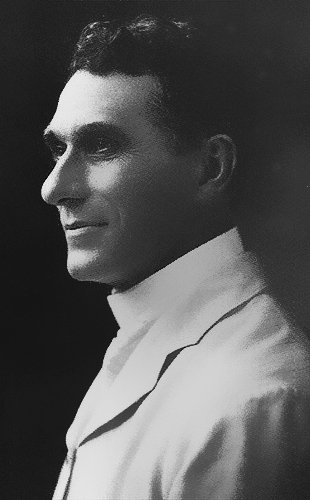
Biography
I am through forever with everything in life but the proclamation and demonstration of the Gospel of Jesus Christ.
John Graham Lake was born on 18 March 1870 at St. Mary’s, Ontario, one of sixteen children in a household that knew more of the sickroom than most. His parents, he remembered, were strong and healthy people, yet one after another their children sickened, and before Lake was a grown man the family had buried eight of them. Looking back over his boyhood, he recalled it as a long procession of doctors and nurses, hearses and gravestones, a brokenhearted mother and a grieving father trying to hold together those who were left. When he was a teenager the family moved across the border to Sault Ste. Marie, Michigan. The question that would govern his whole life — does God still heal? — was pressed on him early.
A house of sickness, and a turning
He grew up in the Methodist church and later said he had been ordained a Methodist minister at twenty-one, though no record of seminary study has been found. What the records do show is a young man working with his hands: the 1900 census lists him as a carpenter, and the historian Barry Morton has traced him as a small builder and roofer who bought, repaired and sold houses. In February 1893 he married Jennie Stevens of Newberry, Michigan. They would have six children and adopt a seventh.
Very soon after the wedding, as Lake told it, the shadow that had followed his father’s family fell on his own. Jennie developed heart disease and tuberculosis. She would lose consciousness without warning; he would find her collapsed on the floor, and the doctors turned at last to nitroglycerine tablets to keep her heart beating. At the same time his brother, an invalid for twenty-two years, and two of his sisters were dying.
Into that darkness came the preaching of John Alexander Dowie, the healing evangelist whose “Healing Homes” in Chicago drew the desperate from across the continent. Lake’s family carried the brother there, and, by Lake’s account, he rose from what had seemed his deathbed and walked. A sister with cancers followed, carried in on a stretcher. Another sister, Lake wrote, was brought back from the edge of death while he knelt with his parents at her bed and rebuked the power of death in the name of Jesus.
Jennie was the last. Her husband later described the morning when a fellow minister, with tears in his eyes, advised him to be reconciled to letting her die, and how, going home in a storm of grief, he threw his Bible on the table and it fell open at Acts 10:38 — Jesus “healing all that were oppressed of the devil.” From that verse he drew the conviction that sickness was the devil’s work and not God’s will, a conviction that shaped, for good and for ill, everything that came after.
That same year Lake opened a small branch of Dowie’s Christian Catholic Church in Sault Ste. Marie, meeting in the attic of his parents’ home. In 1901 he moved his family to Zion, Illinois, the theocratic town Dowie had built north of Chicago, and worked in its construction department.
Business, and the claim to have left it
Lake would later tell a dramatic story about these years: that he moved to Chicago, made a fortune in real estate, bought a seat on the Board of Trade, and was paid fifty thousand dollars a year to organize a trust of insurance companies — and that he laid it all down for the gospel. In his own telling, his heart became so divided that business interviews kept turning into prayer meetings, until he told his company president he could not go on. He took three months to preach, and at the end of them, he said, he made his decision.
I am through forever with everything in life but the proclamation and demonstration of the Gospel of Jesus Christ.
— John G. Lake
Honesty requires a caution here. Morton’s research in local newspapers and church directories found Lake still living in Zion throughout these years, working after 1905 as a salesman of real estate and of fire and life insurance in nearby Waukegan — in Morton’s words, “an ordinary, small-town insurance salesman.” Even Lake’s sympathetic biographer, Kemp Burpeau, found no evidence beyond Lake’s own word for his dealings with great financiers. Lake was a gifted storyteller, and the story of the surrendered fortune grew in the telling. What remains beyond dispute is that he did give himself wholly to preaching, and never went back.
Pentecost in Zion
After Dowie’s fall, Zion was a shaken and divided town, and in 1907 Charles Parham’s Pentecostal tent meetings found many hearers there. Lake was among them. He began to seek what Pentecostals called the baptism in the Holy Spirit, and he sought it for a long time.
The Pentecostal circle in Zion did not stay peaceful. In 1907, after Parham’s departure, violent attempts at exorcism among the Pentecostal remnant ended in deaths, and Zion’s new overseer, Wilbur Voliva, publicly held Parham, Lake’s friend Tom Hezmalhalch and Lake himself partly responsible. Lake and Hezmalhalch moved to Indianapolis. Morton reads this as flight from an angry town; the South African Pentecostal scholar Marius Nel argues that the evidence does not bear that reading out. Either way, the Indianapolis winter was a turning point. There, Lake said, the call to Africa he had felt since boyhood became clear, and in February 1908, after he and Tom had knelt together by Tom’s bed to pray for the two thousand dollars the journey would cost, four drafts of five hundred dollars each arrived by post.
South Africa
The party sailed that spring — by Lake’s count his family of eight and four others, by Morton’s reckoning seventeen people in all — and landed at Cape Town with almost nothing in hand. In Johannesburg an American missionary, Mrs. C. L. Goodenough, met them and gave them a home. Within months Lake and Hezmalhalch had gathered many of the scattered followers of Dowie’s South African work and founded the Apostolic Faith Mission of South Africa. Lake preached at the Apostolic Tabernacle in Johannesburg and travelled widely across the country.
The first year cost him dearly. On 22 December 1908, only some six months after their arrival, Jennie died in Johannesburg; by the usual telling Lake was away preaching when she was taken. He called her death “Satan’s masterstroke.” He stayed on for four more years, raising seven children with the help of his sister Irene.
Those years were marked by great fruit and by serious controversy, and both belong in the record. Some of the men Lake worked beside became pillars of African Christianity. Elias Letwaba, a Black preacher of deep prayer, went on to found and run the Patmos Bible School for more than twenty years; Edward Lion became a founder of the Zionist churches of southern Africa and a mentor of Engenas Lekganyane, who founded the Zion Christian Church, today among the largest churches in the region. Lake’s influence on the whole Pentecostal and Zionist movement there is not in doubt.
Neither are the questions. In 1909 and 1910 Lake faced accusations of misusing mission funds, of ruling the young church like “a second Dowie,” and of exaggerating the revival to supporters abroad. The AFM’s leaders cleared him, and a Los Angeles mission that had sent money declared itself satisfied that it had been well spent. Yet as early as January 1909 the AFM’s own executive council admitted there was “only too much truth” in complaints of exaggerated healing reports, and Morton has shown that at least one expedition Lake later described as a triumph was reported at the time as a fiasco. Lake reported healings and converts in enormous numbers; those figures come from Lake and his admirers and cannot now be checked. Morton goes further and charges deliberate fraud; Nel answers that Morton’s case rests too often on assumption and on a worldview that rules out the miraculous from the start. A reader can hold both things together: a man who was, as even Nel concedes, “prone to exaggerate,” and a ministry through which a great many people came to faith.
The Healing Rooms
Lake returned to America early in 1913, and that September he married Florence Switzer; they had five children. After a year of travelling ministry he settled in Spokane, Washington, by the summer of 1914, and there he opened the work for which he is best remembered in America: “Lake’s Divine Healing Rooms,” run from 1915 until 1920 in the Rookery Building downtown. Lake trained workers he called “healing technicians,” and the sick came for prayer day after day, some from great distances. The large totals of healings later attached to those five years are, again, the ministry’s own reckoning. He wrote that some came from five thousand miles away.
In 1920 he moved to Portland, Oregon, for a similar work of about five years, then carried it down the California coast and as far as Houston, Texas, before returning to Spokane in 1931 to open one last church and healing room.
The consecration
Among Lake’s papers is a written consecration, a set of principles by which he meant to live. It speaks of holding every possession in trust for God, of paying workers justly, of guarding the sanctity of marriage, of refusing to spread evil reports. One promise concerns prayer — that he would never “cease to cry to God and implore Him to deliver mankind from the effects of sin so long as sin lasts.” Another reads almost as a confession of what he knew he needed.
I shall live my life in meekness, never defending my own personal rights, but shall leave all judgment to God who judges righteously.
— John G. Lake, from his consecration
He did not always live up to those words, as the record shows; but they show what he reached for.
In 1935 he suffered a serious stroke, and on 16 September 1935 he died in Spokane, aged sixty-five. He left behind a complicated inheritance. His sermons are still read and his name still carried by healing ministries on several continents; his South African church and the African preachers he stood beside have long outgrown anything he built alone. His stories, too, have outlived him, and some of them cannot bear the weight that has been put on them. Yet beneath the legend is a man whose childhood was spent at gravesides and who never stopped believing that the Christ of the Gospels still meets the sick and the dying. He prayed for them by the thousands, from a Michigan bedside to a Johannesburg tabernacle to a Spokane office building, and he spent his life telling anyone who would listen that the days of Jesus’ compassion were not over.
No books or sermons in the library yet for this writer.
Questions and Answers
Who was John G. Lake?
John Graham Lake (1870–1935) was a Canadian-born Pentecostal preacher and faith healer. After his wife's healing in the circle of John Alexander Dowie, he helped found the Apostolic Faith Mission of South Africa between 1908 and 1913. Returning to America, he opened his "Divine Healing Rooms" in Spokane and later worked in Portland, leaving a lasting and much-debated legacy in the healing movement.
When and where was John G. Lake born?
He was born on 18 March 1870 at St. Mary's, Ontario, one of sixteen children. Though his parents were strong and healthy, one child after another sickened, and before Lake was grown the family had buried eight of them; he remembered his boyhood as a procession of doctors, nurses, hearses and gravestones. As a teenager he moved with his family across the border to Sault Ste. Marie, Michigan, and the question of whether God still heals was pressed on him early.
How was John G. Lake's wife Jennie healed?
Lake married Jennie Stevens of Newberry, Michigan, in February 1893, and soon afterward she developed heart disease and tuberculosis. Told by a fellow minister to be reconciled to her death, Lake threw his Bible on the table and it fell open at Acts 10:38, convincing him sickness was the devil's work. In April 1898, at an appointed hour with friends praying, he knelt at her bed, and he wrote that she stood up crying, "Praise God, I am healed!"
What was John G. Lake's connection to John Alexander Dowie and Zion?
Lake's family carried his invalid brother to Dowie's Healing Homes in Chicago, and by Lake's account he rose and walked; two sisters were also healed. In 1898 Lake opened a small branch of Dowie's Christian Catholic Church in Sault Ste. Marie, meeting in his parents' attic, and in 1901 moved his family to Zion, Illinois, the town Dowie had built north of Chicago, where he worked in the construction department and later sold real estate and insurance.
Is the story of John G. Lake's business fortune true?
Lake later said he had made a fortune in Chicago real estate, bought a seat on the Board of Trade and earned fifty thousand dollars a year organising insurance companies before laying it all down for the gospel. The historian Barry Morton found him still living in Zion, working as "an ordinary, small-town insurance salesman," and even his sympathetic biographer Kemp Burpeau found no evidence beyond Lake's own word. What is beyond dispute is that he gave himself wholly to preaching.
When did John G. Lake receive the baptism in the Holy Spirit?
After Dowie's fall, Charles Parham's Pentecostal meetings found many hearers in Zion in 1907, Lake among them. "I prayed for the Baptism of the Holy Spirit for nine months," he said, "and if a man ever prayed honestly, and sincerely in the faith, I did." The answer came in 1907 as he knelt with a friend in Zion City. He described it as the most vivid experience of his life, an overwhelming sense of Christ's love for a lost and suffering world.
What did John G. Lake do in South Africa?
After four drafts of five hundred dollars each arrived in answer to prayer in February 1908, Lake and Tom Hezmalhalch sailed with their party and landed at Cape Town with almost nothing. In Johannesburg they gathered many of Dowie's scattered followers and founded the Apostolic Faith Mission of South Africa. Men he worked beside became pillars of African Christianity, among them Elias Letwaba, who ran the Patmos Bible School, and Edward Lion, a founder of the Zionist churches.
Why is John G. Lake's ministry controversial?
In 1909 and 1910 he faced accusations of misusing mission funds, ruling like "a second Dowie," and exaggerating the revival. The AFM's leaders cleared him, yet its executive council admitted "only too much truth" in complaints of exaggerated healing reports. His large totals of healings come from Lake and his admirers and cannot be checked. Barry Morton charges deliberate fraud; Marius Nel answers that Morton's case rests too often on assumption, while conceding Lake was "prone to exaggerate."
What were John G. Lake's Divine Healing Rooms?
Jennie died in Johannesburg on 22 December 1908, and Lake returned to America early in 1913, marrying Florence Switzer that September. By the summer of 1914 he had settled in Spokane, Washington, and from 1915 to 1920 he ran "Lake's Divine Healing Rooms" in the Rookery Building downtown, training workers he called "healing technicians" to pray for the sick day after day. In 1920 he moved to Portland, Oregon, for a similar work, and returned to Spokane in 1931.
How did John G. Lake die?
In 1935 Lake suffered a serious stroke, and he died in Spokane on 16 September 1935, aged sixty-five. Among his papers was a written consecration, including the promise, "I shall live my life in meekness, never defending my own personal rights, but shall leave all judgment to God who judges righteously." He did not always live up to it, but it shows what he reached for. His sermons are still read, and his name is carried by healing ministries on several continents.